Why GW and Jefferson Span Three States
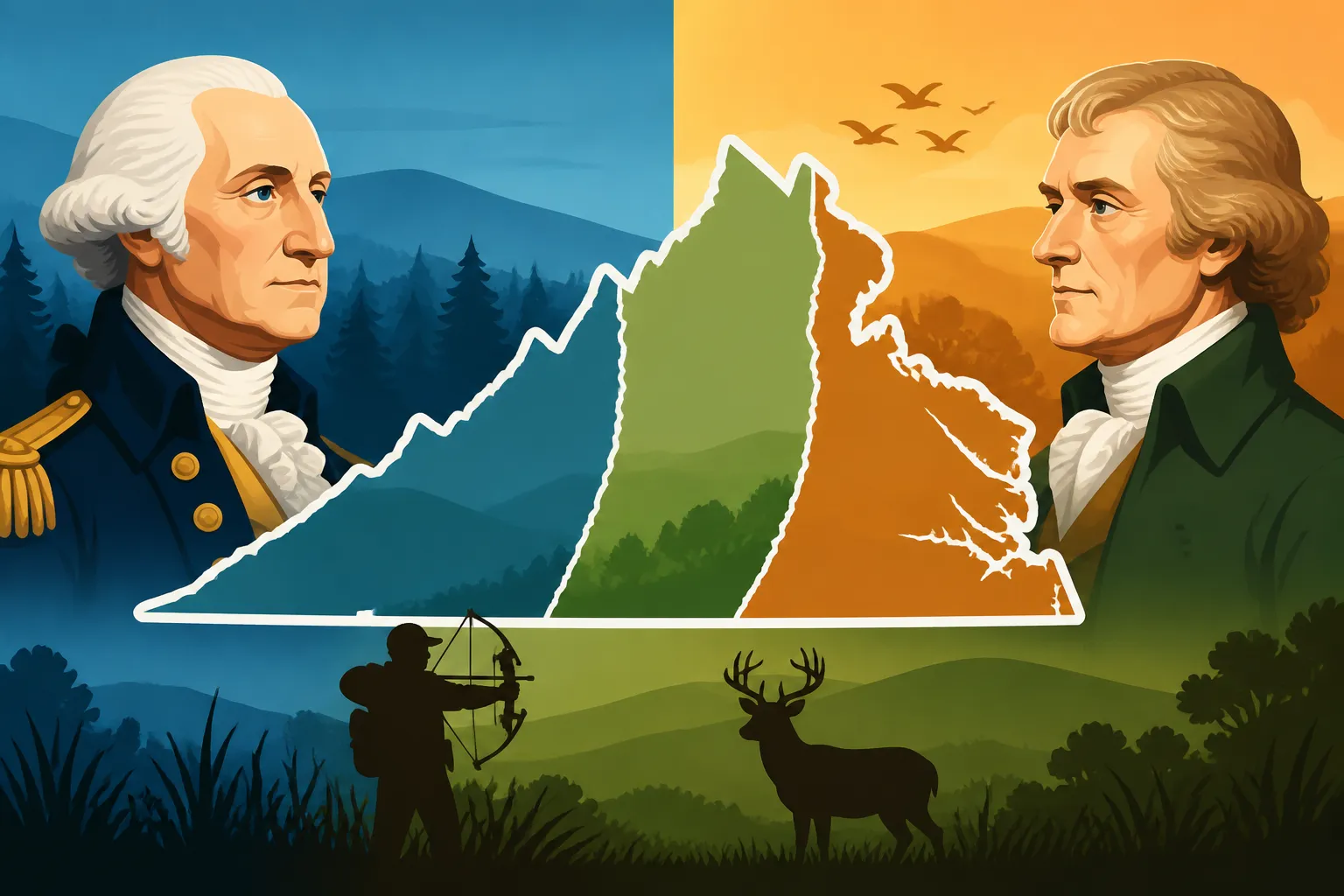
For many Virginia hunters, the vastness of the George Washington and Jefferson National Forests can feel like a labyrinth, especially when you consider they stretch far beyond our state lines. It's easy to wonder why these massive public hunting grounds aren't neatly contained within Virginia's borders. This guide will unravel the historical, geographical, and ecological reasons behind the multi-state span of these incredible national forests, and what that means for your hunting adventures.
Understanding the National Forest System in Virginia
The George Washington and Jefferson National Forests aren't just patches of woods; they are immense, interconnected ecosystems managed for a multitude of uses, including timber, water, recreation, and, crucially for us, hunting. Their very formation and design explain why they pay no mind to state boundaries.
The Genesis of the George Washington and Jefferson Forests
These forests didn't just appear overnight; they were born out of a national conservation movement in the early 20th century. Decades of rampant logging, uncontrolled fires, and unsustainable land practices had severely degraded much of the eastern United States' forestland, particularly in the Appalachian Mountains. Rivers ran muddy, soil eroded, and wildlife populations plummeted. To combat this, Congress passed the Weeks Act in 1911, which allowed the federal government to purchase private lands for the creation of national forests, primarily to protect watersheds and regulate streamflow.
Most of the land that would become the George Washington and Jefferson National Forests was acquired from private timber companies and individuals during this period. These weren't pristine, untouched wildernesses, but often cut-over, exhausted tracts that needed serious restoration. The purpose was clear: restore the forests, protect water sources, and provide for sustainable resource management and public enjoyment. The focus was on ecological units, not arbitrary state lines. When you walk through a mature hardwood stand in either forest today, you're experiencing the fruits of over a century of dedicated conservation.
A Shared Landscape: Why Borders Don't Always Follow States
Imagine trying to manage a mountain range or a major river basin if your jurisdiction ended abruptly at a state line. It just wouldn't make sense from an ecological or administrative perspective. The Appalachian Mountains, which form the spine of both the George Washington and Jefferson National Forests, are a continuous geographical feature. Rivers like the James, Shenandoah, New, and Clinch originate and flow through these mountains, often crossing state lines as they wind their way to the sea. Wildlife, particularly big game like deer and bear, also move freely across these landscapes, ignoring human-drawn borders.
Therefore, the decision to establish national forests that spanned multiple states was a practical one. It allowed for a more holistic approach to land management, ensuring that entire watersheds, mountain ranges, and large swaths of contiguous habitat could be managed under a unified plan. This approach promotes greater ecological integrity and resilience, offering expansive unbroken forest for both wildlife and recreation. For a hunter, this means that while your license might be state-specific, the deer or bear you're pursuing could easily have crossed from West Virginia or Tennessee just hours before you encountered it.
George Washington National Forest: A Multi-State Gem
The George Washington National Forest (GWNF) is a true icon of the Appalachian region, and its presence in Virginia is particularly significant. However, to truly appreciate its scope, you have to understand its full geographical reach.
Virginia's Slice of the GWNF Pie
Within the Old Dominion, the George Washington National Forest covers a substantial portion of the Allegheny and Blue Ridge Mountains in the western and northern parts of the state. Counties like Augusta, Bath, Rockingham, Shenandoah, Page, Warren, and Frederick are home to vast tracts of GWNF land. This part of the forest is characterized by rugged, steep terrain, dense hardwood forests, and numerous stream valleys. For hunters, this means challenging climbs, but also the reward of truly wild country, often with less pressure than smaller public land parcels.
The Virginia sections of the GWNF are rich in diverse habitats, from high-elevation oak-hickory stands to mixed pine-hardwood forests in lower elevations. This diversity supports healthy populations of white-tailed deer, black bears, and wild turkeys. The sheer scale of George Washington National Forest Hunting opportunities can be daunting, but it also means there's always new ground to explore. You'll find everything from deep, remote hollows to high, wind-swept ridges, all within Virginia's boundaries. It's a place where understanding the local topography and game movements is key to success.
Expanding Beyond the Old Dominion: West Virginia and Maryland Connections
What often surprises people is that the George Washington National Forest seamlessly extends into West Virginia and, to a lesser extent, into Maryland. The western edge of Virginia's GWNF flows directly into the vast expanse of the Monongahela National Forest in West Virginia, and in some areas, the GWNF itself crosses into West Virginia. This creates an enormous, unbroken block of public land that is a critical ecological corridor.
For Virginia hunters, this means that the deer, bear, and turkey populations you encounter are often part of a larger, regional metapopulation that utilizes habitat in multiple states. A big buck might spend its summer in a remote West Virginia hollow and then travel south into Virginia during the rut, completely unaware of the state line. This interconnectedness allows for greater genetic diversity and provides crucial refuge areas for game animals, especially during periods of high hunting pressure in one state. It’s a powerful testament to the idea that nature doesn’t respect human boundaries, and it emphasizes the importance of regional wildlife management. This vast, contiguous habitat also offers incredible opportunities for extended backcountry hunts, allowing truly immersive experiences.
Jefferson National Forest: Sprawling Across State Lines
The Jefferson National Forest, often grouped with the George Washington due to shared management, holds its own distinct character, particularly in its extensive reach across multiple states in the southern Appalachians.
The Virginia Backbone of the Jefferson National Forest
In Virginia, the Jefferson National Forest primarily dominates the rugged mountains of the Southwest, extending from the New River Valley down into the Clinch Valley and the state's southwestern coalfields. Counties like Giles, Bland, Botetourt, Craig, Montgomery, Pulaski, Carroll, Wythe, Smyth, Washington, Russell, Buchanan, Wise, and Dickenson all contain significant portions of the Jefferson. This region is renowned for its higher elevations, deep valleys, and unique ecosystems that support a robust array of wildlife. Jefferson National Forest Hunting offers some of the most challenging, yet rewarding, experiences in the state.
The Jefferson National Forest in Virginia is particularly known for its diverse tree species, including northern hardwoods at higher elevations and mixed oak-pine stands elsewhere. This creates varied mast crops, which are critical for supporting the region's abundant black bear and deer populations. The sheer scale of this forest, combined with its challenging terrain, often means that hunters willing to venture off the beaten path can find truly isolated areas where game feels less pressured. Understanding the subtle shifts in elevation and corresponding habitat types is crucial when trying to locate game in this formidable landscape.
Tennessee and Kentucky: The Jefferson's Southern Reach
Just like its northern counterpart, the Jefferson National Forest extends beyond Virginia's borders, pushing into eastern Tennessee and southeastern Kentucky. This continuation of protected forestland is vital for the region's biodiversity and offers truly immense areas of contiguous wild habitat. The Appalachian Trail, a renowned long-distance hiking trail, traverses significant portions of the Jefferson National Forest, highlighting its role as a connective wilderness.
For hunters, these extensions into Tennessee and Kentucky mean even greater expanses for large game to roam. A bear, for instance, might den in Virginia but forage in Tennessee or Kentucky, following seasonal food sources. This vast, unbroken habitat helps maintain healthy, resilient animal populations by providing ample space, diverse food sources, and corridors for migration and dispersal. This also contributes to the genetic health of the herds and flocks, preventing isolation and inbreeding. It means that when you're scouting for Reading a Ridge for Blue Ridge Deer or looking for bear sign, you're tapping into a system that benefits from management across three states, fostering a healthier, more robust game population for everyone.
Implications for Virginia Hunters
Understanding that the George Washington and Jefferson National Forests span multiple states isn't just a geographical trivia fact; it has tangible implications for how you plan and execute your hunts in Virginia.
Navigating Regulations Across State Boundaries
This is perhaps the most critical consideration for any hunter near a state line. While the forest itself might be contiguous, the hunting regulations are not. If you are hunting in the George Washington National Forest near the West Virginia border, or in the Jefferson National Forest near Tennessee or Kentucky, you must be acutely aware of which side of the line you're on. A few yards can make the difference between a legal harvest and a serious violation.
Each state has its own specific license requirements, season dates, bag limits, blaze orange rules, legal weapons, and game checking procedures. What's legal in Virginia might be illegal just across the border in West Virginia or Tennessee. For example, Virginia's deer seasons and Eastern Region Antlered Buck Limits might differ significantly from those in neighboring states. You'll need to purchase the appropriate licenses for the state you're actively hunting in. Many hunters mistakenly believe that because it's the "same" national forest, the rules are universal. This simply isn't the case. Always carry current maps that clearly delineate state lines, and consult the specific hunting regulations for both Virginia and any adjacent state you might be near. Tools like onX Hunt are invaluable for clearly showing these boundaries, helping you stay legal and informed.
The Advantage of Vast, Contiguous Habitat
While the regulatory differences can be a headache, the ecological advantages of these multi-state forests are immense. The sheer scale of these unbroken tracts of forest provides unparalleled habitat for a wide variety of game animals. For big game like deer and bear, having such vast territories allows them to establish larger home ranges, find diverse food sources, and escape hunting pressure. This leads to healthier, more robust animal populations.
Consider black bears: they require huge amounts of space, and the GWNF and JNF provide exactly that. These forests allow for greater genetic exchange among populations, reducing the risk of localized disease outbreaks or genetic bottlenecks. For hunters, this translates to opportunities to pursue animals that truly thrive in wild settings, often reaching older age classes due to the extensive cover and varied food sources available across state lines. It also means that migratory birds, like wild turkeys, have more secure routes and destinations during their movements. When you’re in a place like the Jefferson, looking for Still-Hunting Jefferson Forest Ridges, you’re not just in a big woods, you’re in an interconnected super-forest.
Planning Your Hunt in These Expansive Forests
Hunting in the George Washington and Jefferson National Forests is an experience unlike any other in Virginia, largely due to their immense scale. Success in these sprawling landscapes hinges on diligent preparation and smart use of modern tools.
Essential Mapping and Navigation Tools
When you're dealing with hundreds of thousands of acres that stretch across state lines, reliable navigation is not just helpful; it's absolutely critical. Traditional paper maps are a good starting point, especially the US Forest Service maps that show forest roads, trails, and terrain. However, in today's world, digital mapping applications are indispensable. This is where brands like onX Hunt truly shine.
Applications such as onX Hunt allow you to see property boundaries, including state lines and private land inholdings, in vivid detail right on your phone or GPS device. You can download maps for offline use, which is vital in areas with no cell service – a common occurrence deep within the GWNF or JNF. These tools also allow you to mark waypoints for your stand locations, scouting finds, and even vehicle parking spots. Furthermore, some platforms like GoHunt offer detailed information beyond just property lines, helping you research specific hunt units, access points, and even historical harvest data where available. Understanding onX Layers for Virginia Land Status is a game-changer for navigating these complex areas safely and effectively.
Scouting Across the Landscape
Scouting is always important, but in national forests of this magnitude, it becomes an art form. You can't just drive around and expect to find prime hunting spots; you need to cover ground, both physically and virtually. Start your scouting long before the season opens, using those mapping apps to identify potential access points, remote hollows, high ridges, and areas with diverse habitat. Look for water sources, natural funnels, and areas that might concentrate game.
Because these forests are so vast and span state lines, a deer or bear's preferred bedding area might be in Virginia, while its primary food source might be just over the ridge in West Virginia. Understanding these movements, often dictated by mast crops, weather, and hunting pressure, is key. Walking deep into these forests during the off-season, looking for old rubs, scrapes, and bedding areas, will give you an invaluable advantage. Don't be afraid to put in the miles; the rewards in these majestic, multi-state forests are often proportional to the effort invested. Remember to check Camping Rules on Virginia National Forest Land if you plan an extended scouting trip or hunt.
The Benefits of a Unified Management Approach
Despite the need for hunters to observe state-specific regulations, the overarching management of these national forests as single, integrated units by the U.S. Forest Service provides immense benefits for wildlife. This unified approach, irrespective of state boundaries, allows for broad-scale conservation efforts, consistent habitat improvement projects, and coordinated wildfire management across vast areas. Instead of piecemeal efforts, resource managers can address issues like invasive species, timber health, and water quality on a landscape level.
This cohesive management helps ensure that game populations have healthy, diverse habitats that are resilient to environmental changes. For example, a prescribed burn in a Virginia section of the GWNF might benefit deer that also utilize an adjacent West Virginia section, creating better forage and cover across the region. This foresight and large-scale planning means that the wildlife in these forests—White-Tailed Deer Across Virginia or Virginia's Black Bear Population—are part of a truly robust, well-stewarded ecosystem, offering hunters a premier experience that reflects responsible land management on a grand scale.
Here's a quick comparison of some key aspects of the George Washington and Jefferson National Forests:
| Feature | George Washington National Forest (GWNF) | Jefferson National Forest (JNF) |
|---|---|---|
| Primary Virginia Regions | Northern & Central Appalachians, Shenandoah Valley, Blue Ridge | Southwestern Appalachians, Cumberland Mountains, Blue Ridge |
| Adjacent States | West Virginia, Maryland (smaller presence) | Tennessee, Kentucky |
| Notable Virginia Counties | Augusta, Bath, Rockingham, Shenandoah, Page, Warren, Frederick, Highland | Giles, Bland, Botetourt, Craig, Montgomery, Pulaski, Russell, Wise, Dickenson |
| General Terrain | Rugged mountains, steep ridges, deep hollows, extensive hardwood forests | Higher elevations, more remote, deep valleys, mixed forests, unique ecosystems |
| Major River Systems | Shenandoah, James, Potomac headwaters | New River, Clinch River, Holston River headwaters |
| Hunting Focus | Deer, Bear, Turkey, Small Game; known for challenging mountain hunts | Deer, Bear, Turkey, Small Game; known for rugged, remote hunting opportunities |
| Key Management Purpose | Watershed protection, timber, recreation, wildlife habitat | Biodiversity, water quality, timber, recreation, wildlife habitat |
Disclaimer
This article is for general informational purposes only and does not constitute professional advice. Laws, prices and regulations vary by location and change over time. Consult a qualified professional for guidance on your specific situation.