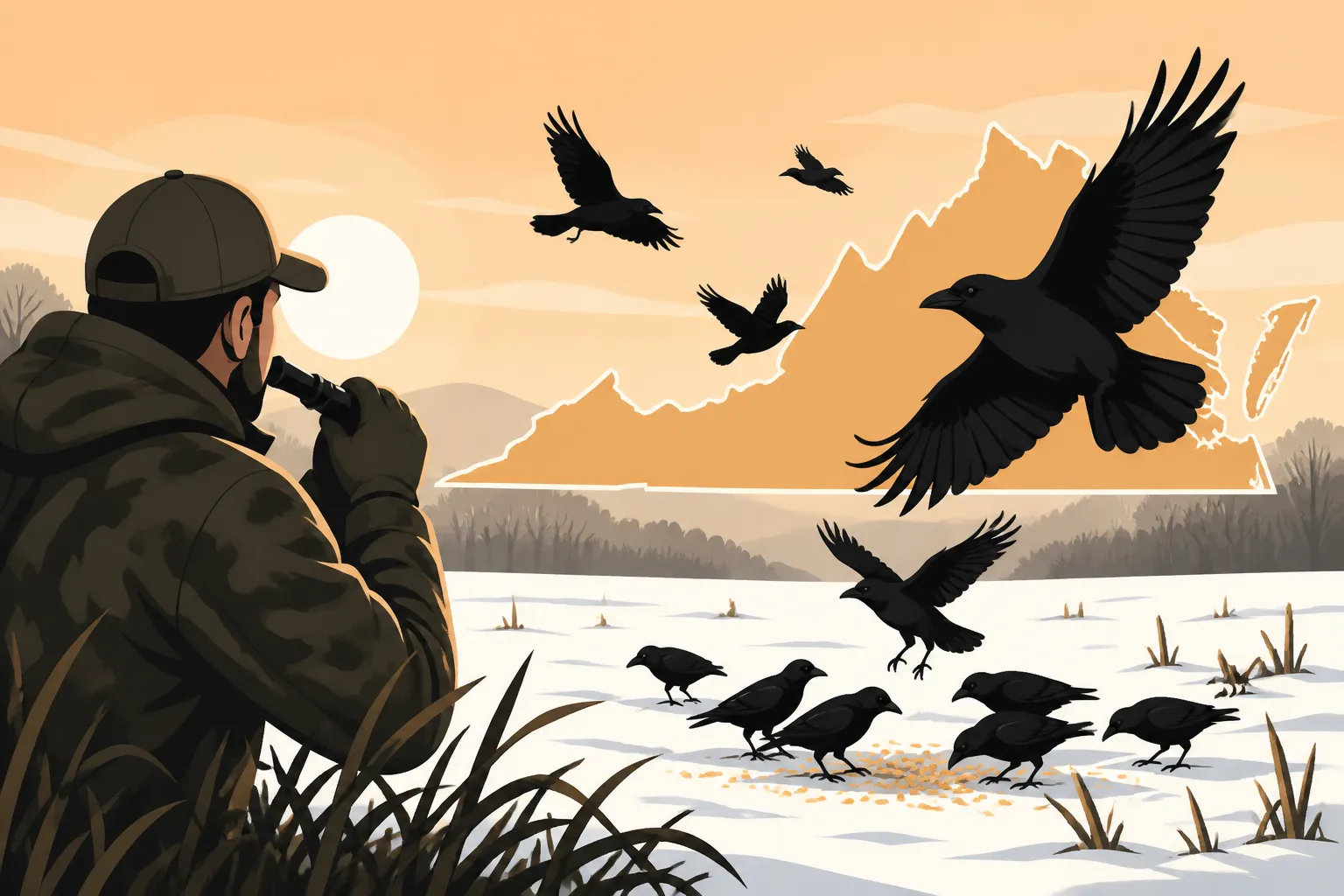
Calling Crows Over a Winter Feed Site
The crisp, biting air of a Virginia winter often means that many hunting seasons have either wound down or closed entirely, leaving avid outdoorspeople feeling a little restless. But for those in the know, the winter months offer an incredible, often overlooked opportunity: crow hunting. These intelligent, wary birds can be an absolute blast to pursue, providing fast-paced action and a chance to sharpen your calling and camouflage skills, especially when you target them over their crucial winter feed sites. This guide will walk you through everything you need to know to call crows successfully over winter feed in the Old Dominion.
The Winter Habits of Virginia Crows
Crows aren't just noisy backyard birds; they're incredibly social and intelligent animals whose behavior shifts dramatically with the seasons. Understanding these winter patterns is the first step toward effective hunting.
Why Crows Flock and Where They Roost in Winter
As temperatures drop and natural food sources become scarcer, Virginia's crows undergo a significant behavioral change: they consolidate into massive winter roosts. This isn't just a few dozen birds; we're talking about hundreds, often thousands, and sometimes even tens of thousands of crows gathering in a relatively small area, usually dense stands of pines, hardwoods, or even urban woodlots. This communal roosting offers safety in numbers from nocturnal predators like owls.
Every morning, like clockwork, these huge congregations disperse, fanning out across the landscape to find food. They might travel dozens of miles from their roost to their feeding grounds, only to return to the same roosting site each evening. This daily migration creates predictable flight paths that become key to successful winter crow hunting. You'll often see these massive streams of crows, sometimes stretching for miles, as they commute between their night-time haven and their day-time buffet. In Virginia, areas with abundant agriculture, particularly across the Piedmont and parts of the Shenandoah Valley, tend to hold the largest winter crow populations due to the availability of reliable feed.
Identifying Prime Winter Feed Sites
Once you understand the crow's daily commute, the next crucial step is pinpointing their preferred winter feed sites. In the colder months, crows become highly opportunistic scavengers and foragers, keying in on high-energy food sources that are readily available.
Think about what's left on the landscape after harvest season. Spilled grain in cornfields, leftover soybeans, or recently cut hayfields are major attractions. But it goes beyond just field gleanings. Livestock operations are absolute magnets for winter crows. Cattle feedlots, dairy farms, and even chicken houses often have spilled feed, accessible silage, or rich, freshly manured fields that offer a smorgasbord of insects and undigested grains. Roadkill, unfortunately, is also a prime draw. Crows will quickly descend on deer, raccoons, or other animals hit on the road, providing a temporary but intense feeding opportunity.
Identifying these sites requires a bit of detective work. You're looking for visual cues: large concentrations of crows actively feeding, the tell-tale black and white "splatter" of their droppings on feedlot fences or power lines overlooking a field, or even just general crow activity and noise. If you see hundreds of crows peeling off from a main flight path to descend into a particular field or farm, you've likely found a prime spot. Don't be afraid to drive the backroads of agricultural counties like Augusta, Rockingham, or Fauquier, especially near dawn or dusk, to observe these patterns. Tools like the Go Outdoors Virginia Map Tool or even Google Earth can help you identify potential agricultural areas or feedlots from above for initial scouting.
Scouting and Setting Up for Success
You can't just drive up to a field, set out a few decoys, and expect crows to magically appear. Effective winter crow hunting is all about meticulous scouting and a well-executed setup.
Pre-Season Scouting for Winter Crow Hunts
Serious crow hunting begins long before you ever pull the trigger. Pre-season scouting is paramount, and it's less about finding where crows are in general and more about identifying their precise travel routes and feeding preferences. Start by observing those massive morning dispersal flights from a distance. Where do they go? Do they funnel through a particular timberline, follow a creek bottom, or cross a specific ridge? Note the direction and general altitude of these flights.
Once you have a general idea, you can begin to narrow down the actual feeding locations. Drive around 30 minutes before sunrise or an hour before sunset. Pull over in safe spots and use a good pair of binoculars or a spotting scope to watch fields and farmsteads. Look for active feeding, not just crows perched in trees. Pay attention to how they approach a field – do they come in high and circle, or low and direct? This information is crucial for planning your ambush.
I’ve had great success using mapping apps to pinpoint potential feeding areas. A tool like GoHunt can be invaluable here. Its satellite imagery helps you identify fields, feedlots, and prominent travel corridors that might be difficult to see from the road. You can mark potential setup locations, note wind directions, and even track observed flight patterns. Remember to be discreet; crows are incredibly intelligent and wary. If they see you repeatedly scouting or setting up in the same spot, they'll learn and adjust their patterns, making your hunt much harder.
Strategic Hide Construction and Decoy Placement
Crows have exceptional eyesight, so camouflage is not just recommended, it’s absolutely essential. Whether you're hunting in a bare cornfield, a snowy pasture, or along a timber edge, you need to blend seamlessly into your environment. Pop-up blinds are fantastic for this, offering full concealment and quick setup. If you're going the natural route, look for brush piles, fencerows with dense cover, or the edge of a woodlot that offers a natural backdrop. Always make sure your blind allows for comfortable shooting lanes without giving away your position.
Decoy placement is another critical factor. Crows are drawn to other crows, especially if those "crows" appear to be feeding or reacting to a distress situation. You can use full-body decoys, shell decoys, or even silhouettes. A common setup involves placing 6-12 (or even more if you have them) decoys in a spread that mimics a feeding flock. Scatter them naturally, some facing different directions, a few with heads down as if pecking. If you’re trying to portray a distress scenario, position a few decoys closer together, perhaps one slightly elevated on a fence post, looking "concerned," while others are on the ground.
A pro tip for winter: if there's snow on the ground, try to find decoys that stand out against the white or use a dark background to make them more visible. Place your decoys within shotgun range, typically 20-35 yards from your blind. Consider the wind direction; crows will almost always approach into the wind, much like ducks or geese. Position your blind downwind or crosswind from your decoys so incoming birds present easy shots as they turn to land or check out your setup. Another excellent strategy is setting up a treestand in the George Washington National Forest or on the edge of a timberline overlooking a field, providing a better vantage point and breaking up your silhouette against the sky.
Mastering the Art of Crow Calling in Winter
Calling crows is an art form, a symphony of caws, cackles, and cries that can either bring them screaming into your setup or send them scattering to the next county. Learning to speak their language, and more importantly, understand their responses, is key to success.
Essential Crow Calls for Winter Situations
Just like deer have different grunts and bleats, crows have a diverse vocabulary. Your calling strategy will depend on the situation and how you want to portray it.
- Distress Calls: These are your bread and butter for attracting crows. A crow in distress, often being attacked by a predator, elicits a strong mobbing response from other crows. They gather to harass the predator and protect their own. Electronic callers, such as those made by FoxPro or ICOtec, excel at these, offering a variety of realistic sounds from a dying crow to a hawk attacking a crow. Hand calls can also produce effective distress sounds, requiring practice to get the shrill, frantic tone right.
- Come Here Calls: These are the classic "caw-caw-caw" sounds, often used to simulate a general gathering or feeding activity. They signal to distant crows that others are present and perhaps something interesting is happening.
- Fighting Crows Calls: A more aggressive version of the "come here" call, this mimics a dispute over food or territory. It can often pique the curiosity of crows and draw them in to investigate the ruckus.
- Assembly Calls: Long, drawn-out caws used to attract crows from a distance, signaling a large gathering. Think of it as a broadcast call to let everyone know where the party is.
For winter, distress calls are typically the most effective, as they tap into the crow's innate protective and mobbing instincts. However, don't be afraid to mix it up. Start with an aggressive distress call, and as crows approach, you might switch to more subtle "come here" calls to reassure them and draw them closer.
Calling Sequences and Adapting to Crow Responses
There's no single "magic" calling sequence; it’s all about reading the birds and adapting. Here’s a general approach:
- Start Aggressively: If you see crows in the distance or know they're nearby, hit them hard with a loud, frantic distress call for 15-30 seconds. This is your initial attention-grabber.
- Observe and Respond: Watch how the crows react. Do they turn toward you? Do they start circling high? If they seem to be coming in but are hesitant, back off the distress call and switch to a softer "come here" or "social" caw to make your setup seem less threatening. If they turn away, hit them again with distress, maybe a different variation.
- Vary the Volume and Cadence: Don't just blast calls continuously. Mimic real crow conversations – periods of intense calling followed by silence, then softer calls. The goal is to sound natural, not like a broken record.
- The "All Clear" Call: If you’ve shot a few crows and others are still circling, a soft, intermittent "all clear" or social caw can sometimes draw them back in for another pass. This is often just a simple, relaxed "caw… caw…"
- Dealing with Call-Shy Crows: Crows that have been hunted extensively will become "call-shy." They'll circle high, out of range, or ignore calls entirely. In these situations, less is often more. Try softer, more sporadic social calls, relying more heavily on your decoys and exceptional camouflage. Sometimes, the silent approach, only calling sparingly when they are close, can be more effective. If you’re hunting on public land, which often sees significant hunting pressure, these tactics become even more crucial. Learning to read aerial photos for identifying potential travel routes and hidden pockets, similar to how you would for Reading Aerial Photos for Piedmont Deer, can give you an edge.
Gear, Safety, and Ethical Considerations for Crow Hunting
While often seen as an informal hunt, proper gear and adherence to safety and ethical standards are just as important for crows as they are for big game.
Recommended Gear for Winter Crow Hunting
Your gear choices can significantly impact your success and comfort.
- Shotgun: A 12-gauge shotgun is the standard, though a 20-gauge can also be effective. A modified or full choke is generally preferred for the longer shots you might encounter with wary crows. As for shot size, 7 ½ or 8 shot is perfect – it provides a dense pattern for these small, fast-moving targets without over-penetrating. Make sure you have plenty of shells; crow hunts can be high-volume.
- Ammunition: Lead shot is generally permissible for crows in Virginia, unlike waterfowl where non-toxic shot is mandatory. However, always double-check current Virginia Department of Wildlife Resources (DWR) regulations as they can change.
- Camouflage: Full camouflage is a must. During winter, patterns that mimic bare trees, dark bark, or snowy ground are ideal. Remember to cover your face and hands.
- Warm Clothing: You'll be sitting still in potentially freezing temperatures. Layering is key. Start with a good base layer, add insulating layers, and top it with a windproof and water-resistant outer shell. Don't forget a warm hat, gloves, and insulated boots. You can find more advice on this in articles like Cold-Weather Sitting Strategy in the Mountains.
- Decoys: As discussed, crow decoys are crucial. If you don't have dedicated crow decoys, sometimes even cheap owl or hawk decoys can work by triggering a mobbing response, though crows might be wary of the predator itself.
- Calls: Whether you prefer an electronic call for realism and volume or a hand call for versatility and challenge, have one (or both!) ready.
- Binoculars: Essential for scouting, observing crow reactions, and identifying distant birds.
- Hearing and Eye Protection: Always, always wear hearing protection and shooting glasses. Crow hunting can involve rapid-fire shooting.
Staying Safe and Respecting the Land
Safety is paramount on any hunt, and crow hunting is no exception.
- Landowner Permission: Always obtain explicit permission before hunting on private land. This is not only a legal requirement in Virginia but also a sign of respect. A simple knock on the door can open up excellent opportunities, especially with farmers who view crows as a nuisance due to crop damage.
- Backstops and Shooting Lanes: Be mindful of your surroundings. Crows often fly at varying altitudes, so ensure you have a safe backstop for every shot. Never shoot toward roads, buildings, or livestock. Clear shooting lanes from your blind to your decoy spread, but be careful not to over-clear, which could expose your position.
- Blaze Orange: While not always legally required for crow hunting specifically, especially if big game seasons are closed, it's always wise to be aware of other concurrent seasons. If you are hunting in an area where Virginia's General Firearms Deer Season or other big game seasons are still open, Virginia's blaze orange requirements would apply. However, for a dedicated crow hunt where concealment is key, full camouflage is typically used, with careful attention to visibility for other hunters if present.
- Respecting Regulations: Familiarize yourself with Virginia's specific crow hunting regulations, including season dates, bag limits, and legal hunting hours. The Virginia DWR website is your best resource for up-to-date information. Crows are a small game species, so look for details under Virginia Small Game Season Rules.
- Leave No Trace: Pack out all your spent shells, trash, and any other items you bring in. If you harvest crows, dispose of them respectfully and legally. Leaving a clean site helps ensure future hunting access.
Crow Calling Quick Reference Table
Here's a quick overview of common crow calls and their typical use cases during a winter hunt:
| Call Type | Purpose | When to Use | Electronic Caller | Hand Call |
|---|---|---|---|---|
| Distress Call | Mimics a crow being attacked by a predator. | Initial attention grabber; to draw distant crows quickly. | Excellent | Good |
| "Come Here" Call | Signals other crows are gathering or feeding. | As crows approach; to reassure hesitant birds. | Good | Excellent |
| Fighting Crows | Suggests a territorial dispute or food fight. | To pique curiosity and draw in birds that are hanging up. | Excellent | Good |
| Assembly Call | A broadcast call to gather large numbers of crows. | To attract very distant crows to a known gathering point. | Excellent | Fair |
| All Clear Call | Signals safety after a threat or shot. | To potentially bring back cautious birds after initial shots. | Fair | Good |
Conclusion
Calling crows over winter feed sites in Virginia is more than just shooting; it's a dynamic, engaging challenge that hones your scouting, calling, and concealment skills. It's a fantastic way to extend your time afield during the colder months, offer valuable pest control to farmers, and create some truly memorable hunting experiences. With patience, practice, and respect for the game and the land, you'll be enjoying the thrill of fast-paced crow action all winter long.
Disclaimer
Hunting is an inherently dangerous activity. Always prioritize safety, understand and follow all local and state regulations, and obtain proper licenses and permissions before hunting. This guide is for informational purposes only and does not supersede official Virginia Department of Wildlife Resources (DWR) regulations.