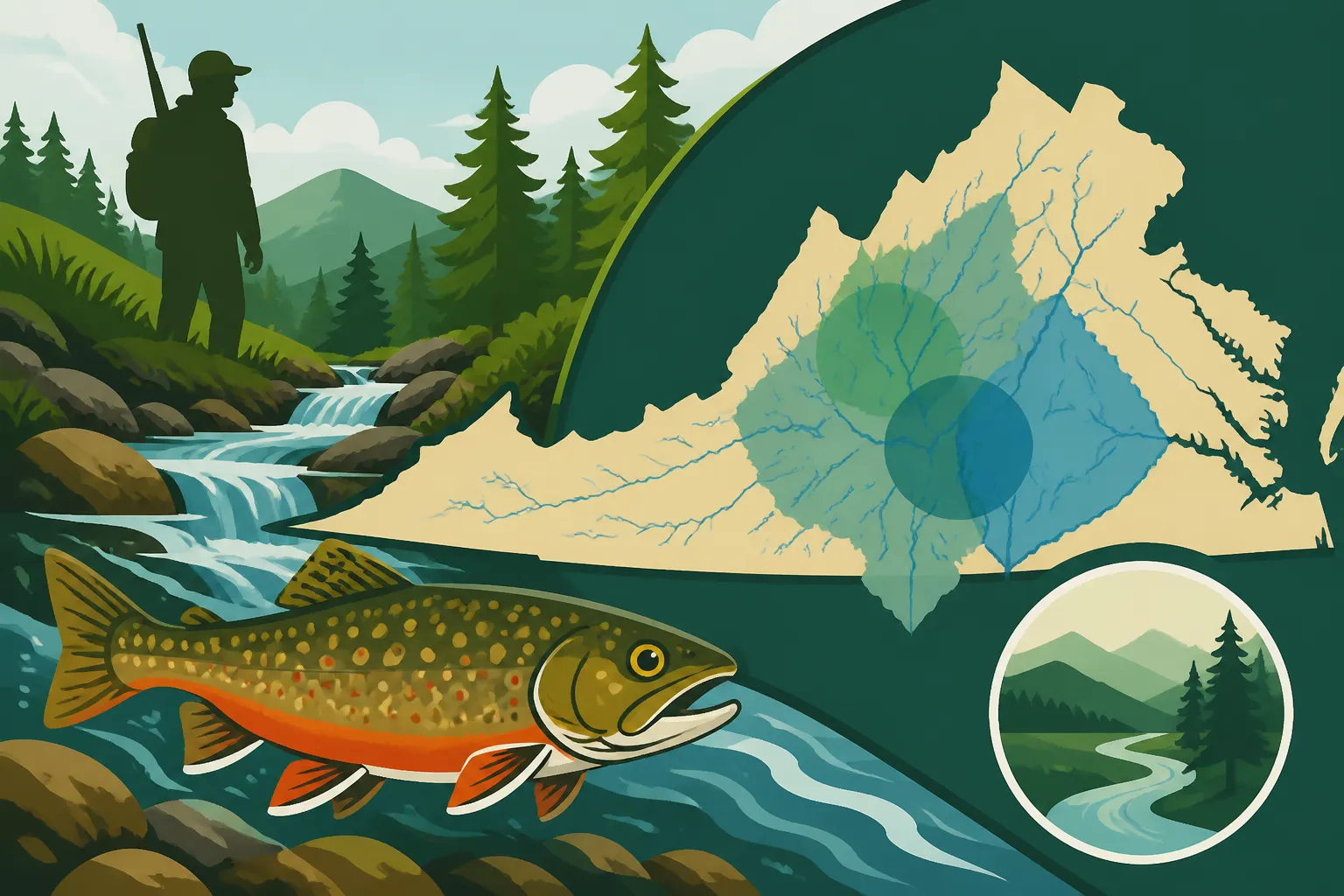
Virginia’s Brook Trout Streams and Watershed Overlap
The quiet solitude of a Virginia brook trout stream is a special kind of magic, isn't it? It’s where the oldest whispers of the Appalachian Mountains seem to coalesce, giving life to these native gems. But for those of us who cherish these wild places, finding healthy, thriving brook trout populations can feel like a secret code you need to crack, especially when the challenges of land use and environmental changes are always pressing. This guide is all about shedding light on Virginia's beautiful brook trout streams, understanding the vital role watersheds play in their survival, and how we, as stewards of the land, can help protect them.
Virginia's Native Brook Trout: A Mountain Gem
There’s something truly special about the native brook trout, or "brookie" as many of us affectionately call them. They aren't just fish; they're living indicators of healthy, vibrant mountain ecosystems, a connection to a wilder Virginia. Understanding their biology and preferred habitats is the first step in appreciating and, more importantly, protecting these incredible creatures.
Native Status and Ecology
Virginia's brook trout are the only native trout species to the state, a true relic of the last ice age. Imagine that – they've been here for thousands of years, long before any of us strapped on a pack or cast a fly. They belong to the char family, and what makes them so unique is their vibrant, almost jewel-like coloring: olive-green backs with wavy vermiculations, speckled sides, and those brilliant red spots encircled by blue halos. Their fins, particularly the lower ones, often boast bright white leading edges, making them unmistakable. These aren't your stocked rainbows or browns; these are the OG residents. Their ecology is intertwined with the cool, clean water they inhabit, preferring temperatures that rarely climb above the mid-60s Fahrenheit. They’re opportunistic feeders, munching on aquatic insects, terrestrial bugs that fall into the water, and even smaller fish if the opportunity arises.
Habitat Requirements and Sensitivity
When you're out there, whether you're deer hunting deep in the mountains or just enjoying a hike, you might stumble upon a small, clear stream tumbling over rocks. If that water feels cold even in the height of summer, and it's surrounded by thick canopy cover, you might be looking at prime brook trout habitat. They absolutely demand cold, clean, well-oxygenated water. That’s why you rarely find them in bigger, warmer rivers. Instead, they thrive in headwater streams, those small tributaries high in the mountains where the water is born. They need plenty of overhead cover from rhododendron thickets, undercut banks, and fallen logs to hide from predators like ospreys and raccoons, and to escape the summer sun. Substrate is important too – gravel bottoms are essential for spawning, where the females lay their eggs in small depressions called redds. Any significant change to water temperature, clarity, or stream structure can have a devastating impact on a brook trout population.
Distribution Across the Commonwealth
While once found throughout many of Virginia's cooler waters, brook trout populations are now primarily restricted to the western and central mountain regions of the state. Think of the spine of the Appalachians, from the George Washington National Forest down through the Jefferson National Forest – this is their stronghold. They're often found in the higher elevations, in those pristine, spring-fed streams that flow out of places like Shenandoah National Park or the more remote corners of the Blue Ridge. You won't find them thriving in the warm, slow-moving rivers of the Piedmont or the coastal plain; it's simply too warm and often lacks the necessary oxygen and clean substrate. Because of their specific needs, their distribution gives us a pretty clear map of where our most unadulterated cold-water resources remain. If you're out Scouting Virginia Public Land Before Season and find yourself near one of these pristine mountain streams, you're in a special place.
The Indispensable Role of Watersheds
We often think about streams as isolated ribbons of water, but they are intrinsically linked to the land around them. This connection is what we call a watershed, and it's absolutely critical for the survival of brook trout. Without healthy watersheds, those pristine streams wouldn't exist.
What is a Watershed?
At its simplest, a watershed is an area of land that drains all the precipitation – rain, snow, sleet – into a common body of water, whether that's a stream, river, lake, or even the ocean. Think of it like a giant funnel. Every drop of water that falls within that funnel’s boundaries will eventually flow to the same outlet. For a small brook trout stream high in the mountains, its watershed might just be a few steep acres of forested hillside. For a major river system like the James, its watershed can span thousands of square miles, encompassing entire counties, cities, and vast agricultural lands. Understanding that every action taken on the land within a watershed has an impact, however small, on the water downstream is fundamental to conservation.
How Land Use Affects Water Quality
This is where the rubber meets the road, or rather, where the land meets the water. The health of a brook trout stream is a direct reflection of the health of its surrounding watershed. Forested watersheds are the gold standard for brook trout. The trees and undergrowth slow down runoff, allowing water to infiltrate the soil, recharging groundwater, and filtering out pollutants. The shade they provide keeps water temperatures low, which is non-negotiable for brookies.
Conversely, activities like logging without proper buffers, agricultural runoff carrying pesticides and fertilizers, development that increases impervious surfaces, and even poorly maintained roads can spell disaster. When heavy rains hit disturbed soil, sediment washes into streams, smothering spawning beds, filling in critical hiding places, and clouding the water. Pollutants like excess nutrients can lead to algal blooms, depleting oxygen when they decay. Even something as seemingly minor as a poorly placed Treestand Setups in George Washington National Forest that requires clearing vegetation along a creek bank can have a cumulative effect if done widely. It's a chain reaction: what happens upstream on the land directly impacts the water quality downstream, and therefore, the fish that live there.
Connectivity and Downstream Impacts
Watersheds aren’t just about the immediate area around a brook trout stream; they’re about connectivity. A small headwater stream eventually feeds into a larger creek, which then joins a river, and so on. This means that problems originating far upstream can travel downstream, affecting ecosystems miles away. For brook trout, this connectivity is a double-edged sword. While it allows for natural migration and genetic exchange between populations, it also means that a dam, a culvert that’s too steep for fish to pass, or a significant pollution event upstream can isolate or wipe out populations across a wide area. This concept is particularly relevant in places like the Shenandoah Valley, where agricultural and urban areas coexist with pristine mountain sections. Understanding this interconnectedness helps us advocate for holistic conservation strategies that consider the entire system, not just isolated pockets.
Major Virginia Watersheds and Their Trout Potential
Virginia is a state of diverse landscapes, and its rivers reflect that diversity. While brook trout are picky about their homes, several major watersheds in the Commonwealth still offer pockets of exceptional habitat.
Shenandoah River Basin
The Shenandoah River Basin, particularly its headwaters in the Blue Ridge and Allegheny Mountains, is a prime area for brook trout. The South Fork and North Fork Shenandoah, along with their numerous tributaries, descend from steep, heavily forested slopes, providing the cold, clean water brookies crave. Think of the streams flowing out of the Massanutten Mountain range or those spilling off the western slope of the Blue Ridge in counties like Augusta and Rockingham. Many of these streams are protected within national forest lands, offering some of the best opportunities for wild trout fishing. However, the lower reaches of the Shenandoah Valley, with its extensive agriculture and growing communities, face significant challenges with nutrient runoff and sedimentation, which can degrade water quality downstream. This creates a stark contrast between the pristine headwaters and the more impacted mainstem river.
James River Basin
The James River, Virginia's longest river, originates in the Appalachian Mountains and winds its way eastward to the Chesapeake Bay. While the lower James is a massive tidal river, its western headwaters in Bath, Alleghany, and Botetourt counties contain some fantastic brook trout habitat. Streams like those feeding the Jackson and Cowpasture Rivers are cold, clear, and plunge through rugged terrain. These areas often coincide with significant public land holdings, including parts of the George Washington and Jefferson National Forests. These headwater tributaries are crucial nurseries for brook trout, acting as cold-water refuges. Anglers and conservationists working to protect these upstream segments are essentially safeguarding the health of the entire river system, as well as the unique fish that call them home. You might find some excellent remote fishing opportunities here, making it worthwhile to brush up on Camping Rules on Virginia National Forest Land if you plan an overnight trip.
Roanoke and New River Basins
Venturing into Southwest Virginia, the Roanoke and New River Basins also hold significant brook trout populations. The New River, an ancient waterway that flows north into West Virginia, boasts numerous high-elevation tributaries in counties like Giles, Montgomery, and Pulaski. These streams are often wild and remote, offering a true backcountry experience. Similarly, the headwaters of the Roanoke River and its tributaries, particularly within the Jefferson National Forest, are known for their healthy brook trout populations. The rugged landscape and extensive public lands in this region, including areas around Mount Rogers and the Clinch River watershed, mean that many of these streams are well-protected by dense forest cover and minimal human disturbance. This isolation is often their greatest defense against environmental degradation, making them strongholds for Virginia's wild brookies.
Potomac River Basin
Moving north, the Potomac River Basin also touches a significant portion of Virginia, particularly in the northern Shenandoah Valley and the mountainous regions bordering West Virginia. The tributaries flowing into the South Branch and North Branch Potomac, as well as smaller rivers like the Cacapon, can be excellent brook trout waters. Counties like Frederick, Clarke, and Loudoun, while often associated with suburban expansion, still possess mountain streams in their western reaches that support wild trout. The challenge here is often balancing the needs of a growing human population with the preservation of natural resources. Conservation efforts in this basin frequently focus on riparian buffer restoration and reducing agricultural runoff to maintain water quality in these critical headwaters.
Other Smaller Coastal Basins
While the major river systems get a lot of attention, it's worth remembering that countless smaller, independent drainages flow directly to the Chesapeake Bay or the Atlantic Ocean. In the more mountainous parts of the Piedmont, particularly the foothills of the Blue Ridge, you can sometimes find isolated brook trout populations in smaller, spring-fed streams. These might not be as vast or well-known as the national forest waters, but they are equally important. They often rely on local conservation efforts and careful private land management for their survival. Discovering one of these hidden gems truly reinforces the idea that brook trout can persist in surprising places when conditions are just right.
Threats to Virginia's Brook Trout and Their Habitats
Despite their resilience and the passionate efforts to protect them, Virginia's brook trout face a gauntlet of threats. These aren't just abstract ecological concepts; they're real, tangible dangers that can wipe out a population or degrade a stream beyond recovery.
Habitat Degradation and Sedimentation
Perhaps the most pervasive threat is habitat degradation. Imagine a pristine stream, gravel bottom sparkling, deep pools offering refuge, and plenty of fallen timber creating eddies and cover. Now imagine a logging operation that doesn't use proper best management practices, or a new housing development that clears too much land near a stream. Suddenly, rain washes huge amounts of fine soil and mud into the water. This sedimentation smothers brook trout eggs, fills in vital interstitial spaces where aquatic insects live, and eliminates the deep pools and cover fish rely on. It can essentially turn a vibrant ecosystem into a barren ditch. Agricultural runoff, unpaved roads, and stream bank erosion all contribute to this problem, making it harder for brook trout to feed, hide, and reproduce.
Water Temperature and Climate Change
Brook trout are cold-water fish, through and through. They simply cannot survive in water that consistently rises above certain temperature thresholds. As our climate shifts, leading to warmer air temperatures and more intense heat waves, many brook trout streams are becoming increasingly vulnerable. Less shade due to deforestation, warmer groundwater inputs, and reduced spring flows during droughts all contribute to rising stream temperatures. A stream that was perfectly suitable for brook trout a few decades ago might now be marginal, or even uninhabitable, during the hottest parts of the summer. This threat is particularly insidious because it’s often a slow, creeping change that’s hard to reverse. It means that preserving riparian buffers—the trees and vegetation along stream banks—is more crucial than ever for maintaining essential shade and cool water.
Invasive Species and Competition
It might sound strange, but other fish species can also pose a significant threat to native brook trout. Non-native trout species, particularly rainbow trout and brown trout, were introduced to many Virginia waters over the years for sport fishing. While they are wonderful game fish in their own right, they often outcompete brook trout for food and space, and in some cases, can even prey on them. Rainbow trout are often more tolerant of warmer water and can establish self-sustaining populations in streams where brookies are struggling. Brown trout, known for their hardiness and aggressive nature, can be particularly problematic. In addition to fish, other invasive species, from plants that choke out native vegetation along stream banks to aquatic insects that alter the food web, can disrupt the delicate balance of a brook trout ecosystem. This is why strict regulations on bait and live well usage are so important, to prevent accidental introductions.
Conservation Efforts and the Hunter/Angler's Role
The good news is that there are dedicated individuals and organizations working tirelessly to protect Virginia's brook trout. As hunters and anglers, we have a unique connection to these wild places and a vital role to play in their future.
Virginia DWR Initiatives
The Virginia Department of Wildlife Resources (DWR) is at the forefront of brook trout conservation. They conduct regular surveys to monitor populations, assess stream health, and identify critical habitats. DWR biologists work on various projects, from restoring degraded stream sections by adding structure and planting native vegetation, to managing fishing regulations that ensure sustainable harvest. They're constantly evaluating water quality, temperature data, and the presence of invasive species. For example, some of DWR's work includes managing public lands like the Virginia Wildlife Management Areas to protect critical stream corridors, sometimes even closing sections to prevent further impact during sensitive periods. Their efforts are data-driven and aim for long-term ecological health. You can often find updates and resources on these initiatives via the Scouting With the Virginia DWR App.
Angler-Led Restoration Projects
Beyond government agencies, the passion of local anglers and conservation groups is a huge driving force. Organizations like Trout Unlimited chapters across Virginia are actively involved in hands-on stream restoration projects. This might involve planting thousands of native trees along stream banks to provide shade and reduce erosion, building in-stream structures like log frames to create better fish habitat, or removing invasive species. These are often volunteer-driven efforts, with people dedicating their weekends to getting their hands dirty for the sake of the fish and the future of the stream. It's truly inspiring to see how much can be accomplished when a community comes together with a shared vision. These efforts often focus on restoring smaller, degraded streams that feed into larger rivers.
Regulations and Sustainable Practices
As hunters and anglers, we have a direct responsibility to adhere to regulations and practice sustainable habits. This includes respecting catch limits for brook trout, which are often more restrictive than for other species, and practicing "catch and release" in many wild trout waters. Using single, barbless hooks can minimize harm to released fish. It also means being mindful of our impact on the land. When we're driving vehicles on forest roads, we should stick to designated routes and avoid creating new ruts that can lead to erosion and sedimentation. If we see issues like pollution or poaching, reporting them to DWR is crucial. Responsible land stewardship, whether we're deer hunting or chasing turkeys, inherently protects the water resources that brook trout rely on. Every time we pack out our trash, stay on established trails, or simply appreciate the beauty of a healthy stream, we're contributing to conservation.
Accessing Virginia's Brook Trout Streams
Part of the allure of brook trout fishing is the adventure of finding them. These aren't usually roadside fishing spots. It often requires a bit of effort, research, and a willingness to explore.
Public Land Opportunities National Forests, WMAs
Virginia is blessed with vast tracts of public land, much of which contains prime brook trout habitat. The George Washington National Forest and the Jefferson National Forest are arguably the jewels in the crown for wild trout enthusiasts. These national forests encompass hundreds of miles of remote, high-elevation streams. Access often involves hiking forest roads or venturing deep into designated wilderness areas. Similarly, several Virginia Wildlife Management Areas (WMAs), managed by DWR, contain smaller streams that may hold brook trout, particularly those located in mountainous or heavily wooded regions. While these areas are primarily managed for hunting, the presence of healthy forests and clean water makes them ideal for trout too. You'll want to consult maps carefully and be prepared for primitive conditions, as many of these streams are not easily accessible. Remember that the rules for Virginia Wildlife Management Areas often require a separate access permit.
Scouting and Research Tools
Finding brook trout streams isn't always as simple as looking at a regular map. You need to identify steep terrain, perennial water sources, and areas with good forest cover. Topographic maps, whether paper or digital, are your best friends. They show elevation changes, contours, and often indicate small streams and springs that are vital to brook trout. Satellite imagery can help you identify canopy cover and potential access points. Tools like GoHunt or the Scouting With the Virginia DWR App can be invaluable here. They overlay land ownership, topography, and even public access points, allowing you to identify potential stretches of stream that might hold fish. It’s about understanding the lay of the land, from ridge to creek, and GoHunt can really help you visualize the flow of water and the surrounding habitat from the comfort of your home before you even lace up your boots. You can zoom in on contours, identify potential waterfalls that act as fish barriers (or sometimes, indicators of healthy, isolated populations), and plan your route.
Respecting Private Land and Permissions
While public lands offer extensive opportunities, many excellent brook trout streams flow through private property. It’s absolutely crucial to respect private land boundaries and always obtain permission before fishing or even accessing a stream that crosses private property. This is where tools that show Finding Virginia Property Lines become invaluable. A simple knock on a door and a polite request can often open up access to pristine waters. Many landowners, especially those who cherish the natural beauty of their property, are amenable to allowing respectful anglers. Building relationships with landowners is not only good etiquette but also helps foster a culture of conservation. Never assume access, and always leave the property better than you found it.
Remember, every time we venture into these places, we're not just looking for a fish; we're connecting with a wild legacy, and our actions play a crucial role in ensuring that legacy continues for generations to come.
Virginia Watersheds and Brook Trout Habitat
Here's a quick overview of some key watersheds and their general characteristics regarding brook trout:
| Watershed Basin | Primary Region in VA | Typical Brook Trout Habitat | Key Conservation Concerns |
|---|---|---|---|
| Shenandoah River | Northern/Central Mountains | High-elevation tributaries, forested headwaters | Agricultural runoff, sedimentation, urban development |
| James River | Central/Western Mountains | Steep, cold mountain streams, remote forested areas | Timber harvesting practices, stream crossings, localized pollution |
| Roanoke River | Southwest Mountains | Rugged, isolated streams within National Forests | Sedimentation from unpaved roads, invasive species |
| New River | Southwest Mountains | Ancient, clear mountain streams flowing northward | Acid rain impact, historical mining, some agricultural runoff |
| Potomac River | Northern Virginia | Headwater streams in Blue Ridge/Allegheny foothills | Urbanization, agricultural pressure, road construction |
| Rappahannock River | Northern Piedmont/Mountains | Scattered cold springs, high-gradient mountain feeder streams | Development, nutrient runoff in lower reaches |
Disclaimer
This article is for general informational purposes only and does not constitute professional advice. Laws, prices and regulations vary by location and change over time. Consult a qualified professional for guidance on your specific situation.