Crossbow Scopes for Virginia Timber Ranges
Hunting in Virginia's diverse timber, from the dense Piedmont woods to the steep mountain hollows, presents a unique challenge for crossbow hunters. You might have a shot open up at twenty yards one moment, and then need to reach out to fifty in a sparse pine stand the next. It’s not just about hitting a target; it's about making precise, ethical shots under varying conditions. This guide will walk you through choosing and optimizing crossbow scopes specifically for the real-world timber ranges you’ll encounter across Virginia.
Understanding Virginia's Timber Ranges for Crossbows
Virginia's landscape is incredibly varied, offering a spectrum of hunting environments that demand versatility from your gear, especially your optics. You're not always in a wide-open field, and even seemingly consistent timber can surprise you with unexpected shot opportunities.
The Dynamics of Piedmont and Mountain Woods
When you're hunting the Piedmont, you might find yourself in thick, overgrown woodlots bordering agricultural fields, or navigating mature hardwood stands that feel quite open under the canopy. These areas often feature a mix of dense undergrowth and more sparse, established trees. Shot opportunities can come fast, often at closer ranges, as deer move through escape cover or along field edges. Think about those moments when a buck suddenly steps out from a thicket at thirty yards – you need to acquire him quickly. Hunting the Piedmont Broomsedge Fields is a good example of this kind of dynamic.
Move west into the Blue Ridge and Appalachian Mountains, and the terrain changes dramatically. Here, you'll encounter steep slopes, deep hollows, and vast expanses of oak and hickory. The cover can be incredibly thick in places, making visibility challenging, but then you'll hit an open bench or a ridgetop saddle where a shot might stretch out further. The undulating topography also affects your line of sight, meaning a flat sixty-yard shot can feel very different from a sixty-yard shot downhill or uphill. Reading a Ridge for Blue Ridge Deer and Hunting a High Elevation Mountain Bench will give you a sense of these dynamics.
How Shot Distances Vary in Different Timber Types
It’s easy to think of "timber hunting" as strictly close-range, but that’s not always the case in Virginia. In the deep, dark conifer stands or dense clear-cuts, your shots might be limited to 15-30 yards. The sheer amount of visual clutter makes anything further a real gamble for a clean shot. However, in mature, open hardwoods with a clean understory, or along the edges of clear-cuts where deer are browsing, you might have clear lanes out to 50-60 yards. Picture yourself perched in a treestand overlooking a logging road or a subtle funnel between two hollows; a deer might walk a well-used trail, presenting a shot anywhere from point-blank to your crossbow's maximum effective range. This variability is precisely why a well-chosen scope is so critical.
The timber ranges also depend heavily on the time of year. Early season Bowhunting Virginia's Statewide Archery Season often means more foliage, reducing visibility and limiting shot distances. By late season, after the leaves drop, those same woods can open up significantly, allowing for longer shots, especially on open ridge systems. Understanding this seasonal change helps you anticipate the types of shots you might get.
The Impact of Light Conditions on Visibility
Virginia's timber, particularly in the mountains or during those classic overcast fall days, can be surprisingly dark. First light and last light are prime hunting times, but they're also when natural light is at its absolute lowest. A scope that performs poorly in dim conditions will severely limit your effective hunting window, potentially causing you to miss out on a prime opportunity or, worse, make a questionable shot. The heavy canopy of a mature oak forest on a cloudy day can feel like dusk at midday. Furthermore, shadows created by dense trees and undulating terrain can obscure vitals or make range estimation difficult. This isn't just about spotting the deer; it's about clearly seeing your aiming point. Many hunters find using scouting tools like GoHunt invaluable for understanding canopy cover and potential light penetration in different areas before they ever step foot in the woods.
Key Features of an Effective Crossbow Scope
Choosing the right crossbow scope isn't about the biggest magnification or the brightest reticle; it's about finding the balance of features that best suits Virginia's timber hunting conditions.
Reticle Design and Ballistic Compensation
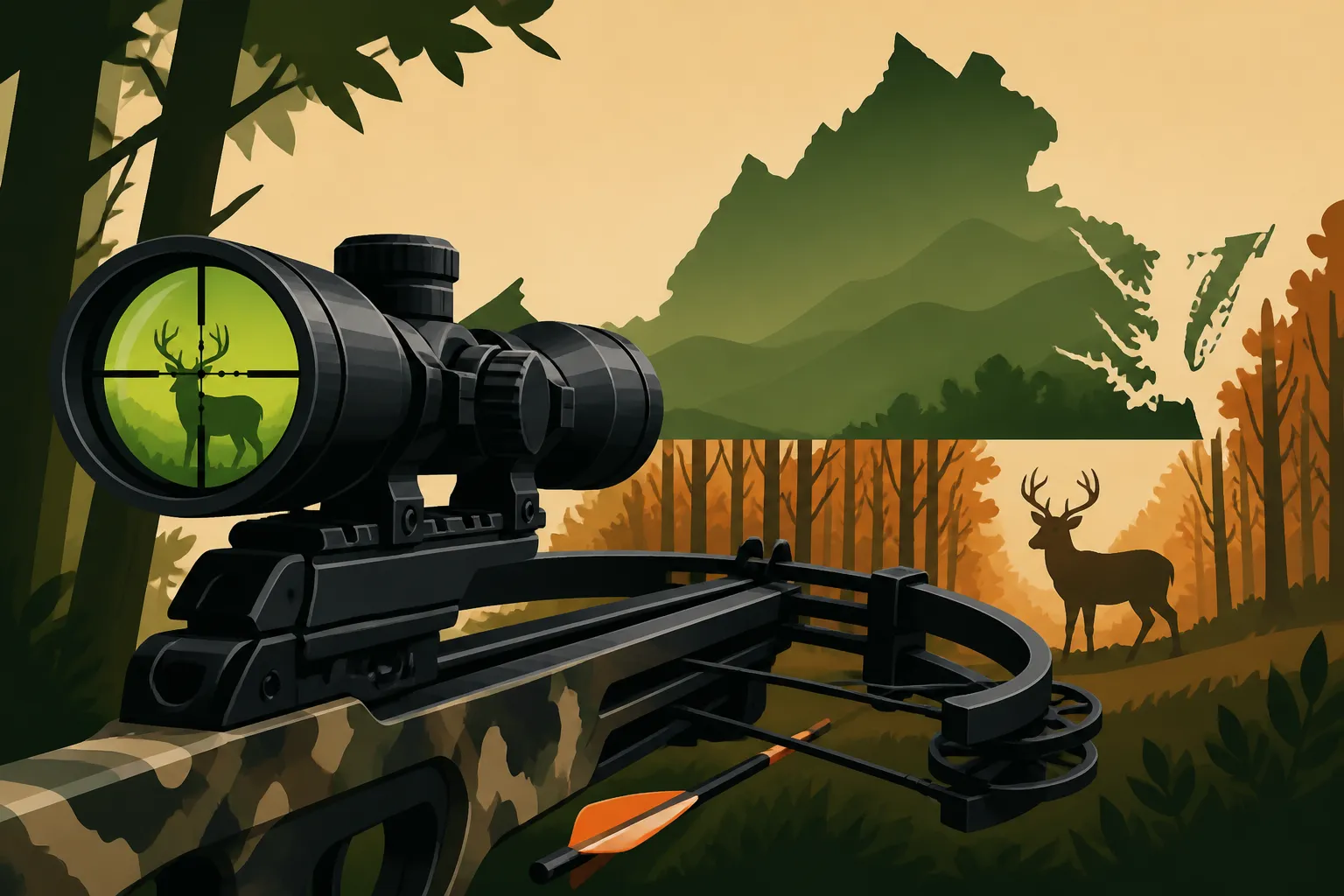
Modern crossbow scopes come with a variety of reticle designs, but for timber hunting, simplicity and precision are key. Most feature multiple aiming points (or dots/hash marks) calibrated for different distances. This "ballistic compensation" is crucial because crossbow bolts don't fly as flat as rifle bullets. You'll often see markings for 20, 30, 40, 50, and sometimes 60 yards.
A clean, uncluttered reticle is paramount. In low light or when a deer presents quickly, you don't want to be fumbling with too many lines or trying to distinguish between fine details. Some scopes offer illuminated reticles, which can be a game-changer in those dim conditions at dawn or dusk, helping you acquire your aiming point without obscuring the target. Just make sure the illumination is adjustable, as too bright can bloom and hinder vision. Look for reticles that are etched into the glass rather than wire, as they are typically more durable and less prone to breaking under recoil or impact.
Magnification and Field of View
While a high magnification might seem appealing, it's often a hindrance in dense timber. The vast majority of shots in Virginia's woods will be under 50 yards, and often much closer. A high magnification significantly reduces your field of view, making it incredibly difficult to find a moving deer quickly or track it through tight cover. Imagine a buck slipping through thick pines at 25 yards; a 6x or 8x scope will make him a blur in a small tunnel.
For timber hunting, a lower fixed magnification (like 3x or 4x) or a variable scope with a low bottom end (e.g., 1.5-5x or 2-7x) is generally superior. A wide field of view allows you to see more of the surrounding environment, crucial for understanding deer movement and anticipating shots. It also helps with target acquisition at those close, fast ranges. Remember, precision at 30 yards is more about quick target acquisition and a steady hold than it is about extreme magnification.
Lens Quality and Light Gathering
This is where many budget scopes fall short and where investing a bit more can truly pay off. High-quality lenses, often multi-coated, gather more light and transmit it more efficiently to your eye. This means a brighter, clearer image, especially in those challenging low-light conditions we discussed. You’ll be able to distinguish antlers from branches, clearly see the vitals, and have a more defined sight picture when legal shooting light is just barely present.
Poor lens quality can result in chromatic aberration (color fringing), distortion, or a dull, dark image. Look for scopes that boast good light transmission ratings and fully multi-coated lenses. This doesn't mean you need a scope designed for extreme long-range rifle shooting, but rather one optimized for clarity and brightness in typical hunting light. A good quality lens can literally add precious minutes to your effective hunting time at dawn and dusk, which often makes all the difference when hunting Late-Season Food Sources for Virginia Whitetails or Entry Routes Through Standing Soybeans.
Choosing and Setting Up Your Crossbow Scope for Success
Getting the right scope is only half the battle; properly setting it up and knowing how to use it effectively in the woods is just as important.
Matching Your Scope to Your Crossbow's Speed
One of the most common mistakes new crossbow hunters make is assuming all scopes work interchangeably. Crossbow scopes are often designed with specific speed ranges in mind. Your crossbow's bolt velocity dramatically impacts its trajectory, and thus how the reticle's aiming points align with actual distances. Most modern crossbow scopes feature a speed adjustment dial or cam that allows you to match the scope's internal ballistics to your specific crossbow's FPS (feet per second).
Before you even mount the scope, know your crossbow's actual measured speed with your chosen bolt and broadhead combination. Don't just rely on the manufacturer's advertised speed, as it can vary. Once you have this number, you can set your scope's speed ring to the corresponding setting. This ensures that when you sight in at 20 yards, your 30, 40, and 50-yard aiming points will be as accurate as possible. Neglecting this step will lead to frustrating misses and lost game, no matter how good your scope is. GoHunt can be a great resource for seeing gear reviews specific to different crossbow speeds.
Mounting, Sighting In, and Range Verification
Proper mounting is the foundation of accuracy. Ensure your scope is securely mounted using quality rings and a base that matches your crossbow's rail. Torque screws to the manufacturer's specifications to prevent movement under recoil. Make sure the reticle is perfectly level. An off-kilter reticle will cause horizontal point-of-impact shifts at longer distances.
Sighting in your crossbow is a systematic process. Start at a close range, typically 10-20 yards, to get on paper. Once you're consistently hitting your bullseye at 20 yards with the primary aiming point, move back to 30, 40, and 50 yards, verifying each aiming point. Some hunters prefer to zero their primary dot at 25 or 30 yards for a slightly flatter trajectory that maximizes the point-blank range, but always verify all aiming points.
Table: Typical Crossbow Zeroing & Verification Process
| Step | Distance | Aiming Point | Goal & Notes |
|---|---|---|---|
| 1 | 10-20 yards | Primary Dot | Get on paper, adjust windage/elevation to hit center. |
| 2 | 20 yards | Primary Dot | Refine zero. Ensure consistent grouping. |
| 3 | 30 yards | 30-yard Dot | Verify point of impact. Minor speed adjustments if needed. |
| 4 | 40 yards | 40-yard Dot | Verify point of impact. Check consistency. |
| 5 | 50 yards | 50-yard Dot | Verify point of impact. This is often your max timber range. |
| 6 | Various | All Dots | Shoot from different positions (treestand height, kneeling, etc.) for real-world feel. |
Crucially, you need to verify these ranges with a rangefinder out in the field. When hunting Deer Drives With Three or Four Hunters or sitting a stand in thick Virginia brush, you need to know exactly how far that patch of open ground is, or the distance to that oak tree your stand overlooks. Practicing with your rangefinder and then making the shot will build confidence in your setup.
Tips for Real-World Timber Hunting Scenarios
Once your scope is dialed in, the real test comes in the woods. Always range known distances around your stand or blind before hunting. This allows you to quickly estimate distances to potential shooting lanes without having to fumble with your rangefinder when a deer appears. Use landmarks like specific trees, rocks, or openings at 20, 30, 40, and 50 yards as mental markers. This habit is especially useful when Hanging a Stand on a Jefferson Forest Ridge where terrain can play tricks on your eyes.
Practice shooting from various positions you might encounter while hunting – sitting, kneeling, or from a treestand. Often, the shot in the woods isn't a perfect bench rest scenario. Understanding how your body position affects your aim and how to use natural rests (like a tree trunk or a portable shooting stick) will significantly improve your accuracy.
Finally, always be aware of your surroundings and your target. In thick timber, it's easy for small branches or leaves to deflect a crossbow bolt. Use your scope's clear view to ensure your shooting lane is truly free of obstructions. A slight shift of an inch can be the difference between a clean pass-through and a deflection that leads to a wounded animal. Trust your scope's clarity and your preparation, and you'll be well on your way to success in Virginia's timber.
Disclaimer
This article is for general informational purposes only and does not constitute professional advice. Laws, prices and regulations vary by location and change over time. Consult a qualified professional for guidance on your specific situation.