Choke Choice for Fast Flushes
There’s nothing quite like the heart-stopping adrenaline rush of a ruffed grouse exploding from a thicket or a covey of quail bursting into the sky. It’s a moment that can make even the most seasoned hunter flinch, and often, it ends in a miss. Many of us have been there, wondering if it was our aim, the gun, or perhaps the wrong equipment. When it comes to those blink-and-you-miss-it, close-range shots on fast-flushing birds in Virginia, your choke choice is absolutely critical, and this guide is here to help you get more birds in the bag.
The Frustration of Fast Flushes: Understanding Your Target
We’ve all experienced it – that sudden, unexpected eruption of feathers and sound from dense cover. One minute you’re easing through the woods, the next a bird is airborne, seemingly doing barrel rolls while accelerating away. It’s a moment designed to test your reflexes and often leaves you with nothing but a ringing in your ears and a frustrated sigh. The truth is, these "fast flushes" are a unique challenge in upland hunting, demanding a specific approach to your shotgun setup.
What Defines a "Fast Flush" in Virginia?
In the world of Virginia upland hunting, a "fast flush" isn't just about speed; it's about proximity, unpredictability, and often, the dense cover the birds call home. Imagine a bird that bursts from literally under your feet, gaining full speed and changing direction in a fraction of a second. These aren't long-range pass shots; these are in-your-face, reactive opportunities.
The core challenge with these close, fast flushes is that the window for a successful shot is incredibly small. If your shot pattern is too tight at such close distances, you essentially have a very small "kill zone," making it easy to miss the bird entirely, or worse, clip it with only a few pellets, leading to a wounded bird. We want a pattern that opens quickly, providing a larger, more forgiving spread while still maintaining enough density for a clean, ethical kill. That's why understanding and choosing the right choke is so paramount.
Common Virginia Upland Species and Their Habits
Virginia offers a diverse landscape, and with it, several species that are prime examples of "fast flush" targets. Knowing their habits helps us anticipate the shot and select the best choke.
First up, the ruffed grouse. Oh, the king of the mountains! If you’ve spent any time chasing these wily birds in the Blue Ridge, you know their flush is nothing short of explosive. They erupt from thickets of mountain laurel, rhododendron, or dense hardwoods, often with obstacles between you and them. The shot is typically close, maybe 15-25 yards, and over in a heartbeat. Successfully hitting a grouse usually means reacting instantly to its sudden appearance. Many a hunter has walked out of Grouse Hunting Blue Ridge Cover with tired legs and an empty vest, cursing that split-second decision.
Then there’s the elusive American woodcock, often called the timber doodle. These migratory birds are usually found in moist, young woodlands, along creek bottoms, or in dense alder thickets. Their flight is notoriously erratic and spiraling, making them a challenging target even at relatively close range. You'll often find them tucked into incredibly tight cover, meaning the flush is right at your feet, and the shot is within 10-20 yards. They're fragile birds, so a dense, open pattern is ideal to avoid tearing them up while still ensuring a clean dispatch. Virginia Woodcock Season Dates are something many hunters eagerly await for these unique birds.
While less common for wild hunting due to declining populations, bobwhite quail, when found, offer the classic covey rise. A whole group of birds bursts out simultaneously, fanning out rapidly. The first shot is often at a very close, dense pattern of birds, with subsequent shots potentially at single birds at slightly longer ranges. Understanding Virginia Quail Season Status is important, as wild quail are a true treasure. And let's not forget quick-flushing rabbits from fencerows or thickets—while not birds, their close-range, darting escapes present a very similar choke challenge.
Deciphering Shotgun Chokes: A Primer for Upland Hunters
Before we dive into specific recommendations, it's really helpful to understand what a choke actually does and why it's so fundamental to shotgun performance. It’s not just a piece of metal; it’s a precision instrument designed to optimize your shot.
The Basics: What a Choke Does and Why it Matters
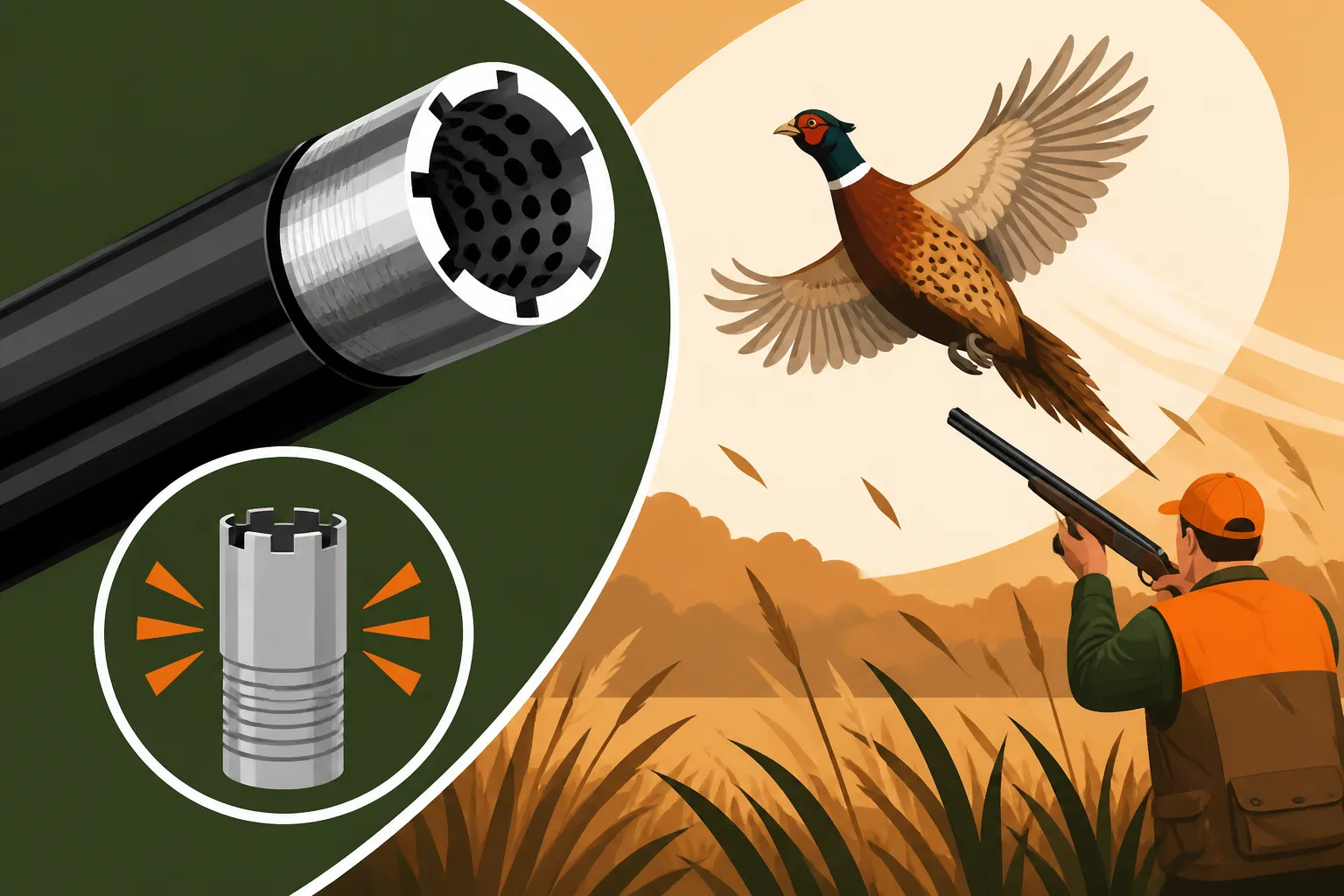
At its heart, a shotgun choke is a constriction at the muzzle end of your barrel. Think of it like squeezing the end of a garden hose. The tighter the squeeze, the more focused and contained the stream of water. In a shotgun, this constriction controls how quickly the shot pellets spread out after they leave the barrel.
The primary purpose is to control the spread of your shot pattern at various distances. If you’re shooting at a clay target 40 yards away, you want a relatively tight pattern to ensure enough pellets hit the target for a break. But if you’re shooting at a grouse 15 yards away, that tight pattern becomes a tiny "bullet" that’s incredibly easy to miss with. For fast-flushing, close-range birds, we want a pattern that opens up rapidly, creating a wider, more forgiving cone of pellets. This increases your chances of connecting with the fast-moving target without having to be surgically precise. However, that pattern still needs to be dense enough to deliver a clean, ethical kill. It's a delicate balance.
Common Choke Constrictions and Their Applications
Most shotguns come with interchangeable choke tubes, allowing you to swap them out depending on what you’re hunting. Older shotguns might have fixed chokes, meaning the constriction is permanently built into the barrel. Here’s a quick rundown of the most common choke types, moving from widest (most open) to tightest (most constricted):
| Choke Name | Constriction Level | Pellet Spread at 40 Yards | Typical Use Case |
|---|---|---|---|
| Cylinder (C) | No constriction | ~40 inches | Very close range (under 20 yds), large targets, slugs, or for pattern development before other chokes. |
| Skeet (SK) | Slight constriction | ~35 inches | Very close range (15-25 yds), skeet shooting, doves, quail, woodcock, grouse in extremely dense cover. |
| Improved Cylinder (IC) | Light constriction | ~30 inches | Close-medium range (20-30 yds), versatile for upland birds, rabbits, close waterfowl, general purpose. |
| Modified (M) | Medium constriction | ~25 inches | Medium range (30-40 yds), pheasants, longer flushing upland birds, medium range waterfowl. |
| Improved Modified (IM) | Medium-tight | ~20 inches | Longer medium range (35-45 yds), harder hitting on tough birds, less common for upland, good for waterfowl. |
| Full (F) | Tight constriction | ~15 inches | Long range (40+ yds), turkeys, geese, pass shooting ducks, trap shooting. |
| Extra Full (XF) | Very tight | <15 inches | Extremely long range, specific turkey hunting, extends range beyond full. |
For our purposes—those fast, close flushes—we're almost always looking at the more open end of this spectrum: Cylinder, Skeet, or Improved Cylinder. These chokes provide a generous pattern diameter at short range, giving you a wider margin for error on those incredibly quick shots. If you’re ever unsure about which gear is best for a particular Virginia hunting scenario, a quick check on a robust resource like GoHunt can often clarify things with detailed information and user reviews. They often break down complex gear choices, making it easier to decide.
The "Ideal" Choke for Up-Close Encounters
When a bird flushes just yards from your boots, you need your pattern to blossom quickly. This is where Improved Cylinder (IC) and Skeet chokes truly shine. An Improved Cylinder choke is, for many upland hunters, the go-to for its versatility. It offers a good balance, opening up enough for those 15-25 yard shots, but still keeping enough density to be effective out to 30 yards or so if a bird gets a little more distance.
Skeet choke, being even more open than Improved Cylinder, provides the widest pattern at the closest ranges. If you’re hunting in extremely dense cover where you know every shot will be within 10-20 yards, a Skeet choke can be incredibly forgiving. It literally provides the largest "strike zone" to connect with a fast-moving, close bird. For instance, if you're navigating really thick stuff where you're brushing against cover and expect a bird right under your nose, the Skeet choke is your friend. It's about maximizing the probability of getting enough pellets on target, quickly, and cleanly.
While Cylinder bore is the most open, sometimes it can spread a little too much at even 20 yards, potentially creating gaps in the pattern, especially with larger shot sizes. For that reason, most upland hunters find Skeet or Improved Cylinder to be the sweet spot for delivering a dense, forgiving pattern for those lightning-fast, close-range flushes.
Matching Choke to Cover and Species in Virginia
Now that we understand the chokes, let’s get down to the brass tacks: putting them to use in Virginia’s diverse hunting grounds. Matching your choke to the specific cover you’re hunting and the habits of the target species is what turns good theory into successful practice.
Thick Mountain Laurel and Grouse
If you've ever pursued ruffed grouse in the dense, tangled undergrowth of the Blue Ridge or Alleghenies, you know the scenario: You’re picking your way through a thicket of mountain laurel, every step a calculated effort to avoid making too much noise. Suddenly, a brown blur erupts from a few feet away, thundering through the branches. It’s gone in a flash, leaving your heart pounding and your gun still halfway to your shoulder.
In these situations, where shots are almost always under 25 yards and often obstructed by branches, an Improved Cylinder (IC) or even a Skeet choke is paramount. You need that pattern to open up immediately, giving you the best chance of putting enough pellets on target through the narrow lanes in the cover. A tight choke here would mean almost certain misses. For these scenarios, you're not trying to hit a single pellet; you're trying to put a dense cloud of shot where the bird will be. Remember that smaller shot sizes, like #7.5 or #8, also contribute to a denser pattern for upland birds, which helps compensate for any branches that might strip off a few pellets. It's a real art, and the right choke gives you a significant edge in these challenging environments. For more on getting set up, you might find Upland Guns for Mountain Grouse Cover a useful read.
Woodcock in Bottomland Alders
Hunting woodcock in Virginia often means exploring moist bottomlands, creek edges, and areas with young alders or dogwoods. The cover here, while not as impenetrable as some mountain laurel thickets, is still dense, and the woodcock’s flight is famously erratic and quick. They twist and turn, often rising sharply before leveling off, making them a true aerial challenge.
For these close-range, twisting flushes, a Skeet choke is often the preferred choice, though Improved Cylinder also works well. The woodcock is a relatively small and delicate bird, so you don't need a huge amount of stopping power, but you do need a wide, dense pattern to account for their unpredictable flight. The goal is to maximize the chances of hitting the bird without over-penetrating or damaging too much meat. If you’re working a particular creek bottom that's known for holding these timber doodles, having a more open choke will definitely increase your success rate.
Covey Flushes and Open Fields (Quail and Doves)
While wild bobwhite quail coveys are less common than they once were, if you’re fortunate enough to find them in Virginia’s Piedmont broom sedge fields or managed hunt areas, their flush is an unforgettable experience. A covey rise is a sudden explosion of birds, all heading in different directions. The first shot is typically very close as the entire covey bursts out.
For that initial covey rise, an Improved Cylinder choke is incredibly versatile. It gives you a good, broad pattern for the closest birds, allowing you to connect with one or more if you're quick enough. If you’re then tracking a single bird for a follow-up shot as they disperse, the IC still offers enough pattern density for shots out to 25-30 yards. For dove hunting, especially on opening day when birds might be less wary and offer closer shots over a field, an IC can be effective. However, for later season doves or pass-shooting, where birds are flying higher and faster, you might consider stepping up to a Modified choke. When it comes to managing fields for these birds, sometimes checking out resources like Setting Up a Dove Field Before Opening Day can make all the difference.
Versatility for Mixed Bag Hunts
Let's be realistic: not every hunt is focused on a single species in a perfectly uniform cover type. Many Virginia hunters pursue mixed bags, where you might jump a rabbit in a fencerow and then flush a grouse from a nearby timber stand. Or perhaps you're walking a field edge and then dip into a creek bottom. In these situations, switching chokes can be impractical, especially with a single-barrel shotgun.
This is where the Improved Cylinder (IC) choke truly earns its stripes as a fantastic all-around option for most close-to-medium range upland scenarios. It’s open enough for those fast-flushing birds at 15-25 yards, but still retains sufficient pattern density to be effective on a bird that gets out to 30-35 yards. If you're using a double-barrel shotgun, many hunters opt for a combination like Skeet in the first barrel (for the closest shot) and Improved Cylinder in the second, or IC in the first and Modified in the second. This gives you a quick-opening option for the initial flush and a slightly tighter pattern if the bird flies a bit further or you get a second shot. Always remember that whatever combination you choose, getting to know its performance with your specific loads is crucial, and that leads us to patterning. A tool like GoHunt's gear database can help you compare different choke-and-load combinations for your specific needs.
The Critical Step: Patterning Your Shotgun
You can read all the articles in the world, look at all the choke tables, and listen to every veteran hunter's advice, but there's one step you absolutely cannot skip: patterning your shotgun with your chosen ammunition and choke. It's the only way to truly understand what your particular setup will do in the field.
Why Patterning is Non-Negotiable
Every shotgun is a little different, even two identical models off the same assembly line. The barrel dimensions, the way the choke fits, and even subtle variations in ammunition can all affect how your shot string patterns downrange. Relying solely on the choke designation stamped on the tube can be misleading; an "Improved Cylinder" from one manufacturer might pattern a bit differently than another.
Patterning helps you achieve several vital things:
- Verify your pattern: You’ll see, with your own eyes, how your choke and load actually perform. Is the pattern wide enough for those fast flushes? Is it dense enough for a clean kill?
- Identify point of impact: Does your shotgun shoot where you’re looking? Sometimes a gun might shoot slightly high, low, left, or right, which is critical to know.
- Establish effective range: You’ll learn the maximum distance at which your chosen choke and load consistently deliver a dense enough pattern for an ethical kill.
- Build confidence: Knowing exactly what your shotgun can do instills confidence, and confidence is a huge factor in successful shooting. Many hunters get frustrated with "clean misses" when the real issue is that their pattern isn't where they thought it was, or it's simply too tight for the situation.
How to Pattern for Fast Flushes
Patterning your shotgun for fast-flushing birds isn't complicated, but it does require a bit of dedication. Here’s a basic approach:
- Gather your materials: You'll need large sheets of paper or cardboard, ideally 3×3 feet or 4×4 feet. Some hardware stores sell rolls of builder's paper that work perfectly. Bring a measuring tape, a marking pen, and plenty of your chosen ammunition.
- Set your distance: For fast-flushing upland birds, you want to pattern at typical shooting distances. For grouse and woodcock, this might be 15, 20, and 25 yards. For quail, you might add 30 yards.
- The process: Set up your target. Stand exactly at your chosen distance and aim for the center of the paper, as if you were shooting at a bird. Fire a shot. Repeat this several times (at least 3-5 shots) on fresh paper to get a good average.
- Analyze the results: Examine each target. Circle the densest part of the pattern to see if it’s centered where you aimed. Count the pellet strikes within a 30-inch circle (often marked on commercial patterning targets) to assess density. Look for any significant holes or uneven distribution.
- Adjusting based on results: If your pattern is consistently too tight at 20 yards for grouse, you might need to step down to a Skeet choke or even a Cylinder. If it's too sparse, try a different brand of ammunition or a slightly different shot size that might pattern better through your choke. You can adapt some of the principles used for Patterning a Turkey Gun at 40 Yards to these closer ranges, just with different distances and pellet counts.
This hands-on approach takes the guesswork out of choke selection. A resource like GoHunt can even help you record your patterning results and compare them to others' data, helping you make informed decisions.
Practicing with Your Choke and Load
Patterning gives you the data, but practice builds the skill. Once you've selected and patterned the ideal choke for fast flushes, take that knowledge to the range or even to a sporting clays course. Skeet shooting is an excellent way to simulate those close, fast, crossing, and going-away shots you'll encounter in the uplands. Sporting clays courses often have stations designed to mimic game birds flushing.
The goal here isn’t just to hit clays, but to build muscle memory: mount the gun smoothly, swing through the target, and trust your pattern. When that grouse explodes from the thicket, you won't have time to think about your choke or pattern; your body needs to react instinctively. The more you practice with the actual choke and load you'll use in the field, the more confident and effective you'll be. Ultimately, the "best" choke is the one you shoot most effectively, allowing you to react quickly and put a dense, forgiving pattern on a fast-flushing bird, increasing your odds of success in the beautiful and challenging Virginia uplands.
Disclaimer
This article is for general informational purposes only and does not constitute professional advice. Laws, prices and regulations vary by location and change over time. Consult a qualified professional for guidance on your specific situation.