Shot Size for Grouse and Woodcock
There are few things more frustrating than meticulously scouting a promising patch of cover, hiking through rugged Virginia terrain, and finally getting that heart-stopping flush of a ruffed grouse or the tell-tale erratic flight of a timberdoodle, only to have your shot fail. Often, the reason isn't your aim, but the ammunition you chose. Picking the right shot size for these elusive upland birds can feel like a guessing game, but it's a critical factor in ensuring a clean kill and a successful hunt. This guide will help you understand the dynamics of shotgun ammunition and equip you with the knowledge to select the perfect shot size for grouse and woodcock in Virginia, minimizing frustration and maximizing your ethical hunting success.
Understanding Upland Bird Shot Dynamics
Before we dive into specific recommendations, let's talk about what makes shotgun shot work and why choosing the right size is so crucial. It’s not just about throwing a bunch of pellets downrange; it’s about delivering enough energy, with enough density, to humanely dispatch your quarry.
How Shot Size Affects Pattern Density and Penetration
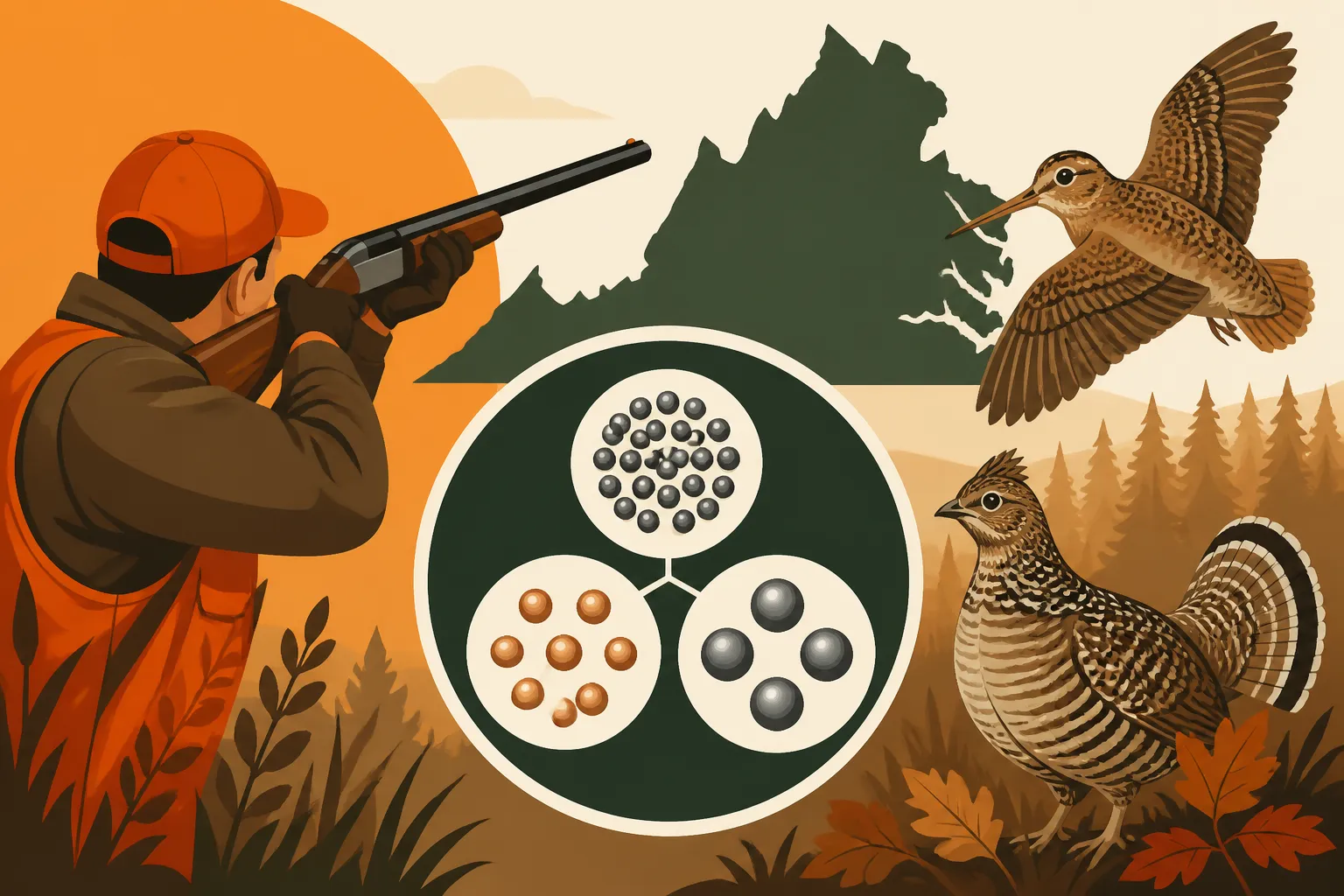
Think of your shotshell as a tiny cannon filled with a specific number of projectiles. The number on the box, like #7.5 or #8, refers to the size of each individual pellet. Here's the key: the larger the number, the smaller the individual pellets. So, #8 shot contains more, smaller pellets than #6 shot, for example.
This inverse relationship has direct consequences for your pattern and the pellet's ability to penetrate. Smaller shot, like #8 or #7.5, creates a much denser pattern at shorter ranges. This means you've got a higher probability of putting multiple pellets on a fast-moving, small target like a woodcock. However, each of those tiny pellets carries less kinetic energy. They don't penetrate as deeply. For birds with heavier bone structure or denser feathers, this can lead to superficial wounds rather than a clean kill.
On the flip side, larger shot, like #6 or #5, has fewer individual pellets, making for a sparser pattern. If your aim is a fraction off, or the bird is at the edge of your pattern, you might only hit it with a pellet or two, or even worse, miss it entirely. But when those larger pellets do connect, they carry significantly more energy and penetrate deeper, making them highly effective for birds that require more "punch." The trick is finding that perfect balance for the specific bird you're pursuing in the unique Virginia cover.
The Critical Balance of Killing Power and Pattern Spread
The art of choosing upland bird shot is truly about finding a balance. You need enough pellets to ensure a vital hit, but those pellets also need to carry enough energy to do the job. If your pattern is too sparse because your shot is too large, you risk simply not hitting the bird with enough pellets to achieve a clean kill. Imagine a grouse flushing tight in dense timber; if your #5 shot spreads too wide, you might get a clean miss even with good aim.
Conversely, if your shot is too small, say #9, you'll have an incredibly dense pattern, but the individual pellets might not penetrate a grouse's muscle and bone deeply enough, especially if it's not a head or neck shot. You might pepper the bird, breaking a wing or leg, but leave it to suffer or fly off to die later, which is something every ethical hunter wants to avoid.
The goal is to put at least 3-5 pellets into the vital zone (head, neck, or chest cavity) of the bird, ensuring immediate incapacitation. For small, quick birds like grouse and woodcock, this often means prioritizing pattern density, but not at the expense of penetration. That's why medium-sized shot is almost always the answer, rather than going to extremes.
Recommended Shot Sizes for Virginia Grouse Hunting
Ruffed grouse hunting in Virginia is a pursuit steeped in tradition, and it’s arguably one of the most challenging forms of upland hunting you can undertake. The rewards are immense, but success hinges on a keen understanding of the bird and its environment.
Why Grouse Present a Unique Challenge
Virginia's ruffed grouse populations are primarily found in the mountainous regions, particularly west of the Blue Ridge, thriving in dense, regenerating timber, laurel thickets, and areas with mixed hardwoods and conifers. These birds are masters of evasion. When a grouse flushes, it’s rarely a leisurely affair; they explode from cover with a thunderous roar of wings, often darting between trees and saplings, presenting incredibly brief and challenging shooting opportunities. The window for a shot can be mere seconds, often at close ranges of 10-25 yards, sometimes even closer.
Their dense feathering and relatively robust build, compared to something like a quail, means you need pellets that can punch through. Losing a bird in thick cover after a marginal hit is a demoralizing experience, and unfortunately, it's a real possibility if your shot isn't up to the task. Understanding the typical conditions where you'll find them, such as Grouse Hunting Blue Ridge Cover, helps inform your gear choices, including shot. The challenging conditions often demand quick, clean kills.
Optimal Shot Choices and Their Performance
For grouse, many seasoned Virginia hunters gravitate towards #7.5 or #6 shot. There's a strong argument for both, depending on your preferred range and the specific type of cover you're hunting.
-
#7.5 Shot: This is often considered the gold standard for many upland hunters, and for good reason. It offers an excellent balance of pattern density and individual pellet energy. At the typical ranges you encounter flushing grouse—say, 15 to 30 yards—#7.5 shot will deliver a dense pattern with enough pellets to guarantee multiple hits in the vitals. The pellets are small enough that your pattern will be forgiving, but large enough to cleanly dispatch a grouse. If you're busting through thick laurel and hemlock, where shots are almost always tight, this is an excellent choice.
-
#6 Shot: Some hunters prefer #6 shot, especially if they anticipate slightly longer shots or hunt in areas with more open woods where a grouse might get a little further out before you swing on it. The individual pellets are larger and carry more energy, meaning slightly better penetration, which can be an advantage on a bird with dense musculature or a glancing body shot. The trade-off, however, is a sparser pattern. If your shots are consistently under 20 yards, you might find #7.5 to be more forgiving due to the higher pellet count. However, a well-placed load of #6 shot is devastating on a grouse. When contemplating Upland Guns for Mountain Grouse Cover, consider how #6 shot performs in a tight pattern from your chosen choke.
-
#5 Shot: While less common for grouse, some hunters who prefer a heavier hit, perhaps with a more open choke, might opt for #5 shot. These larger pellets deliver maximum individual punch. However, the pattern density can be significantly reduced compared to #6 or #7.5, making clean hits more challenging. This might be a viable option if you're consistently shooting at the absolute maximum range you’d consider for grouse, but generally, the increased pellet count of #6 or #7.5 provides a greater margin for error on these lightning-fast flushes.
Ultimately, your choice might also come down to personal preference and how your particular shotgun patterns different loads. It’s always a good idea to pattern your shotgun with your chosen ammunition before the season begins.
Recommended Shot Sizes for Virginia Woodcock Hunting
Virginia’s woodcock population, while perhaps not as widely pursued as deer or turkeys, offers a unique and incredibly rewarding challenge for the upland hunter. These small, migratory birds, sometimes affectionately called "timberdoodles," have a distinct charm and require a slightly different approach to ammunition selection.
The Elusive Timberdoodle and Its Vulnerability
Woodcock inhabit damp, brushy cover, often near water sources, in dense alder thickets, young sapling stands, and the edges of swampy bottoms. In Virginia, you might find them along creek beds in the Piedmont or even in dense, regenerating clearcuts in the mountains. Their migration patterns can be observed, and services like GoHunt can help track these movements, giving you an edge. Checking Virginia's Place on the Woodcock Flight can give you an idea of when these birds will be most prevalent. They're much smaller than grouse, with a slender build and softer plumage, making them more vulnerable to shot.
When flushed, a woodcock has a characteristic vertical ascent, sometimes called a "towering" flush, before leveling off into an erratic, bobbing flight pattern. Their flight is typically slower than a grouse's explosive burst, but no less unpredictable. Most shots on woodcock are taken at very close range, often within 10 to 20 yards, in extremely thick cover where visibility is limited.
Because of their small size and softer build, the primary concern for woodcock is pattern density. You want to blanket the bird with enough pellets to ensure a quick, humane kill without over-penetration that might simply destroy too much meat.
Preferred Shot Sizes for Clean Woodcock Kills
Given the woodcock's size, flight characteristics, and typical engagement range, the focus shifts even more heavily towards shot density.
-
#8 Shot: This is the undisputed champion for woodcock. The sheer number of pellets in a #8 load creates an incredibly dense pattern, ensuring multiple hits even on the most erratic flyers at close range. These smaller pellets have more than enough energy to penetrate a woodcock's delicate frame, delivering a clean, humane kill without excessive damage to the meat. When a woodcock flushes from under your feet in a tangle of briars, that dense pattern of #8 shot is your best friend.
-
#7.5 Shot: While #8 is generally preferred, #7.5 shot is also an excellent choice for woodcock. It still provides a very dense pattern, only slightly less so than #8, but with individual pellets carrying a touch more energy. If you're carrying one load for both grouse and woodcock, or if you anticipate slightly longer shots on woodcock due to more open cover, #7.5 can perform admirably. It offers a versatile option, and many hunters will carry it for general upland hunting, especially when hunting cover that might hold both species. This size is often a great general-purpose choice for small game.
Using larger shot, such as #6 or #5, for woodcock is generally overkill and counterproductive. The sparser patterns increase the risk of clean misses or merely wounding the bird, and the larger pellets can cause excessive damage to the delicate meat. The goal is a quick, humane kill, and for woodcock, density triumphs over raw pellet energy. For more information on their presence, looking up data like Virginia Woodcock Singing Ground Surveys might give insights into local populations.
Ammunition Types and Choke Considerations for Upland Birds
Selecting the right shot size is just one piece of the puzzle. The type of ammunition (lead vs. non-toxic) and the choke you use are equally important in optimizing your shotgun's performance for Virginia's upland birds.
Lead vs. Non-Toxic Shot Regulations
For many years, lead shot was the standard for all hunting. However, environmental concerns, particularly regarding waterfowl and wetlands, have led to regulations requiring non-toxic shot in certain areas. In Virginia, while lead shot is generally permissible for upland hunting on private lands and most public lands, there are exceptions. For instance, any hunting on federal lands, such as National Wildlife Refuges, will require non-toxic shot. It's crucial to check Where Nontoxic Shot Is Required in Virginia before you head out, as these regulations can change and vary by specific location.
When you transition to non-toxic alternatives like steel, bismuth, or tungsten, it's important to understand their characteristics:
- Steel Shot: This is the most common and affordable non-toxic option. However, steel is lighter than lead, meaning a steel pellet of the same size as a lead pellet carries less energy and can lose velocity more quickly. To compensate, many hunters go up one or two shot sizes when using steel (e.g., if you normally shoot #7.5 lead, you might use #6 or #5 steel). Steel also has a harder nature, which means you typically need more open chokes to prevent barrel damage and achieve good patterns.
- Bismuth Shot: Bismuth is heavier and softer than steel, closer in performance to lead. It patterns well and hits harder than steel, making it a good "lead-like" alternative without being as hard on your barrel as steel can be with tight chokes. The downside is that it's typically more expensive than steel.
- Tungsten Shot: Tungsten alloys are denser than lead, meaning these pellets carry a lot of energy and penetrate exceptionally well. They are also non-toxic. However, tungsten is often the most expensive option, making it a specialty load for situations where its superior performance is truly warranted.
When choosing non-toxic shot, always test it with your shotgun and choke combination to see how it patterns. Performance can vary significantly.
Pairing Shot Size with Your Choke
Your shotgun's choke acts like a nozzle, controlling how tightly your shot pattern holds together as it leaves the barrel. For upland bird hunting, particularly for close-flushing birds like grouse and woodcock, an open choke is usually your best friend.
Common choke constrictions, from tightest to most open:
- Full: Very tight pattern, best for long-range shots.
- Modified: Good all-around choke, tighter than Improved Cylinder.
- Improved Cylinder (IC): Opens the pattern more quickly, ideal for medium ranges.
- Skeet / Cylinder: The most open chokes, providing the widest pattern at close ranges.
For grouse and woodcock, where shots are frequently under 30 yards and often much closer, a Skeet, Cylinder, or Improved Cylinder choke is almost always recommended. These open chokes allow the shot column to spread out faster, giving you a wider pattern to increase your chances of hitting a fast-moving, erratic bird. With a grouse exploding from thick cover, you often don't have time for precision aiming, and that wider pattern is invaluable. The goal isn't to hit with every pellet, but with enough to be lethal.
If you’re using a double-barrel shotgun, it's common to have a more open choke in the first barrel (e.g., Skeet or IC) for that immediate, close-range flush, and a slightly tighter choke in the second barrel (e.g., IC or Modified) for a follow-up shot if the bird gets out a little further. When considering your shotgun gauge choice, remember that even with a 12-gauge, an open choke is crucial for these birds.
The most important step, regardless of your chosen shot size or choke, is to pattern your shotgun. Take your gun, your chosen ammunition, and a large piece of paper (or patterning target) to a safe shooting range. Shoot at typical upland ranges (e.g., 20, 30 yards) to see how your shot and choke combination performs. You want a consistent, even pattern with no large holes that a bird could fly through. A quick look at local ranges on GoHunt can help you find a spot to do this critical pre-season task. This practice ensures you know exactly what your setup is capable of, giving you confidence when that bird finally flushes.
Remember, every shotgun patterns slightly differently with various brands and types of ammunition. Don't assume. Patterning removes the guesswork.
Shot Size Comparison for Virginia Upland Birds
Here's a quick reference table to help visualize the differences in shot sizes commonly used for grouse and woodcock in Virginia.
| Shot Size | Pellet Diameter (Approx.) | Pellets per Ounce (Approx.) | Primary Use for Grouse | Primary Use for Woodcock | Pros for Upland | Cons for Upland |
|---|---|---|---|---|---|---|
| #8 | 0.09 inches | 410 | Acceptable (Close Range) | Excellent | Very dense pattern, ideal for small, close-range birds. | Less penetration, might be insufficient for longer grouse shots. |
| #7.5 | 0.095 inches | 350 | Excellent | Excellent | Great balance of density and penetration, versatile. | Slightly less dense than #8 for very close woodcock. |
| #6 | 0.11 inches | 225 | Very Good | Less Ideal | Good penetration, effective for grouse, especially at slightly longer ranges. | Sparser pattern, higher chance of missing vitals on small birds like woodcock. |
| #5 | 0.12 inches | 170 | Good (Longer Range) | Not Recommended | High penetration, suitable for longer shots on larger upland birds. | Very sparse pattern, high risk of clean misses on quick, close targets. |
Note: Pellet counts are approximate and can vary slightly by manufacturer and material (lead vs. non-toxic).
Understanding these nuances is key. While #7.5 might be a great all-around choice for many Virginia upland hunters, knowing when to opt for the denser #8 for woodcock or the harder-hitting #6 for grouse in specific cover can significantly improve your success and ensure more ethical kills.
As Virginia's ruffed grouse populations face challenges, as highlighted in discussions around Virginia Ruffed Grouse Decline, ethical hunting practices, including clean kills, become even more important. Likewise, understanding the migratory habits and best practices for Virginia's Place on the Woodcock Flight ensures respectful harvesting of these unique birds.
Conclusion
The pursuit of ruffed grouse and American woodcock in Virginia is a truly rewarding experience, connecting us with rugged landscapes and the timeless traditions of upland hunting. But to be consistently successful, and more importantly, ethical, you need to pay attention to the details—and shot size is one of the most critical.
By understanding the balance between pattern density and pellet penetration, you can confidently choose the right ammunition for the job. For the elusive woodcock, prioritize density with #8 shot. For the explosive grouse, a versatile #7.5 or a more powerful #6 shot will serve you well. Don't forget to consider your choke selection and, above all, pattern your shotgun with your chosen loads. This simple act can make all the difference when that bird finally flushes. With the right knowledge and preparation, you'll be well-equipped to enjoy the thrill of the flush and the satisfaction of a clean, ethical harvest in Virginia's beautiful uplands.
Disclaimer
This article is for general informational purposes only and does not constitute professional advice. Laws, prices and regulations vary by location and change over time. Consult a qualified professional for guidance on your specific situation.