Setting Up a Dove Field Before Opening Day
Ever shown up to a dove field on opening day, full of anticipation, only to find birds flying high and wide, seemingly ignoring your perfectly placed decoys? It's a common frustration that can turn a much-anticipated hunt into a dispiriting wait. The secret to a successful dove season in Virginia often starts long before you ever shoulder a shotgun, with the meticulous preparation of your hunting grounds. This comprehensive guide will walk you through everything you need to know about setting up a prime dove field, ensuring those fast-flying targets are drawn right into your zone for an unforgettable hunt.
The Foundation: Understanding Dove Behavior and Habitat
Before you even think about planting a seed or mowing a strip, you need to get inside the head of a mourning dove. These birds aren't just flitting around randomly; they have very specific needs for food, water, grit, and roosting cover. Understanding these elements is the absolute bedrock of a successful dove field setup. Without them, you're just throwing seed to the wind.
What Doves Really Look For
Mourning doves are primarily seed-eaters, and they have a distinct preference for small, easily digestible seeds found on the ground. Think about it: they don't have strong talons to tear apart fruit or sturdy beaks to crack open large nuts. They need things they can quickly peck up and swallow. Beyond food, they also require reliable water sources, readily available grit for digestion, and safe places to rest and roost, especially tall trees.
A truly attractive dove field provides a smorgasbord of these necessities. For food, they love small grains like millet, wheat, sunflowers, and even corn, but the key is that these seeds must be accessible on relatively bare ground. They’re not going to root through dense, tall grass. Water is critical, particularly in Virginia's late summer and early fall heat. A shallow puddle, a livestock water tank, or a small pond nearby can be a magnet. Grit, tiny stones or coarse sand, is essential for doves to grind down seeds in their gizzards. They'll actively seek out bare, gravelly spots. And finally, tall trees or power lines in close proximity offer ideal spots for doves to perch, survey the field, and feel secure before dropping down to feed. If your chosen field lacks any of these components, your chances of a truly epic hunt diminish significantly.
Timing is Everything: Pre-Season Scouting
You wouldn't buy a house without looking at it first, right? The same goes for setting up a dove field. Pre-season scouting is non-negotiable. You need to be out there, well before the season opener, observing bird patterns, identifying potential flyways, and confirming that doves are actually using the area. Don't wait until the week before the hunt to realize your chosen spot is a ghost town.
Start your scouting efforts in late summer, usually mid-July through August, when doves are actively feeding and congregating before the hunting pressure begins. Drive around local farmlands, check power lines, and observe field edges at dawn and dusk. Look for significant dove activity – birds flying in groups, landing in fields, or perched on wires. Pay attention to their flight paths; do they consistently come from a certain direction, perhaps from a nearby roosting woodlot or water source? This information is gold for planning your shooting lanes and blind placement.
Don't be afraid to pull over (safely, of course!) and use binoculars to glass potential fields. You're looking for signs of feeding, like doves on the ground, or even just droppings. Websites and apps like the Virginia DWR's Go Outdoors Virginia map or even commercial mapping tools like GoHunt can be invaluable here. They allow you to study aerial photos, identify crop types, locate water sources, and understand property boundaries, helping you narrow down promising areas without even stepping out of your truck. This initial reconnaissance is critical to understanding if a field has the natural draw for doves, or if you'll be starting from scratch. Remember, doves are creatures of habit, and finding their existing habits makes your job much easier. If you want to learn more about broader scouting techniques, consider reading up on Scouting Virginia Public Land Before Season or Reading Aerial Photos for Piedmont Deer for transferable skills.
Crafting the Perfect Attraction: Field Preparation Strategies
Once you've identified a promising location and understood the local dove population, it's time to transform your field into an irresistible dove magnet. This isn't just about planting seeds; it's about strategic habitat manipulation to make those seeds available and appealing, all while staying within legal bounds.
Crop Selection and Planting for Doves
Choosing the right crop is paramount, but it's not a one-size-fits-all solution. Different crops offer different benefits and appeal to doves at various times throughout the season. The key is to plant something doves love and to plant it in a way that maximizes seed accessibility.
| Crop Type | Primary Appeal to Doves | Planting Season | Harvest/Availability Timing | Notes |
|---|---|---|---|---|
| Browntop Millet | Small, highly palatable seeds; fast growing. | Late Spring/Early Summer | Late Summer/Early Fall | Excellent for early season. Can be broadcasted. |
| Proso Millet | Larger seeds than browntop; good yield. | Late Spring/Early Summer | Late Summer/Early Fall | Similar to browntop, but often preferred for later availability. |
| Sunflowers | Large, oily seeds; highly attractive. | Spring | Late Summer/Early Fall | Needs more space; can be costly. Doves love them, but may need to be knocked down for accessibility. |
| Wheat/Rye | Smaller grains; good for early season, can be over-seeded. | Fall/Early Spring | Early Summer (harvested) | Often planted as a cover crop and then managed for doves. Leftover seeds are great. |
| Corn | Larger seeds; provides cover and food. | Spring | Late Summer/Fall | More involved; usually needs to be mechanically harvested or disced to make seeds accessible. Great for later season. |
For early season hunts in Virginia, which often kick off in September, fast-growing millets like browntop or proso are often your best bet. They mature quickly, providing abundant small seeds. Sunflowers are also incredibly attractive to doves, but they require more space and can be a bit more expensive to plant. If you choose sunflowers, consider knocking down strips or areas just before the season to make the seeds accessible, as doves often struggle to feed directly from standing stalks. Corn, while a favorite food, typically needs to be harvested or mechanically disced to scatter the kernels, making it better for later season hunts.
When planting, ensure proper depth and spacing as recommended for each seed type. The goal is to have a robust stand that produces plenty of seed. Remember, the seeds need to be on the ground for doves to eat them, so avoid overly dense planting that creates a thick mat of vegetation where seeds can get lost. For longer season opportunities, look into strategies that align with Hunting the Second Dove Split in October.
Strategic Mowing and Disking
Here's where the magic truly happens, and also where you need to be very mindful of legalities. Doves prefer to feed on bare ground or very sparse vegetation. A thick, tall field of mature millet, while full of seeds, won't be nearly as attractive as a field where those seeds are exposed and easy to spot. This is where strategic mowing and disking come in.
The most common and effective technique is "strip mowing." Instead of mowing the entire field, you mow strips, leaving standing rows of crop in between. This creates clear feeding lanes for doves while also providing some cover and still-maturing seeds in the standing rows. Start mowing a week or two before opening day, perhaps a few strips at a time, to gauge dove interest and to provide a continuous food source. For larger fields, you might mow 10-20 foot wide strips, leaving similar widths of standing crop.
Disking small patches within your mowed strips or in other areas of the field can also be highly effective. Disking exposes bare soil, making it easier for doves to find fallen seeds and providing them with essential grit. A shallow discing is usually sufficient.
It is absolutely crucial to understand Virginia's baiting laws. The Virginia Department of Wildlife Resources (DWR) clearly states that migratory game birds (which include doves) cannot be hunted over bait. "Baiting" means placing or scattering grain or other food to attract birds. However, making naturally present seeds accessible through normal agricultural practices is generally allowed. Mowing standing crops and disking fields where crops were grown as part of a normal agricultural operation typically fall under this exception. Always consult the latest Virginia Small Game Season Rules and DWR guidelines or contact your local game warden if you have any doubts. Misinterpreting baiting laws can lead to severe penalties.
Water and Grit Management
Even with the best food plot, a dove field can fall short if it lacks accessible water and grit. Doves, especially in warmer weather, need to drink frequently. If your field isn't naturally close to a pond, creek, or even a standing puddle after a rain, you might need to get creative.
For water, a simple, shallow depression that collects rainwater can be surprisingly effective. If you have access to a reliable water source, creating a shallow "mud puddle" area that slowly seeps water can draw doves in. Just ensure it's a natural-looking feature and not an artificial watering hole specifically designed to lure birds to a shooting zone. Doves are wary and prefer to drink from open, visible areas where they can spot predators.
Grit is often overlooked but just as vital. Doves lack teeth, so they ingest small pebbles and coarse sand, which get stored in their gizzard to help grind up seeds. Bare soil exposed by disking or mowing will usually provide enough grit. However, if your soil is particularly fine or sandy, creating a small patch of gravelly dirt, perhaps by scattering a load of pea gravel in a discreet corner of the field, can be a game-changer. Again, ensure this is done in a way that doesn't resemble "baiting" by specifically placing it for hunting purposes, but rather as an enhancement to the overall habitat.
Day-Of Tactics: Setting Up for the Shot
All your hard work in preparing the field culminates on opening day. Even a perfectly prepared field needs a smart setup to maximize your shooting opportunities. This means thinking about concealment, decoy placement, and understanding the birds' flight patterns.
Blind Placement and Concealment
Doves have incredible eyesight, and they'll spot you a mile away if you're not properly concealed. Your blind placement is critical. You'll want to be hidden but have a clear, unobstructed view of the primary feeding areas and incoming flight paths.
Natural cover is always best. Look for fencerows, standing corn or sunflower strips, hedgerows, or the edge of a woodline bordering your field. If natural cover is sparse, a simple pop-up ground blind or even a makeshift blind constructed from natural materials like cut branches and brush can work wonders. The key is to break up your outline and blend into the surroundings. When setting up a blind, consider the sun's position throughout the day. You don't want to be staring directly into it, and you ideally want the sun at your back so incoming doves are silhouetted. Also, think about the prevailing wind direction; doves often prefer to land into the wind, much like an airplane, so positioning your blind downwind of where you expect them to land can give you an advantage. For more ideas on how to make your blind disappear, check out Brushing In a Blind on a Field Edge.
Decoy Spreads for Doves
Dove decoys might seem simple, but their effective use can dramatically increase your success. The goal is to make your field look inviting and safe to passing birds, signaling that other doves are already on the ground, feeding.
A good spread usually includes a combination of stationary decoys on the ground and some elevated, often spinning, decoys. For ground decoys, scatter them in small groups (3-5 decoys) on the bare ground or mowed strips where you expect birds to land and feed. Make it look natural, as if they're feeding casually. Don't clump them all together in a perfect circle. A common mistake is using too few decoys; a dozen or more spread out can be much more effective than just two or three.
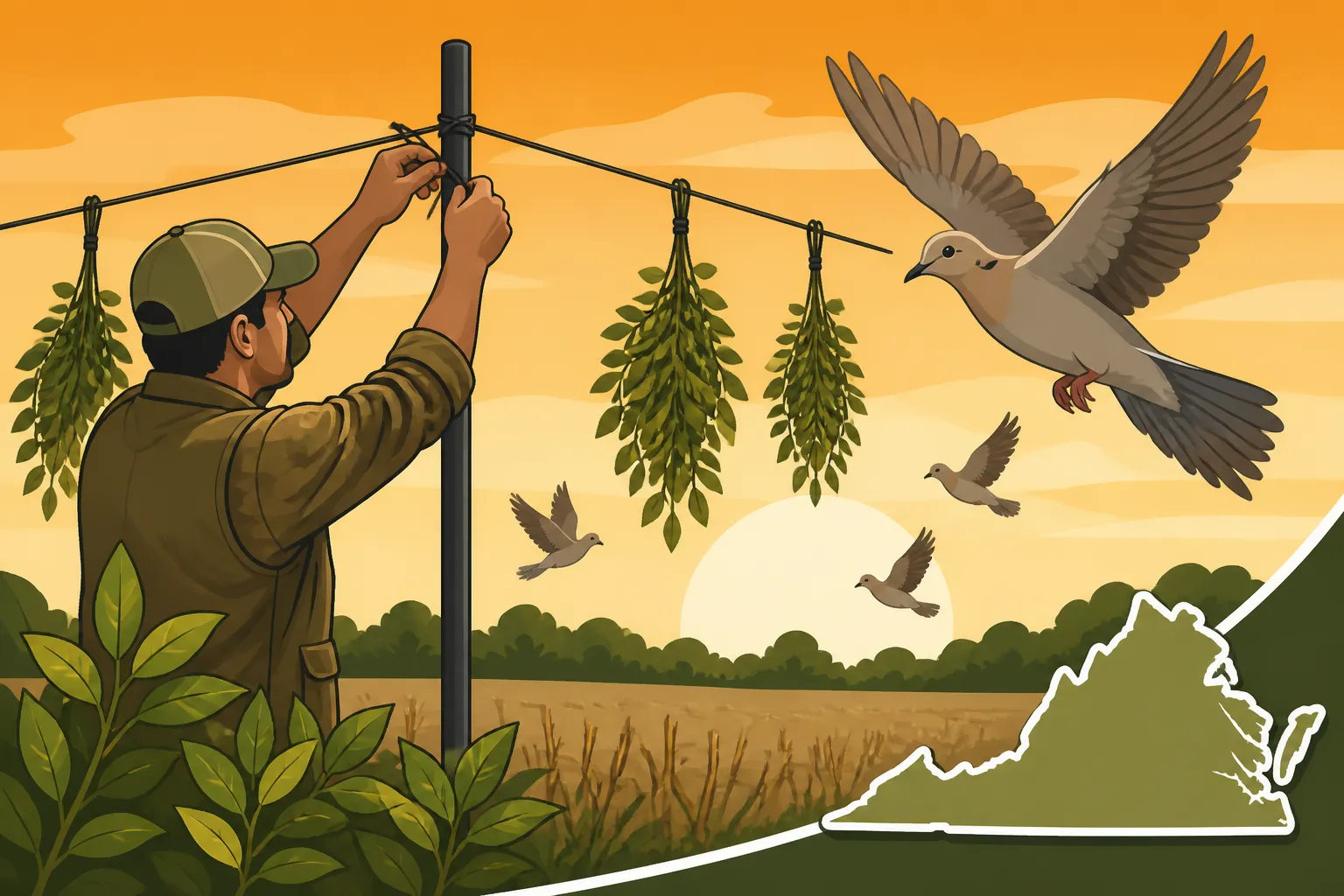
Elevated decoys, particularly spinning-wing decoys like the Mojo Dove, are game-changers. Their erratic movement catches a dove's eye from a distance, drawing them in for a closer look. Place these on poles or stands 3-5 feet off the ground, preferably in the middle of your spread or along a prominent flyway. While effective, be aware that heavily pressured birds may become wary of spinning wing decoys later in the season. Consider starting with one or two and adjusting based on bird reaction. Create a realistic "landing strip" in front of your blind, leading to your ground decoys. This gives incoming birds a clear, inviting path to commit to. If you are interested in further tactics using decoys, read Working a Dove Field on Opening Day for more detail.
Scouting the Flyways and Entry/Exit Points
Remember that pre-season scouting? This is where that information truly pays off. Doves often use consistent flight paths to enter and exit a field, usually following natural corridors like tree lines, creeks, or even subtle changes in topography. Identifying these "flyways" allows you to position yourself and other hunters (if you're hunting with a group) strategically to intercept birds.
On opening day, observe for the first hour or so without firing a shot, if possible. Watch how the birds are entering the field. Are they coming in low over the trees? Are they funneling through a specific saddle in the terrain? Are they coming from a particular direction, perhaps a nearby roost or water source that you identified earlier? Once you've identified these patterns, you can adjust your position or move hunters to better intercept these flight paths. A good strategy is to have hunters spread out along different potential flyways, ensuring that every incoming bird has a chance to be engaged, or at least redirected. If you're hunting over a water hole, specifically, tactics might differ, so check out Pass-Shooting Doves Over a Water Hole. Understanding these movements is akin to Reading Aerial Photos for Piedmont Deer—it's all about interpreting the landscape to predict animal movement.
Navigating Virginia's Rules and Regulations
No matter how perfectly you prepare your field, a successful and ethical hunt demands strict adherence to Virginia's hunting laws. Ignorance of the law is never an excuse, and violating regulations can lead to fines, loss of hunting privileges, and even confiscation of equipment.
Legalities of Field Preparation
As mentioned earlier, the most critical legal aspect for dove hunters in Virginia is the "baiting" rule. While it's perfectly legal to plant crops and then manipulate them (like mowing or disking) to make naturally grown seeds accessible to doves, it is illegal to scatter or place grain, salt, or other foods in a way that constitutes baiting. This isn't just about throwing out a pile of corn; it can also include leaving harvested grain where it doesn't normally occur as part of a normal agricultural operation.
The DWR's stance is generally that normal agricultural practices, such as harvesting, mechanical disking, or mowing standing crops, are permitted even if they incidentally attract doves. However, broadcasting seeds, placing feed, or dumping unharvested crops specifically to attract doves for hunting is illegal. For example, if you plant millet, you can mow strips of that millet field to expose the seeds. But you cannot simply scatter millet seeds on bare ground that was never planted with millet, or leave large piles of unharvested grain that are not part of a legitimate farming operation. When in doubt, always err on the side of caution. Contact a Virginia Department of Wildlife Resources (DWR) conservation police officer or check their official website for the most current and specific regulations regarding dove field preparation. This is crucial for avoiding legal trouble and ensuring your hunt is always above board.
Permits and Licenses
To legally hunt doves in Virginia, you'll need the proper licenses and certifications. This isn't just a suggestion; it's a hard requirement, and you can be checked by a conservation police officer at any time.
First and foremost, you'll need a valid Virginia hunting license. For residents, various options exist, including annual or multi-year licenses. Non-residents also have specific license options. In addition to the base hunting license, you must also purchase a Virginia Migratory Bird Hunting License and be Harvest Information Program (HIP) certified. HIP certification is free and simply involves answering a few questions about your migratory bird hunting activities from the previous year. This data helps wildlife agencies monitor populations and set regulations. Always carry proof of your licenses and HIP certification with you while hunting, whether it's a physical copy or stored digitally on your phone via the Go Outdoors Virginia app. For a deeper dive into general licensing, refer to Virginia Hunting Licenses and What They Cost. More specifically, make sure your Virginia HIP Certification for Bird Hunters is up to date.
Bag Limits and Shooting Hours
Finally, pay close attention to the daily bag limits and legal shooting hours for mourning doves in Virginia. These regulations are designed to manage the population sustainably and ensure fair chase.
The daily bag limit for mourning doves can change from year to year, so always consult the latest Virginia DWR regulations before heading out. Typically, it's a generous number, but you cannot exceed it. This limit applies to the birds you kill and possess in the field. The possession limit, which is how many doves you can have in your possession after multiple days of hunting, is usually higher than the daily bag limit.
Legal shooting hours for migratory game birds, including doves, typically begin one-half hour before sunrise and extend until sunset. Always check an official sunrise/sunset table for your specific location on the day of your hunt. Shooting outside of these hours is illegal. It's also important to note that these regulations apply to everyone in your hunting party. If one person exceeds the bag limit, or if shooting occurs outside of legal hours, the entire party could face consequences. By following these rules, you're not only protecting yourself legally but also contributing to the ethical and sustainable management of Virginia's dove population. Always stay informed about the Virginia Dove Daily Bag Limit before your hunt.
Disclaimer
Please note: Hunting regulations and seasons are subject to change. Always consult the latest Virginia Department of Wildlife Resources (DWR) regulations and local ordinances before engaging in any hunting activities. This guide is for informational purposes only and does not supersede official legal requirements.