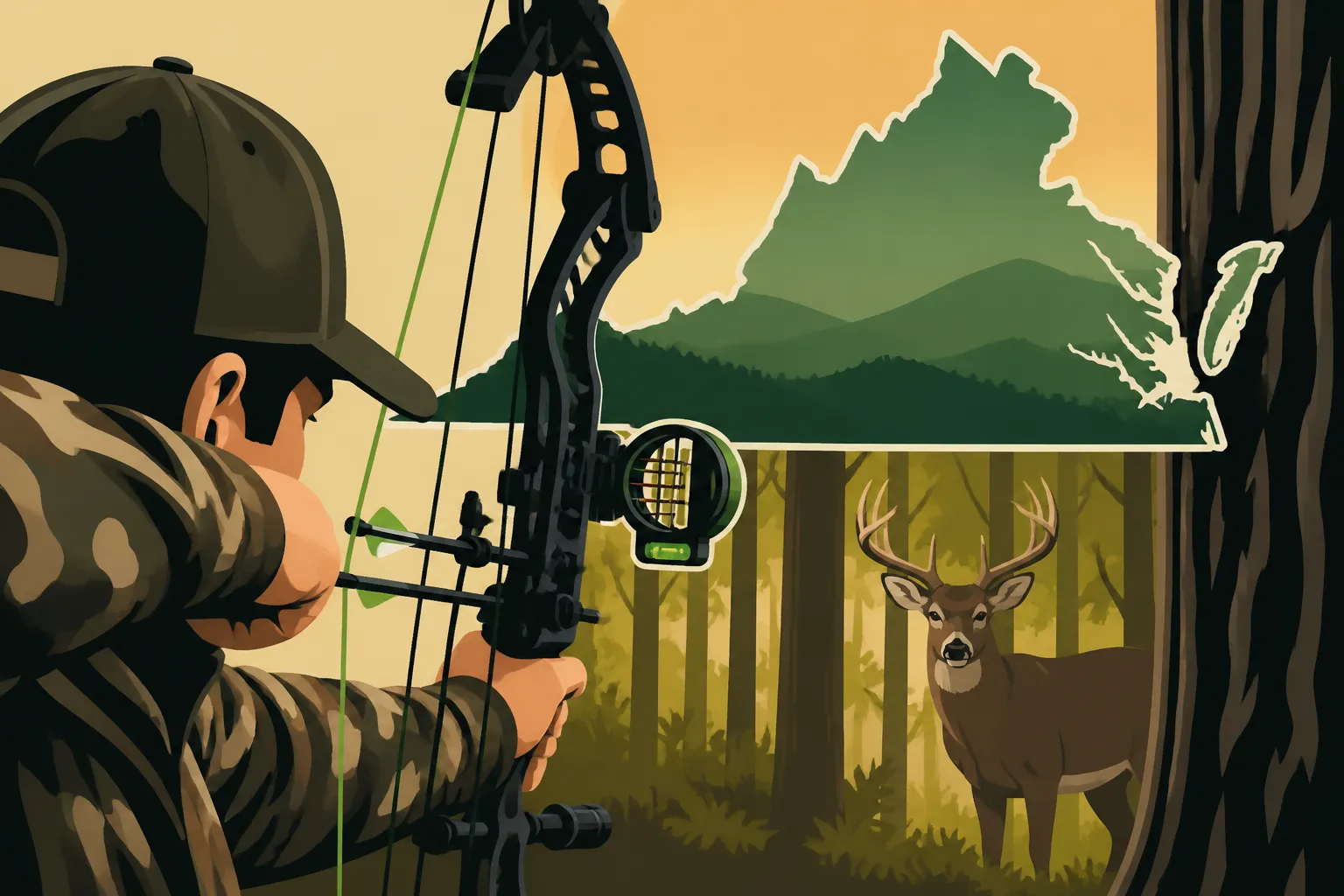
Bow Sights for Timber Shots
As a Virginia bowhunter, you know that feeling all too well: the sun just barely peeking over the ridge, the air thick with damp earth, and that buck steps out of the shadows at twenty yards, perfectly broadside. But in the dense timber of our mountains or the thick hardwoods of the Piedmont, those precious seconds before the shot can be a whirlwind of low light, cluttered lanes, and the pressure of making a precise, ethical shot. This guide is all about equipping you with the knowledge to choose, set up, and effectively use bow sights that excel when every fraction of an inch counts in our Virginia woodlands.
Understanding the Unique Challenges of Virginia's Timber Environment
Virginia's diverse hunting landscape means we encounter a lot of timber. From the steep, dark hollows of the George Washington National Forest to the sprawling private woodlots interspersed with agriculture in the Piedmont, hunting deer with a bow often means navigating tight spaces, limited visibility, and quick, close-range opportunities. It’s a far cry from open-country hunting, and your bow sight needs to be up to the task.
Low Light Conditions and Deep Shade
Anyone who’s spent time in a Virginia treestand knows that the best deer movement often happens in those magical low-light hours of dawn and dusk. But add in a thick canopy of oaks, maples, and pines, and "low light" quickly becomes "deep shade," even in the middle of the day. This is where standard bow sights can really falter. Pins that glow brightly in direct sunlight might disappear into a dull blur under dense timber, making it incredibly difficult to pick a precise aiming point on a deer's vitals. The struggle is real, and it’s a primary reason why specialized timber sights are so valuable. The ability to distinguish your pin clearly against a dark animal in a dark environment can be the difference between a clean shot and a missed opportunity.
Imagine sitting in a stand on the edge of a mature oak flat, just as the sun dips below the horizon. A deer steps into a small opening, but the surrounding timber has already swallowed the last remnants of daylight. If your pins aren't optimized for this kind of gloom, you might find yourself struggling to even acquire a target, let alone confidently place your shot. Many hunters find that resources like Virginia Public Land Hunting Hours really drive home the point about needing gear that performs at the very beginning and end of legal shooting light.
Short, Cluttered Shot Opportunities
Unlike hunting vast fields or Western open country, timber hunting in Virginia is defined by close encounters and tight shooting lanes. You might spend hours patiently waiting, only for a buck to materialize at 15 or 20 yards, moving quickly through thick brush. Your sight needs to allow for rapid target acquisition and a clear sight picture, even when you only have a small window to shoot through. Those precious few yards can be filled with small branches, saplings, and hanging vines that seem to appear out of nowhere, obstructing your shot.
This environment also means that your effective range is naturally reduced. While some archers can confidently shoot out to 60 or 70 yards in an open field, a 30-yard shot in dense timber can feel like a marathon. The sight system you choose should reflect this reality, emphasizing clarity and quick reference points for those common, closer distances. It's not about how far you can shoot, but how effectively you can shoot in the conditions you're actually hunting.
Angle and Elevation Challenges
Virginia's topography, especially in areas like the Blue Ridge Mountains or the rolling Piedmont hills, often means shooting from elevated positions or at steep angles. Whether you’re in a treestand perched high above a ravine or trying to get an arrow through a small gap while still-hunting a steep ridge, your bow sight needs to handle these challenges. Pins can appear to "jump" or be harder to settle when shooting at a sharp downward angle. Some sights incorporate level bubbles to help with cant, which becomes even more crucial when dealing with steep terrain.
When you're hanging a stand on a Hanging a Stand on a Jefferson Forest Ridge, you're often dealing with significant elevation changes that aren't present in flatter farmlands. A good timber sight will complement your ability to adjust for these angles, helping to mitigate the natural tendency to overshoot or undershoot in such situations. Practice shooting from various elevated positions, if safe and practical, is key to truly understanding how your sight performs under these conditions.
Key Features to Look for in a Timber Bow Sight
When you're outfitting your bow for the dense woodlands of Virginia, not just any sight will do. You need specific features that cater to the unique demands of timber hunting. These aren't just fancy add-ons; they're practical necessities that can significantly improve your accuracy and confidence when that moment of truth arrives.
Bright Fiber Optics and Pin Size
The cornerstone of any good timber sight is its ability to gather and transmit light effectively. You need pins that "pop" in low light, standing out clearly against a dark background. This comes down to the quality and length of the fiber optics. Longer, higher-quality fibers will collect more ambient light, making your pins brighter. Some sights feature a rheostat light, which allows you to fine-tune pin brightness—a critical feature when moving from bright sunlight to deep shade, preventing pin glare in one scenario and dim pins in another.
Consider also the size of your pins. While micro-pins might seem precise, in truly low light or against a dark animal, they can be incredibly hard to see. A slightly larger pin size, perhaps .019 or even .029 for the closest pin, can offer better visibility without sacrificing significant precision at typical timber ranges. The goal is a pin that's bright enough to see, but not so bright it creates a halo effect or "blooms" in your vision. This delicate balance is something hunters constantly evaluate, and even reviewing gear information on platforms like GoHunt can help you understand the nuances of different manufacturers' fiber optic systems.
Multiple Pins for Quick Range Referencing
In the timber, shots often happen fast. A deer might only offer a small window before disappearing behind cover. Having multiple fixed pins set at common hunting distances—say, 20, 30, and 40 yards—allows for instant range estimation and quick shot placement without the need to adjust a slider or rangefinder mid-draw. This speed is paramount when a whitetail suddenly appears and your shot opportunity is fleeting.
While single-pin slider sights offer ultimate precision at specific ranges, the time it takes to adjust them can cost you a shot in dense timber. With fixed multi-pins, you simply settle the appropriate pin on your target and release. Many experienced Virginia archers find a 3-pin or 5-pin setup ideal. A 3-pin system might cover your most common timber ranges, while a 5-pin offers a little more versatility if you occasionally hunt slightly more open areas, provided the extra pins don't clutter your sight picture. Knowing your ranges intimately with each pin is non-negotiable for consistent success.
Durable, Lightweight Construction
Bowhunting in Virginia often means covering serious ground. Whether you're hiking into a remote section of the Jefferson National Forest or still-hunting through a thick Piedmont woodlot, your gear takes a beating. Your bow sight needs to be robust enough to withstand bumps, drops, and the general abuse of the woods. Look for sights made from machined aluminum or other high-quality, impact-resistant materials. A heavy sight can also throw off your bow's balance, impacting accuracy, so lighter options are generally preferred.
The materials also need to stand up to the elements. Rain, humidity, and temperature swings are common throughout Virginia's archery season. A sight that fogs up or has pins that get easily knocked out of alignment after a wet sit is a huge liability. Investing in a durable, well-constructed sight ensures reliability season after season, giving you one less thing to worry about when you're focused on the hunt. For tips on general bow maintenance and setup, you might find valuable information in a guide like Bow and Crossbow Setups for Virginia.
Adjustable Second and Third Axis
This is a feature often overlooked by new bowhunters but is incredibly important, especially when shooting from a treestand or at steep angles. Second axis adjustment corrects for left-to-right cant when your bow isn't perfectly vertical. Third axis adjustment corrects for cant when shooting uphill or downhill. Without proper adjustment, your pins won't be truly in line, leading to consistent misses, especially at longer ranges or extreme angles.
Think about it: when you're perched in a treestand, sometimes you're not perfectly level. If your sight isn't properly adjusted for second and third axis, your horizontal pin placement can be off, even if your bubble is centered. This becomes even more critical when trying to shoot over or under obstacles in the timber. It's a technical adjustment, but one that ensures your arrow flies exactly where your pins are aimed, regardless of your shooting angle. Getting these adjustments dialed in is a crucial part of fine-tuning your Bowhunting Virginia's Statewide Archery Season setup.
Types of Bow Sights and Their Suitability for Timber
Choosing the right bow sight often comes down to personal preference, but certain types naturally lend themselves better to the specific challenges of timber hunting in Virginia. Let's break down the common options and why some shine brighter than others in the woods.
Fixed Multi-Pin Sights
For many Virginia timber hunters, fixed multi-pin sights are the gold standard, and for good reason. These sights come with several pins (typically 3, 5, or 7) that are set to specific distances, usually in 10-yard increments (e.g., 20, 30, 40, 50, 60 yards). The primary advantage here is speed. When a deer steps into a shooting lane at 30 yards, you simply pick your 30-yard pin and shoot. There's no ranging, no dialing, just aim and release. This is absolutely critical when hunting in an environment where shot opportunities can be fleeting.
The simplicity and reliability of fixed pins make them incredibly popular. They're robust, have fewer moving parts than slider sights, and once set, they stay put. For the vast majority of shots you'll take in Virginia's timber, a 3-pin or 5-pin setup provides all the necessary range coverage. You'll rarely get a clean, ethical shot beyond 40 or 50 yards in truly dense woods, making those closer pins your primary tools. Many hunters find that focusing on core distances rather than trying to cover every possible range with a single pin leads to more confident and accurate shots in the woods.
Single-Pin Slider Sights
Single-pin slider sights offer unmatched precision. With these, you have one adjustable pin that you can move up or down to dial in the exact yardage to your target. This means less "gapping" between pins at longer distances, theoretically offering a more precise aiming point. For open-country hunting or situations where you have ample time to range and adjust, they are fantastic. However, for the quick, close-range action often found in Virginia's timber, they present a significant drawback.
The biggest issue is the time it takes to adjust. If a buck walks into your shooting lane at 28 yards, you need to range it, then quietly and smoothly dial your pin to 28. In the time it takes to do this, that buck might have already walked through your narrow shooting window. While some hunters are incredibly proficient and quick with their single-pin sliders, the risk of missing a shot opportunity due to adjustment time is higher in the timber. If your hunting style involves long waits and very deliberate shots, a single-pin could work, but most will find themselves at a disadvantage during common timber encounters.
Hybrid Sights
Hybrid sights try to offer the best of both worlds. They typically feature a few fixed pins (say, 20 and 30 yards) for those quick, close shots, combined with a slider mechanism for a third pin that can be dialed to longer ranges. This gives you the rapid acquisition for common timber distances, plus the precision for the occasional longer shot if the scenario allows. It’s a versatile option that can appeal to hunters who spend time in both dense timber and slightly more open transitional areas.
For a hunter who might be Hunting a Funnel Between Two Hollows, where shots could be 20 yards in the thick stuff or 45 yards across a small clearing, a hybrid sight offers excellent adaptability. You have your fixed pins for instant action, and if a longer, slower shot presents itself, you can still dial in that third pin for precision. The trade-off is often a slightly more complex sight picture than a pure multi-pin, and a bit more weight due to the extra mechanisms. However, for many, the versatility is worth it, allowing them to confidently hunt various Virginia terrains without changing their setup.
Here's a quick comparison of the sight types for timber hunting:
| Feature/Type | Fixed Multi-Pin | Single-Pin Slider | Hybrid Sights |
|---|---|---|---|
| Speed of Use | Excellent | Slow (requires adjustment) | Good (fixed pins for quick shots) |
| Precision | Good (gap shooting) | Excellent (exact yardage) | Good (fixed for close, slider for distant) |
| Low Light Visibility | Excellent (multiple bright pins) | Excellent (one bright pin) | Excellent (multiple bright pins) |
| Durability | Very Good | Good (more moving parts) | Good (more moving parts) |
| Best for Timber | Highly Recommended | Less Recommended | Recommended (versatile) |
| Typical Ranges | 20-60 yards | Any range (dialed) | 20-30 yards fixed, 40+ dialed |
Setting Up and Practicing with Your Timber Sight
Having the right bow sight is only half the battle. To truly excel in Virginia's timber, you need to properly set up your sight and dedicate time to practice in conditions that mimic your actual hunting scenarios. This isn't just about sending arrows downrange; it's about building confidence and muscle memory for those high-stakes moments.
Precise Pin Calibration and Zeroing
Once you've mounted your chosen timber sight, the most critical step is to accurately calibrate each pin. Start by establishing your 20-yard pin. Shoot a small group, adjust, and repeat until your arrows are consistently hitting dead center. Then move to 30 yards, then 40, and so on. Make sure to use the exact arrows and broadheads you plan to hunt with, as practice points can fly differently than broadheads. Take your time with this process; precision here pays dividends in the field.
After setting your pins, check your second and third axis adjustments if your sight has them. This is crucial for shooting from an elevated position, such as a treestand. A perfectly level bow is rare when you're perched twenty feet up, twisted around to make a shot. Tools like a bow vise and a high-quality level kit can make these adjustments much easier. Remember, every little bit of precision you build into your setup reduces variables when a deer is in front of you. Many bowhunters consult detailed guides on their specific sight model, and online resources like GoHunt often have user-submitted tutorials or manufacturer specifications that can be helpful.
Practicing in Realistic Timber Conditions
This is where many hunters fall short. It's great to shoot tight groups at the range, but the range doesn't have swaying branches, thick shadows, or a deer walking through a narrow gap. Take your practice into the woods or a natural setting. Set up targets at varying, unknown distances, forcing yourself to quickly estimate range and select the correct pin. Practice shooting from elevated positions—either from an actual treestand or a platform—to simulate real hunting angles.
Practice shooting during those low-light periods that match prime hunting times. This will help you understand how well your fiber optics perform and if your pins are truly visible when the sun is barely up or nearly set. Simulate the quick draw and shot process. Have a friend walk a target into a shooting lane, requiring you to draw, acquire, and shoot within seconds. This kind of pressure simulation builds the mental toughness and physical coordination needed for success in the timber. It helps you recognize where your "effective range" truly ends in challenging conditions, especially when considering variables like Wind and Thermals on a Blue Ridge Slope.
Incorporating Scent Control and Quiet Movement
While not directly related to your bow sight, your ability to get into position undetected significantly impacts your shot opportunities in the timber. Even the best sight in the world is useless if a deer busts you before you can even draw your bow. Make sure your clothing and gear are quiet, preventing snags or rustles that could alert a deer. Practice drawing your bow silently, ensuring no part of your setup scrapes or squeaks.
Utilize scent control strategies, especially when hunting in tight quarters. Human odor can travel far, particularly in still morning air or downwind thermals. Think about your approach to the stand, your scent elimination routine, and how you handle your gear. Combining a perfectly tuned bow and sight with impeccable woodsmanship is the recipe for success in Virginia's challenging timber. Articles like Scent Control Gear for Urban Archery Hunts can offer some universal tips that apply well beyond city limits.
Disclaimer
This article is for general informational purposes only and does not constitute professional advice. Laws, prices and regulations vary by location and change over time. Consult a qualified professional for guidance on your specific situation.