Wind and Thermals on a Blue Ridge Slope
There's nothing quite like the beauty of hunting Virginia's Blue Ridge Mountains, but the stunning views come with a challenging reality: incredibly shifty winds. You can pour hours into scouting, find the perfect sign, and set up your stand feeling confident, only to have a sudden shift in air currents blow your scent right to the deer you're pursuing. It’s a frustrating experience many mountain hunters know all too well, costing us opportunities time and again. This guide is here to unravel the mysteries of mountain wind and thermals, helping you understand, predict, and ultimately hunt more effectively on those tricky Blue Ridge slopes.
Understanding the Basics of Mountain Air Movement
Hunting in the mountains means constantly battling the unseen forces of wind and thermals, which are often more complex and dynamic than in flatter terrain. Unlike the relatively consistent winds you might find on a wide-open field or in dense, flat timber, mountain air currents are influenced by elevation changes, sunlight, shade, and topographical features in ways that can feel utterly unpredictable. But with a little understanding of the science, they become a whole lot less mysterious.
How Thermals Work in the Blue Ridge
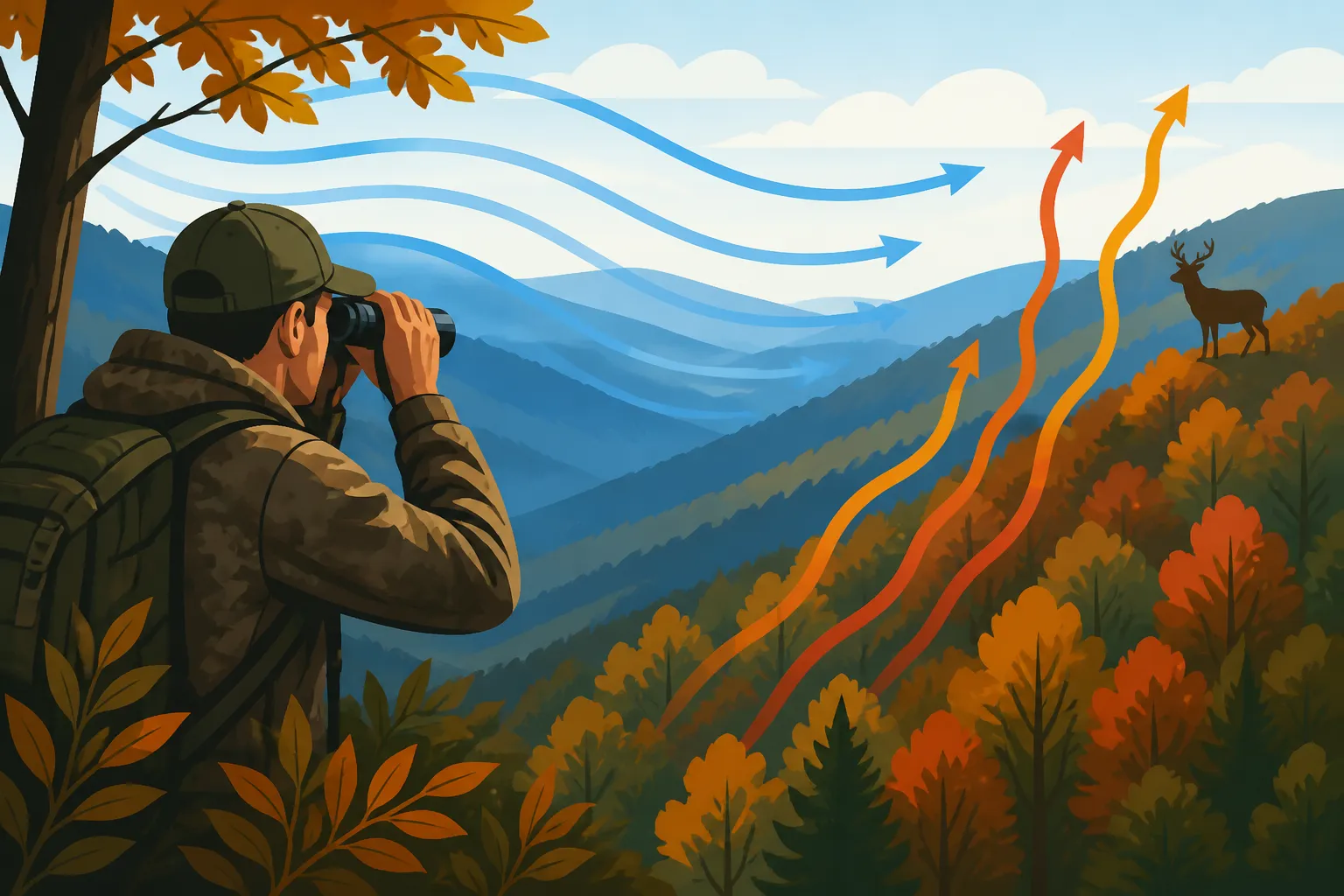
Thermals are essentially localized air currents driven by temperature differences, and they play a massive role in how scent moves through the mountains. Think of them as the mountain's breath, inhaling in the morning and exhaling in the evening.
As the sun begins to climb over the Blue Ridge in the morning, it hits the eastern slopes first, warming the ground and the air directly above it. This warm air, being lighter, starts to rise, creating an uphill thermal. If you're set up on a ridge or slope on an east-facing aspect, your scent will generally be carried uphill with this rising air. This is why many hunters prefer to climb high before dawn, setting up to catch deer moving up from lower bedding areas, knowing their scent will rise harmlessly above them. However, this also means if you're trying to sneak up a ridge in the morning, your scent is preceding you directly into areas deer might be.
As the day progresses and the sun moves higher, the thermals get stronger, pulling air from lower elevations and funnelling it upward through draws and hollows. Then, as the afternoon wears on and the sun begins to set, the process reverses. The slopes start to cool, and the heavier, cooler air begins to sink, creating a downhill thermal. This is when your scent will generally be carried downhill into the valleys and hollows. This phenomenon makes evening hunts especially tricky if you're trying to intercept deer moving down from bedding areas to feeding grounds, as your scent will likely precede you down the slope. Experienced hunters often plan their afternoon hunts to be just off the main travel corridors, allowing the settling evening thermals to pull their scent away from the deer's likely approach.
The Role of Prevailing Winds
While thermals are a daily cycle dictated by the sun, prevailing winds are the larger, regional air currents driven by weather systems. These are the winds you see on a general weather forecast – a northwest wind, a southwest wind, etc. In mountainous terrain, these prevailing winds don't just blow in a straight line; they interact with the topography in fascinating and often frustrating ways.
A strong prevailing wind can, at times, override thermals, pushing air consistently in one direction regardless of the sun's position. This can feel like a relief when you get that consistent breeze. However, the Blue Ridge is rarely that simple. When a strong prevailing wind hits a mountain, it doesn't just go over it. It gets deflected, funneled, and swirled. One side of a ridge might be experiencing a strong, consistent wind, while the other side, in what's known as a "wind shadow," might have swirling, unpredictable air currents. Imagine a westerly wind hitting an east-west running ridge. The west side will be blasted, but the east side could be relatively calm, with small, localized thermals still playing a role, creating a pocket of swirling air perfect for giving away your presence.
This interaction is why just checking your phone's general wind forecast isn't enough. It's a critical piece of the puzzle, but you need to understand how that overall wind will behave once it encounters the specific peaks, valleys, and slopes of your hunting area. Using tools like GoHunt, which can integrate detailed topographic maps with real-time wind overlays, can give you a much better predictive model than a simple weather app. This kind of detailed information, alongside your own observations, helps you mentally map out where the wind will be predictable and where it might be a swirling mess, making all the difference for a successful hunt.
Reading the Landscape for Wind Patterns
Successfully hunting a Blue Ridge slope isn't just about knowing how thermals and prevailing winds work; it's about understanding how the specific contours of the land will channel, block, and swirl those air currents. The mountain itself becomes a giant, complex wind tunnel, and learning to read its features is paramount.
Ridgelines and Saddles: Predictable Funnels
When you're dealing with the broad expanse of the Blue Ridge, certain terrain features act as natural funnels or barriers for air movement, and knowing them can give you a significant advantage. Ridgelines, especially long, continuous ones, tend to offer the most predictable wind patterns. Air moving over a ridge will typically follow its contour, often making the wind on the top and downwind side more consistent. This predictability can be a hunter's best friend.
Saddles, those lower dips or passes along a ridgeline, are particularly interesting. They act like natural highways for deer, funneling them through the easiest path between two higher points. But they also act as powerful wind tunnels. A prevailing wind that might be broad and diffuse across the general landscape will often compress and accelerate as it’s forced through a saddle. This can create a very strong, consistent wind direction through that saddle, making it an excellent place to set up if you can position yourself on the downwind side, far enough away to avoid being smelled by deer moving through the funnel. However, if the wind is swirling or inconsistent, a saddle can be a nightmare, as your scent could be blown in multiple directions at once. This is where scouting applications, like GoHunt's detailed topographic maps, combined with an understanding of prevailing winds, become invaluable. You can virtually scout these critical junctures and plan your approach before you even step foot in the woods, helping you find those ideal treestand setups in George Washington National Forest or other public lands.
When considering a stand site on a ridgeline, think about the wind direction relative to deer travel. If deer are typically moving along the top of the ridge, you'll want to be set up slightly below the crest on the downwind side, allowing your scent to be carried away from their path. This also applies when trying to intercept deer moving from one side of a mountain to another; a saddle becomes a crucial pinch point. Understanding these dynamics is key to success, especially when you're still-hunting Jefferson Forest ridges, where stealth and scent control are paramount.
Hollows, Benches, and Draws: Complex Swirls
While ridgelines and saddles can offer predictable wind scenarios, hollows, benches, and draws are often where the mountain winds become truly maddening. These recessed or varied elevation features tend to trap and swirl air currents, making consistent scent control a significant challenge.
Hollows, for instance, are natural bowls or depressions in the terrain. Air tends to get trapped in these areas, especially during periods of light wind. A morning thermal might pull scent up the sides of a hollow, but then as the day warms, the air can swirl unpredictably within the basin. Even a light breeze over the top can create eddy currents, making it nearly impossible to keep your scent from swirling in all directions. If you're trying to fill three antlerless tags before the rut, these areas can be productive due to higher deer densities, but the wind challenge is real.
Draws, which are essentially elongated hollows or small valleys that lead up a hillside, act as natural funnels for both deer and air. While they can be prime travel corridors for deer moving between feeding and bedding areas, they are also notorious for swirling winds. An uphill thermal can be very strong in a draw in the morning, but a slight crosswind or an eddy created by terrain features can cause your scent to bounce around inside the draw before being carried away. Imagine trying to hunt a funnel between two hollows; if you don't account for the complex air currents, your setup might be compromised instantly.
Benches, which are flatter sections on a steep slope, are often overlooked bedding or travel areas for deer. They can offer a temporary respite from the unpredictable swirling, but they are still subject to the larger thermal and prevailing wind patterns. A deer bedded on a bench might be able to smell anything coming from below or above, especially if the wind is light. The key to hunting these complex areas is often a highly mobile approach, like still-hunting, and constant vigilance with a wind checker. Knowing where George Washington Forest bucks bed will only help if you can get there undetected, and wind is often the primary factor in that equation.
Practical Strategies for Hunting Windy Slopes
Navigating the challenging winds and thermals of the Blue Ridge requires more than just understanding them; it demands a strategic approach to your hunt, from planning your entry to selecting your stand site and using the right gear. It's about minimizing your footprint and maximizing your chances in an environment that often seems to conspire against you.
Planning Your Approach and Exit Routes
The moment you step out of your vehicle, you're interacting with the mountain's air currents. Your approach and exit routes are just as critical as your stand location. A perfectly placed stand is useless if deer smell you on your way in or out. The general rule is to always approach and exit with the wind or thermal in your favor, carrying your scent away from where you expect deer to be.
For a morning hunt, this often means hiking in while the thermals are still going downhill (before the sun hits the slopes), or waiting until they reverse and start to pull uphill, carrying your scent above the deer you're trying to intercept. If you're targeting a ridge top, plan to approach from the downwind side or use a contour that keeps you below the main deer travel until you reach your stand. For an evening hunt, you might want to approach from below your target area, allowing rising thermals to carry your scent up and over before they begin to fall with the setting sun.
A common mistake is to simply take the easiest or shortest path to a stand. In the mountains, the easiest path is often the one that compromises your hunt. Study your maps meticulously using a tool like GoHunt. Look for routes that utilize existing topography to block or carry your scent harmlessly. Sometimes, this means adding significant distance to your walk or taking a circuitous route. For example, if you know you want to hunt a specific north-facing slope with a southerly prevailing wind, your approach might involve circling around to come in from the north, even if it feels counterintuitive on the map. Remember that hunting pressure on Virginia public land can make deer even warier of inconsistent winds, so your entry and exit need to be flawless.
Adjusting Stand Placement and Hunting Tactics
Once you understand the basics and have a plan for your approach, the next step is adapting your actual hunting setup and tactics. This is where the rubber meets the road, and where flexibility truly pays off.
One of the most important lessons in mountain hunting is that your "perfect" stand might only be perfect for a specific wind direction and time of day. Instead of one perfect spot, aim for several strategic locations for different scenarios. For example, you might have a stand for a north wind, another for a south wind, and yet another for a calm, thermal-dependent morning. A good rule of thumb is to hunt the edges of known deer travel or bedding areas, allowing the prevailing wind or thermal to carry your scent away from the core of their activity.
Here's a quick reference for common Blue Ridge wind scenarios and tactics:
| Scenario | Typical Wind/Thermal Behavior | Recommended Tactic |
|---|---|---|
| Early Morning (Sunrise) | Downhill thermals usually strongest until sun hits slope. | Approach from above, set up slightly below ridge crest on lee side. Scent drops away from deer moving up. |
| Late Morning/Midday | Uphill thermals strengthen as sun warms slopes. Prevailing wind often overrides. | Set up high on a ridge or bench. Scent carried upwards. Look for wind-protected bedding areas or travel routes. |
| Late Afternoon (Sunset) | Uphill thermals weaken, downhill thermals start to settle. | Approach from below, set up slightly above deer travel. Scent drops away as deer move down. |
| Strong Prevailing Wind | Dominates thermals, but still creates wind shadows and funnels. | Hunt the downwind side of ridges, in saddles, or use the edge of a wind shadow. Be mindful of swirling. |
| Light/Variable Wind | Thermals dictate scent movement more strongly, very unpredictable. | Mobile hunting (still-hunting), frequent wind checks, stick to areas with clear thermal drainage like creek bottoms. |
For morning hunts, consider setting up high on a ridge or bench, allowing the rising thermals to carry your scent up and over the mountain. When reading a ridge for Blue Ridge deer, remember that deer often travel just below the crest on the downwind side, especially on windy days. You might need to adjust your setup to be a bit lower than you initially thought to intercept them.
In the afternoon, as those thermals reverse, you might want to consider Still-Hunting Jefferson Forest Ridges or hunting the bottom of draws where deer are moving down towards feeding areas, again ensuring your scent is carried away from their path by the now-falling air. Sometimes, sitting a field edge in late season can offer more consistent wind, but in the mountains, it's rarely that simple. Don't be afraid to move your setup if the wind shifts unexpectedly; sometimes, even a 50-yard relocation can put you in a much better position.
Using Technology and Scent Control
In today's hunting world, technology can be a powerful ally in the battle against unpredictable winds. While nothing replaces in-field experience, modern tools can give you a significant edge.
Beyond general weather apps, look for hunting-specific applications like GoHunt that integrate detailed topographic maps with real-time and forecasted wind data. These apps often allow you to see wind direction and speed at different elevations, which is invaluable for predicting how air will flow over the Blue Ridge's complex terrain. Some even offer "wind checker" features that simulate scent dispersion based on the topography, helping you visualize your scent cone. Remember that even with the best technology, you need to verify in the field. Carry a small, sensitive wind checker (powder or milkweed seeds are excellent) and use it constantly, especially when you pause to glass a powerline cut at last light or scan for movement.
Scent control is, of course, a paramount concern, particularly when dealing with swirling mountain winds. While no product can completely eliminate your scent, a multi-pronged approach helps significantly:
- Hygiene: Shower with scent-free soap and shampoo before your hunt.
- Laundry: Wash all hunting clothes in scent-free detergent and store them in airtight containers or bags.
- Cover Scents/Eliminators: Use sprays or wafers as an added layer of defense, but understand they are not a substitute for proper wind management.
- Layering: Wear appropriate clothing, such as wool or synthetics, to manage sweat, as body odor is a primary scent source.
It's also worth noting the evolving technology around Thermal and Night Vision Rules in Virginia. While these tools are typically for spotting animals, understanding how heat signatures interact with air currents can further inform your knowledge of thermals, even if you're not using them for active hunting. Ultimately, the best defense against shifty mountain winds is an active offense: constant awareness, flexible tactics, and a deep understanding of how the land and air interact.
Disclaimer
Hunting is an inherently dangerous activity. This guide provides information for educational purposes only and does not guarantee success or safety. Always consult the most current Virginia Department of Wildlife Resources (DWR) regulations before hunting, prioritize safety, and hunt ethically and responsibly.