Hunting a Funnel Between Two Hollows
The challenge of consistently finding and intercepting Virginia's whitetails can often feel like a puzzle, especially in areas with varied topography. Deer rarely move randomly; instead, they opt for paths of least resistance that offer safety and efficiency, often leading them through natural bottlenecks. This comprehensive guide will walk you through the nuances of identifying, scouting, and effectively hunting these prime locations: funnels situated between two hollows.
Understanding Funnels and Hollows in Virginia Terrain
Virginia's diverse landscape, from the steep ridges of the Blue Ridge to the rolling hills of the Piedmont and the flatlands of the Tidewater, is rife with hollows. Understanding these features and how deer utilize them is the first step to pinpointing those crucial funnels.
Defining Hollows and Their Role
In Virginia, "hollows" often refer to drainages, ravines, or low-lying areas that typically run off larger ridges or hillsides. These natural depressions are usually characterized by dense vegetation, sometimes a seasonal or year-round water source, and offer a significant degree of thermal cover and security for deer. Think of them as natural hideaways where deer can bed down, escape the wind or sun, and move relatively unpressured.
Deer use hollows extensively for several reasons. During the day, they provide excellent bedding cover, especially on the leeward side of a ridge where they are protected from prevailing winds. In the heat of early season, cooler, shaded hollows with access to water are prime spots. Conversely, in late-season cold, hollows can offer thermal protection from harsh winds. They also serve as important travel corridors, particularly along the bottom or lower edges, allowing deer to move between different parts of their home range with minimal exposure. Many of the big bucks harvested in areas like the George Washington National Forest are often found traveling in or out of these secluded hollows.
What Makes a Funnel Between Hollows?
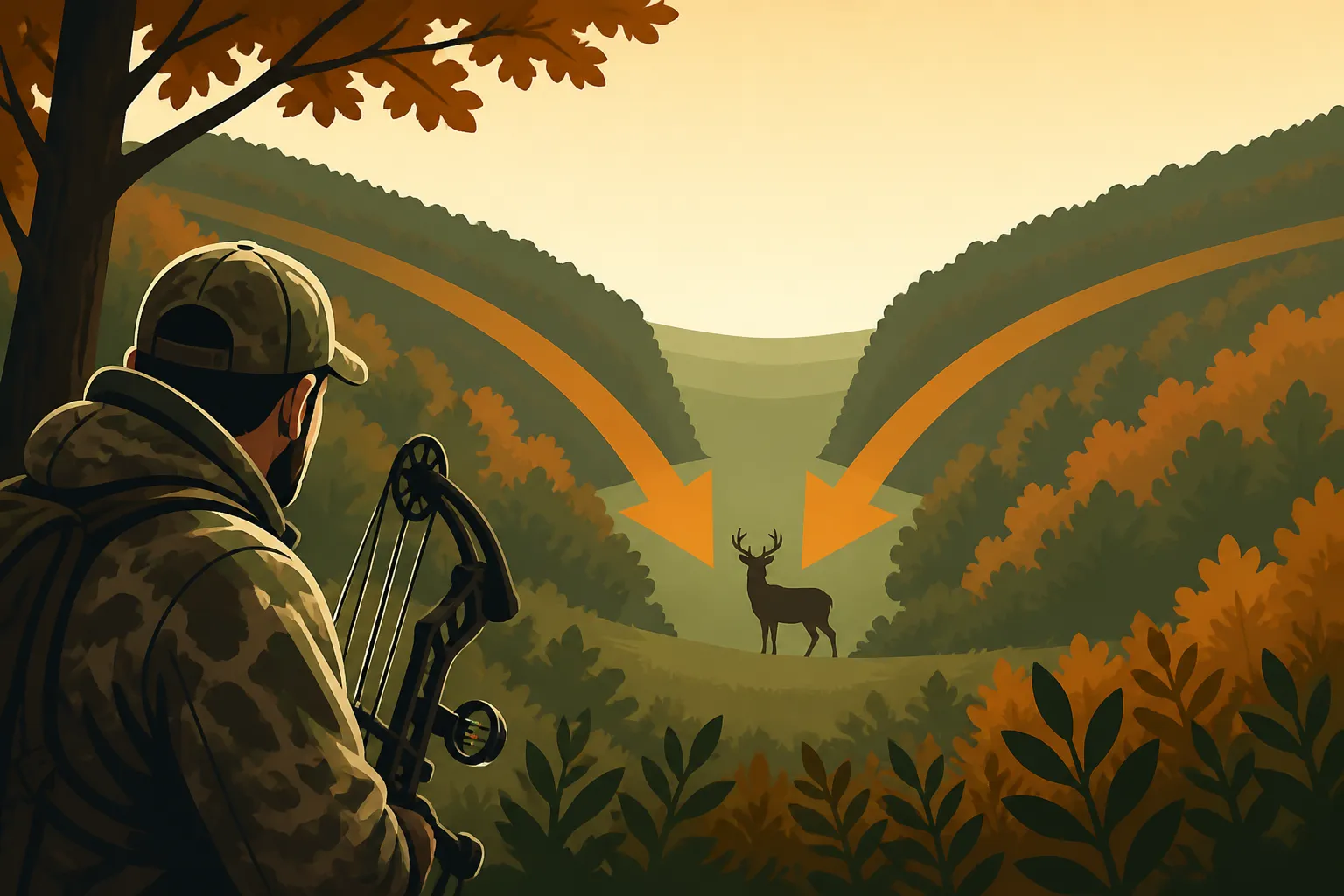
A funnel, at its heart, is any landscape feature that constricts deer movement into a narrower, more predictable path. When you combine this with the natural travel patterns associated with hollows, you uncover incredibly high-percentage hunting spots. A funnel between two hollows specifically implies a feature that connects these otherwise separate areas of cover or travel.
Imagine two deep hollows running parallel or converging, both holding deer. What connects them? It could be a subtle saddle on a ridge line where the elevation briefly drops, forming a natural cross-over point. It might be a narrow bench or a flat spot on a steep hillside that offers easier footing than the extreme slopes above and below. Sometimes, it's a hard-to-spot pinch point formed by rock outcroppings, thick laurel thickets, or even changes in timber type that force deer into a very specific, narrow path as they traverse from one hollow to another. For example, a saddle between two large mountain hollows in Western Virginia is a classic example of a funnel. On the other hand, in the Piedmont, it might be a narrow strip of hardwoods connecting two dense swampy bottoms. These are the places deer have to travel through, making them predictable ambush sites.
Scouting for Productive Funnels
Finding these funnels isn't always obvious from the road. It requires a combination of modern mapping tools and old-fashioned boots-on-the-ground effort.
Topographical Map and Aerial Imagery Analysis
Before you ever step foot in the woods, the best place to start is with good mapping software. Tools like GoHunt, onX Maps, or even the Virginia DWR's Go Outdoors map tool are invaluable. These platforms allow you to overlay topographical maps with aerial imagery, giving you a bird's-eye view of the terrain.
When looking at a topo map, pay close attention to contour lines. Look for areas where contour lines pinch together, indicating steep terrain, or spread out, indicating flatter ground. A saddle will appear as a dip in a ridge line where contour lines form an hourglass shape. Identify drainages – these are your hollows. Then, look for those narrow strips of land, slight elevation changes, or natural breaks in the contour lines that connect one drainage to another. Aerial imagery helps you confirm what you see on the topo. Are there distinct changes in vegetation that might create a natural travel lane? For instance, a narrow strip of mature timber between two clear-cuts, or a small field edge bordering two creek bottoms. I often spend hours on the computer, marking potential funnels with pins, looking for those subtle topographical cues that scream "deer highway." This initial remote scouting is a crucial step in preparing for any hunt, especially if you're Scouting Virginia Public Land Before Season.
Boots-on-the-Ground Reconnaissance
Once you've identified potential funnels on your map, it's time to hit the woods. Nothing beats firsthand observation. Head out in the off-season or during midday to avoid disturbing deer. Your goal is to confirm your map findings and identify actual deer sign.
Look for heavily worn trails. Deer are creatures of habit, and their preferred paths will be evident, especially where soft ground or leaf litter shows impressions. Seek out rubs and scrapes, which are clear indicators of buck activity. Scrapes along a logging road or the edge of a funnel during the early fall can signal a hotspot. Check for fresh droppings and tracks. The size and freshness of tracks can tell you what kind of deer are using the funnel and how recently. Pay close attention to the entrance and exit points of the hollows and how they connect to the funnel. Are there bedding areas on the higher ground surrounding the hollows? Are there clear travel corridors leading from those beds, through the funnel, and towards potential food sources or water? This is where you can truly differentiate a theoretical funnel from an active deer highway. Learning to interpret the subtle clues deer leave behind, like those you find when Reading Virginia Mud for Fresh Deer Movement, will dramatically increase your success.
Strategic Stand Placement and Wind Considerations
Successfully hunting a funnel is less about luck and more about precise stand placement and an intimate understanding of wind and thermals. Your goal is to be invisible, unheard, and unscented.
Identifying Key Ambush Points
Once you've confirmed an active funnel, the next step is to choose your stand location. This is where many hunters make or break their hunt. You need to position yourself to intercept deer as they move through the funnel, often without them knowing you're there. Look for natural pinch points within the funnel itself. This might be a downed log they step over, a tight bend in a trail, or a section where the cover is particularly dense on one side, forcing them closer to the other.
Consider your shooting lanes. Can you get a clear shot at various distances where deer are likely to pass? This means trimming branches beforehand, if allowed on public land, or choosing a spot where natural openings exist. Think about your backdrop: are you silhouetted against the sky, or do you blend into the trees? If you're on a ridge or saddle, setting up just below the crest can help break up your outline. For areas with mature trees, a well-placed treestand offers an elevated advantage, providing a better view and helping to carry your scent over deer. However, if the timber is sparse or you need to be quickly mobile, a ground blind brushed into natural cover can be incredibly effective, especially when hunting close to the trail. Remember, whether it's Treestand Setups in George Washington National Forest or Using a Ground Blind on Virginia Public Land, visibility and concealment are paramount.
Playing the Wind and Thermals
In Virginia's varied terrain, especially with hollows involved, wind and thermals are your biggest allies or worst enemies. Understanding them is non-negotiable. Thermals are air currents created by temperature changes. In the morning, as the sun warms the earth, air rises, carrying your scent up the hillside. In the evening, as the air cools, it sinks, carrying your scent down into the hollows.
When setting up on a funnel between two hollows, you must consider both the prevailing wind direction and the thermal currents. If deer are bedding in the hollows and moving up towards a ridge-top food source, you might want to hunt a morning thermal that carries your scent away from their bedding area as they move up. Conversely, for an evening hunt, you might want a thermal that pulls your scent down into the hollow after they've moved out. Always try to position yourself so that your scent cone is blowing away from where you expect deer to come from or travel to. Often, this means setting up on the leeward side of the funnel or ridge. Don't underestimate how wind eddies and swirls in draws and hollows can betray your position. Before every hunt, check the forecast and have multiple stand locations ready for different wind scenarios. This careful consideration of Wind and Thermals on a Blue Ridge Slope is what separates consistent hunters from those who just get lucky.
Tactics for Hunting Funnels Effectively
Even with the perfect stand, your approach and timing can make all the difference. Funnels are magnets for deer, but they can also be areas of high alert for wary animals.
Entry and Exit Strategies
Getting to and from your stand without spooking deer is critical, especially when hunting a tight funnel. A sloppy entry can ruin an entire hunt before it even begins. Plan your routes carefully, using terrain features, creek beds, or dense cover to conceal your movement. If possible, approach from a direction that puts the wind in your favor, or at least neutral, for your walk-in. I often try to use the lowest point of a hollow, or a natural drainage feature, as my path in, knowing that deer are less likely to be in the very bottom during travel times.
Exit strategies are equally important. If you shoot a deer and need to track it, your exit will be different. But for a normal sit, try to wait until deer activity has subsided or until dark to climb down. If you're hunting an evening sit, try to slip out along a contour line or through thick cover that keeps you off the main travel routes. The goal is to leave the area undisturbed for your next hunt. Repeatedly bumping deer on your way in or out will quickly teach them to avoid that funnel during hunting hours.
Timing Your Hunt
Funnels are productive throughout the hunting season, but when you hunt them can significantly impact your success. During the early archery season in September and October, deer are often still on a relatively predictable pattern of food to bed. Find the funnels connecting these key resources, and you'll find deer. As the season progresses into late October and especially into November, when the Hunting the Virginia Rut in November kicks in, funnels become absolutely explosive. Bucks are constantly cruising, looking for does, and they will utilize these natural travel corridors heavily. This is when a small saddle or pinch point between two hollows can become a parade ground for bucks of all sizes.
Even in the late season, after the rut, funnels remain important as deer shift their focus back to food and survival. They will use funnels to move between remaining Late-Season Food Sources for Virginia Whitetails and thick cover. A cold front or a fresh snowfall can also trigger increased movement through funnels as deer seek out food or better shelter. Pay attention to weather patterns and historical deer activity to time your hunts effectively. A reliable tool like GoHunt can provide historical harvest data and weather overlays to help you make informed decisions about when to be in the stand.
Maximizing Your Setup
Once you're in your stand, maximizing your setup involves more than just sitting still. Consider incorporating calling, scents, and ensuring you are ready for action at all times. A well-placed grunt or doe bleat can sometimes stop a cruising buck just long enough for a shot, especially if he's following a trail through your funnel. Techniques like Rattling and Grunting in Virginia can be particularly effective during the pre-rut and rut, mimicking deer activity in a high-traffic area.
Think about using a decoy if legal and appropriate for your setup, or at least some scent wicks with doe estrus or curiosity scents during the rut. Just be mindful of wind direction so your scent isn't being carried to where you don't want it. Most importantly, stay vigilant. Deer can appear silently and quickly in a funnel. Be prepared to draw your bow or raise your rifle instantly. Having multiple stand locations for different wind directions, or even a flexible mobile setup, allows you to adapt to changing conditions and keeps the pressure off any single spot. Remember, the areas surrounding these hollows, especially where bucks may bed, such as Where George Washington Forest Bucks Bed, are often connected by these very funnels, making your careful preparation even more vital.
Here's a quick comparison of different types of funnels you might encounter and how they generally fish:
| Funnel Type | Description | Key Characteristics | Best Hunting Conditions | Typical Deer Movement |
|---|---|---|---|---|
| Ridge-Top Saddle | A low point or dip on a ridge connecting two higher points, often between two drainages/hollows. | Natural travel lane, often well-worn trails, can be exposed. | Rut, transition between food/bedding, steady crosswind. | Bucks cruising for does, deer moving between adjacent hollows/valleys. |
| Terrain Pinch Point | A narrow strip of land, rock outcropping, or dense vegetation forcing deer through a very specific, tight corridor. | Very defined, limited options for deer movement, high predictability. | Any time deer are moving, especially during feeding/bedding transitions. | Straight-line travel, often at a slower pace due to constriction. |
| Creek Bottom/Drainage | A narrow section of a creek bed or drainage that provides easy travel through dense cover or steep terrain. | Often cooler, can have water, provides cover, good for quiet entry/exit. | Early season (heat), late season (cover), after rain (quiet movement). | Along water source, often for bedding to water/food transitions. |
| Bench/Terrace | A relatively flat, horizontal strip of ground on a steep hillside, offering easier footing than the slopes above or below. | Provides level travel, often less visibility from above/below, can be subtle. | Anytime deer are traversing steep slopes, especially during feeding/bedding. | Contoured travel, often parallel to the hillside. |
| Vegetation Line | A distinct change in timber type or density (e.g., edge of clear-cut, thicket line) that directs deer movement. | Offers cover along one side, often connects different habitat types. | Deer moving between cover and food, or seeking thermal cover. | Parallel to the vegetation edge, often utilizing the thicker side. |
No matter the specific type, understanding these funnels is key to unlocking consistent success in the Virginia woods. By combining careful scouting with strategic execution, you'll find yourself in the right place at the right time more often than not. Happy hunting!
Disclaimer
Hunting is an inherently dangerous activity. Always follow all local, state, and federal hunting regulations. Prioritize safety by wearing appropriate blaze orange, knowing your target and what is beyond it, and using proper tree stand safety equipment. Always consult the Virginia Department of Wildlife Resources (DWR) for the most up-to-date regulations and season dates before heading afield. The information provided here is for educational and informational purposes only and should not be considered a substitute for proper hunter education or official DWR guidelines.