Turkey Chokes and Patterning
There are few things as frustrating as calling a longbeard off the roost, watching him strut his way in, and then completely missing him because your shotgun pattern let you down. Or maybe you hit him, but he still ran off, leaving you wondering if your setup was truly optimized. This guide is all about demystifying turkey chokes and the crucial process of patterning your shotgun, so you can step into the Virginia woods each spring with confidence, knowing your scattergun is dialed in for maximum effectiveness on those tough gobblers.
Understanding Turkey Chokes: The Heart of Your Pattern
Think of your choke tube as the conductor of an orchestra, guiding each individual pellet to work together harmoniously to deliver a dense, devastating pattern. Without the right choke, your shot can spread too quickly, leaving gaps that a gobbler's head and neck can easily slip through. This isn't just about throwing a lot of lead or TSS downrange; it's about concentrating those pellets precisely where they need to be for a clean, ethical harvest.
What is a Turkey Choke and Why Does it Matter?
A choke tube is a removable or fixed constriction at the muzzle end of your shotgun barrel. Its job is to control the spread of the shot as it exits the barrel. For hunting upland birds like grouse or quail, you might want a wider spread to cover more ground quickly. But for turkeys, which require a dense pattern of pellets to penetrate the skull and spine in a very small target area—the head and neck—you need a much tighter constriction.
Turkey chokes are designed to squeeze the shot column just right, keeping those pellets together for as long as possible after they leave the barrel. This creates a much tighter, more concentrated pattern at longer distances, increasing the probability of placing enough pellets in that critical zone. Using a "full" or "extra full" choke, while good for some situations, often isn't enough to deliver the kind of pellet density needed for modern turkey loads and ethical kills beyond typical close-range scenarios. Dedicated turkey chokes are engineered with specific constrictions and internal geometries that truly excel at keeping those payloads together.
Common Choke Constrictions for Virginia Turkeys
When you look at turkey chokes, you'll often see numbers like .665, .660, .655, and so on. These figures represent the internal diameter of the choke in inches. A standard 12-gauge barrel might have a bore of around .729 inches. So, a .665 choke is significantly tighter than the barrel itself. Generally, for lead shot, many hunters find success with chokes in the .660 to .675 range. However, if you're shooting the increasingly popular Tungsten Super Shot (TSS), which is denser and retains energy better, you'll often find optimal patterns with even tighter constrictions, sometimes in the .650 to .665 range. The reason for this difference is how the different shot materials react to the constriction and how tightly they can be packed without deforming.
It's also worth noting that chokes are made from various materials, often steel or more advanced alloys, sometimes with specialized coatings. Some chokes are ported, meaning they have small holes or slots near the muzzle, designed to reduce recoil and muzzle rise, though their effect on pattern density can be debated and is often load-dependent. The key takeaway is that a "turkey choke" isn't a one-size-fits-all component; it's a precise tool designed to work with specific ammunition.
Choosing the Right Choke for Your Shotgun and Ammo
This is where the magic (and sometimes the headache) begins. There's no single "best" choke that works perfectly in every shotgun with every load. The synergy between your specific shotgun's barrel, the choke tube, and the ammunition you choose is paramount. A choke that performs incredibly well in one brand of shotgun might be mediocre in another, even if they're both 12-gauge. This is due to slight variations in bore diameter, forcing cone length, and barrel harmonics.
When selecting a choke, start by considering the type of ammunition you plan to use. Are you sticking with traditional lead shot? Or are you investing in the superior density and performance of TSS? Many choke manufacturers will specify which types of shot their chokes are designed for. For instance, a choke optimized for TSS might be too tight for lead, potentially leading to excessive pressure or blown patterns. Always consult the choke manufacturer's recommendations.
Once you have a few options in mind, it's time to test them. Don't assume a choke will perform simply because it has good reviews online or your buddy swears by it. Your gun is unique, and its preferences are its own. You might find that a slightly less constricted choke gives you a more even pattern with your chosen load than an ultra-tight one that blows the center out. This process, known as patterning, is not just recommended; it's absolutely essential for any serious turkey hunter heading out for Spring Turkey Hunting in Virginia.
The Art and Science of Patterning Your Turkey Gun
Patterning isn't just a chore; it's a fundamental part of responsible hunting that builds confidence and ensures ethical shots. It's the only way to truly understand what your specific shotgun, choke, and ammunition combination can deliver downrange. Skipping this step is like driving a car without knowing if the brakes work properly. You might get there, but you're taking a huge, unnecessary risk.
Setting Up Your Patterning Session
Before you even load a shell, you need to set up your patterning range.
- Targets: You'll want large sheets of paper, at least 30×30 inches, with a clear aim point in the center. Many hunters use specific turkey head and neck targets that have a 10-inch circle (representing the vital zone) to make it easier to count pellets.
- Distance: Start with a benchmark distance, typically 40 yards, as this is a common effective range for many turkey setups. However, you'll also want to test at closer ranges (like 20 or 30 yards) to see how the pattern holds up, and potentially at 50 yards if you're confident in your setup's ability to maintain a dense pattern there.
- Shooting Position: This is critical. You need to eliminate as much human error as possible. Shoot from a stable bench rest with sandbags supporting both the forend and the buttstock. Your goal isn't to practice shooting offhand; it's to determine the gun's inherent accuracy and pattern. This stability allows you to objectively evaluate the pattern itself, rather than your shooting form.
Make sure you have plenty of shells of the exact same lot number you plan to hunt with, and an adequate supply of targets. A spotting scope or binoculars can be helpful for checking patterns without having to walk downrange after every shot, saving you time and effort. Optics for Blue Ridge and Piedmont Hunting often includes models perfectly suited for this task.
The Patterning Process: What to Look For
Once set up, fire at least three, but ideally five, shots at each target distance with your chosen choke and ammo combination. After each shot, approach the target and examine the pattern closely.
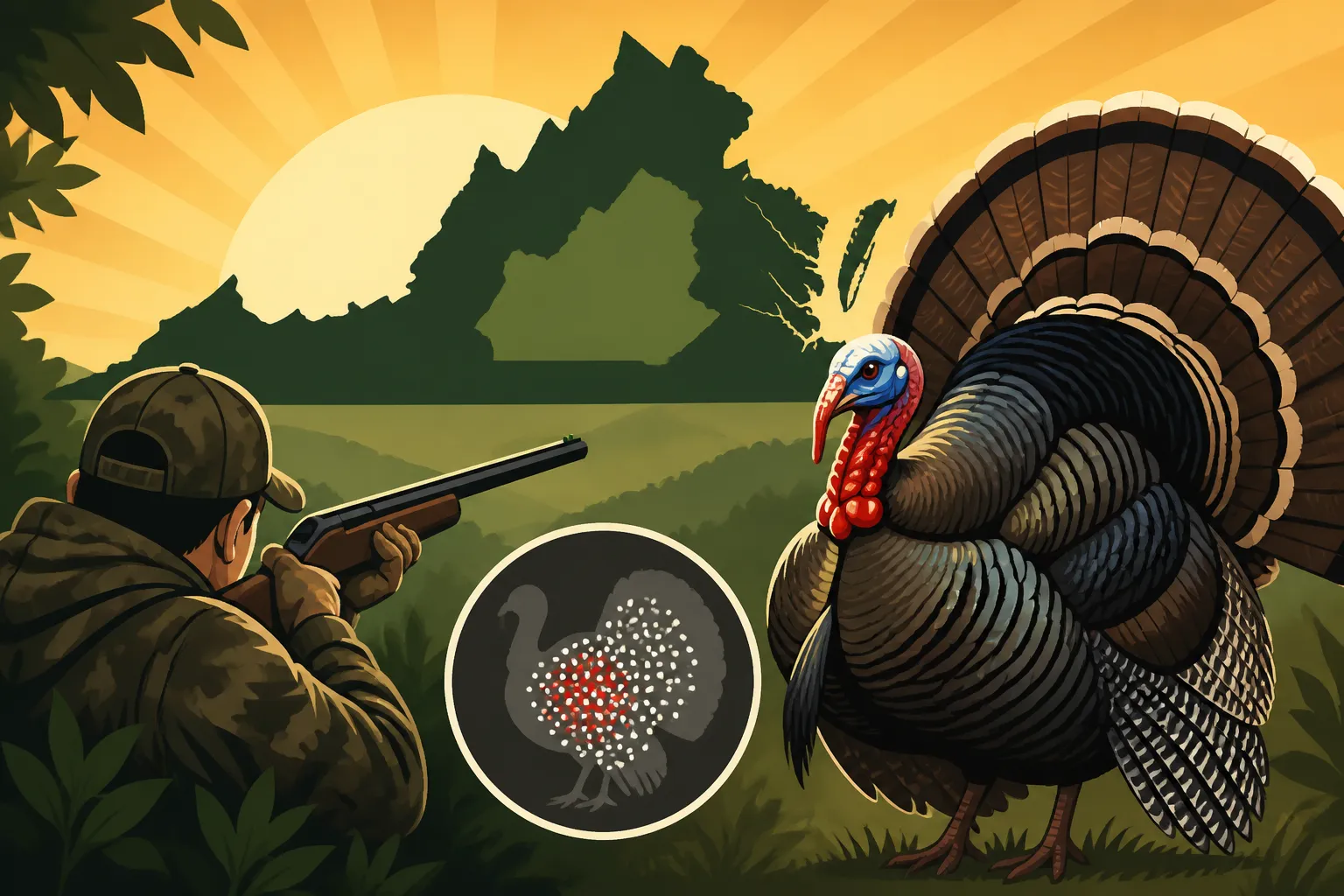
- Pellet Count in the Critical Zone: The most important metric is the number of pellets within a 10-inch circle centered on your aim point. For TSS, many hunters aim for 100+ pellets in that 10-inch circle at 40 yards. For lead, it might be closer to 60-80 pellets. This number represents the density needed to reliably incapacitate a gobbler.
- Even Distribution: Beyond just the number, look at how evenly those pellets are distributed. Are there large gaps or "holes" in the pattern that a turkey's head could slip through? You want a consistent, even spread across the entire 10-inch circle, with no major voids.
- Point of Impact: Is the center of your pattern hitting exactly where you aimed? Often, a shotgun's point of impact can shift when you change chokes or ammunition. This is why many turkey hunters opt for a red dot sight, which can be precisely zeroed to the center of the pattern, eliminating any stock fit or bead alignment issues.
- Fliers: Notice if there are individual pellets that are far outside the main pattern. A few fliers are normal, but a consistent "blown" pattern with pellets scattered wildly indicates a bad choke/ammo combination.
Keep detailed notes for each choke and load combination you test. You can use a dedicated app or platform, like GoHunt, to track your patterning results, including the choke, load, distance, pellet count, and even upload photos of your targets. This becomes an invaluable resource for comparing performance year after year, or if you decide to try a new setup.
Troubleshooting Poor Patterns
It's entirely possible your first few shots won't produce the pattern you're hoping for. Don't get discouraged – this is precisely why we pattern!
- It's a System: Remember, the shotgun, choke, and ammunition are a system. If one component isn't meshing, the pattern will suffer.
- Experiment with Chokes: If your pattern is too sparse or uneven, try a different choke with a slightly different constriction (e.g., if you started with a .665, try a .660 or a .670). A tiny change in internal diameter can make a big difference.
- Experiment with Ammunition: This is often the biggest variable. Different brands, different pellet sizes (e.g., #5 lead vs. #6 lead; #7 TSS vs. #9 TSS), and even different loads within the same brand can pattern wildly differently through the same choke and gun. Buy a few boxes of different loads and see what your gun likes best. It might seem expensive, but the cost of a few boxes of shells is negligible compared to the heartache of a missed gobbler or a wounded bird.
- Check Your Sights: If your point of impact is consistently off-center, adjust your sights (if applicable) or consider adding a dedicated red dot sight for precision.
- Gun Issues: While less common, sometimes an older barrel might have issues, or there could be residue from plastic wads built up that affects patterning. A thorough cleaning can sometimes help.
If you're still struggling, online communities and forums, or resources available through platforms like GoHunt, can offer a wealth of shared experience and suggestions from other hunters who might have faced similar challenges with specific shotgun models or chokes.
| Choke Type | Typical Constriction (12 Gauge) | Best For | Pros | Cons |
|---|---|---|---|---|
| Full | ~0.700" | General hunting, some turkey loads | Decent range, versatile | May not be dense enough for modern turkey loads, especially TSS, leading to poorer long-range patterns. |
| Extra Full | ~0.690" | Lead turkey loads | Tighter than Full, good for closer-range lead | Still not as tight as dedicated turkey chokes, can deform softer shot, pattern can open up quickly. |
| Turkey Specific | 0.650"-0.675" (Lead) 0.640"-0.660" (TSS) |
Dedicated turkey hunting with specific loads | Maximum pattern density and range for vital head/neck shots; designed for specific shot types. | Less versatile for other hunting, requires extensive patterning to find optimal load, can be sensitive to shot material. |
Maximizing Effectiveness for Virginia's Spring Birds
Once you've put in the work at the patterning board, you're not just ready to shoot, you're ready to hunt with confidence. This confidence translates directly into more ethical and successful hunts for Wild Turkeys in Virginia. Understanding your gun's capabilities allows you to make better decisions in the field.
Practical Range for Virginia Gobblers
Your shotgun's practical range isn't what the ammunition box claims it can do, or what your buddy says his setup can do. It's the maximum distance at which your patterned shotgun can consistently place enough pellets in a gobbler's head and neck to ensure a clean kill. For many setups, this is typically 30-40 yards, but with a highly optimized gun and TSS loads, some hunters can push that to 50 yards or even a bit further.
In Virginia, whether you're hunting dense mountain timber or open Piedmont fields, knowing your ethical range is paramount. Trying to stretch a shot beyond your proven pattern is a recipe for heartbreak. If your pattern shows an unacceptable drop in density at 45 yards, then 45 yards is too far, no matter how hard you've worked that bird in. Sticking to your proven range helps you judge incoming birds and make smarter calling decisions, knowing exactly how close you need that bird to be. It also guides your decision-making when considering Decoy Placement for Pressured Virginia Birds.
The Impact of Ammunition Choice (Lead vs. TSS)
The ammunition landscape for turkey hunting has changed dramatically in recent years, largely due to Tungsten Super Shot (TSS).
- Lead Shot: Traditional lead loads are still effective and widely used. They are generally more affordable and come in various pellet sizes like #4, #5, and #6. A good lead load through an appropriate turkey choke can deliver lethal patterns out to 35-40 yards. However, lead is softer and lighter than tungsten, so its energy retention and penetration decrease more rapidly with distance.
- Tungsten Super Shot (TSS): TSS is an alloy significantly denser than lead, typically 18 grams per cubic centimeter compared to lead's 11. This incredible density means smaller pellets hit harder and penetrate deeper. A #9 TSS pellet carries more energy than a #5 lead pellet. This allows hunters to use much smaller shot sizes (#7, #9, even #10) which increases the pellet count in the shell, resulting in incredibly dense patterns at longer ranges (often 50+ yards) with exceptional penetration. The downside? TSS is significantly more expensive.
When making your choice, consider your budget, your ethical range, and your shotgun's capabilities. If you're hunting smaller properties or dense woods where shots are always close, lead might be perfectly adequate. If you hunt more open areas or simply want the absolute best performance and reach, TSS is a game-changer, but it often requires a different choke constriction to truly shine. Always ensure your choke is rated for TSS if you choose to use it, as some older or less robust chokes might not handle the harder material.
Beyond the Choke: Other Factors Affecting Accuracy
While your choke and ammo are the stars of the patterning show, other elements play a crucial supporting role in your overall accuracy:
- Gun Fit: A shotgun that fits you properly points naturally. If you're constantly fighting the gun to get a proper sight picture, your patterning results (and your field performance) will suffer.
- Sighting Systems: While bead sights work, many serious turkey hunters swear by red dot sights. They offer a single, precise aiming point, excellent low-light performance, and eliminate any issues with proper head alignment on the stock. They are also much easier to zero precisely to the center of your pattern.
- Shooter Consistency: Your form, how you hold the gun, and your trigger pull all influence where the pattern hits. This is why patterning from a stable rest is so important—it removes you from the equation to judge the gun's performance. But when you move to hunting, practice shooting from hunting positions (kneeling, sitting) to see how your body mechanics might affect your aim.
- Practice, Practice, Practice: The more comfortable you are with your hunting setup, the more confident you'll be when that big gobbler steps into range. Don't let the first time you pull the trigger on your turkey gun for the year be on a live bird.
Common Mistakes and Advanced Tips for Choke & Patterning
Patterning can feel like a chore, but like most things worth doing, there are common pitfalls to avoid and nuances that can elevate your success. Learning from others' mistakes, and understanding the finer points, can save you time, money, and most importantly, prevent a missed opportunity on a Virginia gobbler.
Mistakes to Avoid When Patterning
It's easy to fall into traps that skew your patterning results or leave you less prepared than you think you are.
- Only Shooting One Type of Ammo: This is probably the biggest mistake. Just because a load is popular or expensive doesn't mean your specific gun will like it. You must try several different loads, from different manufacturers and potentially different pellet sizes, with your chosen choke.
- Not Shooting Enough Targets: One shot doesn't tell the whole story. Patterns can vary slightly from shot to shot. Shooting at least three, and preferably five, targets at each distance gives you a much more reliable average and shows you the consistency of your setup.
- Using the Wrong Target: A small paper plate won't cut it. You need a large target that shows the entire pattern, and ideally one with a 10-inch circle or a turkey head outline to easily assess pellet count in the vitals.
- Rushing the Process: Don't blast through shells quickly. Take your time between shots. Let the barrel cool down. Re-establish your stable shooting position. Patience here pays dividends in accurate data.
- Ignoring Recoil: Modern turkey loads, especially heavy TSS, can deliver a significant punch. If you choose a load that's uncomfortable to shoot, you might flinch in the field, leading to a missed shot. Your patterned load should be one you can comfortably and consistently shoot accurately.
- Not Zeroing Sights: If you have a scope or red dot, make sure it's zeroed to the center of your pattern, not just where you think the bead is pointing. This is a critical step for precision. Many hunters swear by Red Dots on a Turkey Shotgun for this very reason.
Advanced Considerations and Fine-Tuning
Once you've got the basics down, there are a few other aspects you might consider to truly fine-tune your turkey rig.
- Ported vs. Non-Ported Chokes: Ported chokes have holes or vents designed to reduce recoil and muzzle jump. While they definitely help with recoil management, their effect on pattern quality is often negligible or highly dependent on the specific load. Some argue they can slightly disrupt the gas seal, but for most hunters, the recoil reduction is the primary benefit. Test both if you're curious, but don't expect a miraculous pattern improvement from ports alone.
- Barrel Length Considerations: While a longer barrel can contribute to slightly higher velocity, for modern turkey loads, barrel length has a surprisingly minimal impact on pattern quality compared to the choke/ammo combination. A 20-inch barrel can pattern just as effectively as a 26-inch barrel with the right choke and load. Choose a barrel length that balances maneuverability (especially in thick cover) with comfortable swing.
- Patterning at Multiple Distances: Don't just pattern at 40 yards. Shoot at 20, 30, and 50 yards (if your pattern holds up). This gives you a complete picture of how your pattern behaves at different ranges, helping you make split-second decisions in the field when that gobbler steps out. Understanding the pattern at close range is important too, as some extremely tight chokes can be too constrictive at 20 yards, leading to a pattern so small it's easy to miss with.
- Data Tracking: Seriously consider using a system or app to record all your patterning results. This historical data, easily managed through a tool like GoHunt, is invaluable. You can compare patterns from different years, track choke preferences, and even share results with trusted hunting buddies. It helps you stay organized and make informed decisions, whether you're working a hot bird in a creek bottom or trying to fill your tag during the Virginia Late Turkey Period Hours. This careful preparation is just as important as good scouting for Scouting Virginia Public Land Before Season.
Disclaimer
This article is for general informational purposes only and does not constitute professional advice. Laws, prices and regulations vary by location and change over time. Consult a qualified professional for guidance on your specific situation.