Hanging a Stand on a Jefferson Forest Ridge
Hunting the steep, rugged terrain of the Jefferson National Forest can feel like an overwhelming task, especially when you're trying to pinpoint the perfect ambush spot for a wary whitetail. It’s easy to get lost in the sheer scale of the mountains and the seemingly endless timber, making the idea of hanging a stand efficiently and effectively feel like a pipe dream. This guide is dedicated to breaking down the process, offering practical, boots-on-the-ground advice for successfully hanging a stand on a Jefferson Forest ridge, turning those daunting hillsides into productive hunting grounds.
Understanding Jefferson National Forest Terrain for Deer Hunting
The Jefferson National Forest, sprawling across parts of Virginia, Kentucky, and West Virginia, presents a unique challenge for deer hunters. It's not your typical flat, agricultural deer woods. Here, the landscape itself dictates much of how deer move and where they spend their time, which is crucial for anyone hoping to hang a stand in a productive spot.
The Unique Challenges of Mountain Ridges
When you step into the Jefferson National Forest, you’re immediately confronted with elevation changes that can take your breath away – literally. These aren't gentle rolling hills; we're talking about steep inclines, deep hollows, and seemingly endless timber that can feel impenetrable. The thick canopy often limits visibility, making it hard to scout from a distance or track deer movement over long ranges. Limited access points mean you often have to hike significant distances, often uphill, just to get to a potential hunting area. This isn't just a physical challenge; it also impacts how you plan your hunt, carry your gear, and even retrieve a deer.
One of the biggest frustrations, and indeed, one of the most critical factors, is the notoriously shifty wind. On a flat piece of property, you might pick a stand based on a prevailing wind direction and be reasonably confident. In the mountains, however, thermals play a huge role. Cold air drains down slopes in the morning and evening, while warm air rises during the day. This creates swirling, unpredictable conditions that can bust a deer faster than you can blink. Understanding these micro-thermals is absolutely paramount when considering a stand location on a ridge. Deer use these wind currents to their advantage, often bedding high and moving down or across the slope to feed, always with the wind in their favor.
Key Topographical Features to Scout
Despite the ruggedness, deer are creatures of habit, and they utilize specific topographical features to make their lives easier on these steep ridges. Your job, as a hunter, is to identify these high-percentage areas before you even think about putting up a stand.
- Saddles: These are depressions or low points along a ridge line. Think of them as natural highways that deer use to cross from one side of a mountain to another, often linking bedding areas with feeding grounds or escape routes. They're often wind-swept, making them ideal places for deer to feel secure as they travel. A well-chosen saddle stand can intercept deer moving between two drainages or over the top of a mountain.
- Benches: These are flat or gently sloping areas on an otherwise steep hillside. Deer love benches because they offer easier walking and often hold thicker cover or better browse. They can be excellent bedding areas or travel corridors where deer feel less exposed than on the crest of a ridge. Sometimes, these benches are subtle, only a few yards wide, but a keen eye or a good mapping app can reveal them.
- Natural Funnels: Beyond saddles and benches, look for any feature that constricts deer movement. This could be a rocky outcrop that forces deer around it, a thick laurel tangle that herds them into a narrower path, or even the convergence of several small ravines. These funnels naturally channel deer, increasing your odds of an encounter. Old logging roads, even overgrown ones, can also act as linear funnels, providing easier travel for deer.
- Creek Bottoms and Springs: While not directly on the ridge itself, these features often lie at the base or within the hollows leading up to a ridge. Deer need water, and these areas can draw them off the high ground, especially in drier periods. Connecting these water sources to ridge-top bedding via saddles or benches is a classic mountain hunting strategy. Understanding how these elements influence deer travel is key to Reading a Ridge for Blue Ridge Deer.
By diligently scouting these features, either on a map or with boots on the ground, you can start to piece together the puzzle of deer movement on a Jefferson Forest ridge. This understanding forms the bedrock of choosing a successful stand location.
Scouting and Location Selection for Stand Placement
Before you haul a treestand up a mountain, you need to dedicate significant time to scouting. This isn't just a casual walk in the woods; it's a strategic investigation, trying to read the subtle clues deer leave behind and interpret how they use the challenging mountain terrain.
Identifying Productive Deer Sign
Deer leave a wealth of information for us if we know how to look for it, and on a mountain ridge, these signs become even more critical. They tell you where deer are, and more importantly, how they are using the landscape.
- Rubs and Scrapes: These are perhaps the most obvious indicators of buck activity, especially as the rut approaches. Look for fresh rubs on saplings and small trees, particularly along travel corridors like benches or the edges of saddles. Scrapes, patches of bare earth where bucks paw the ground and deposit scent, also indicate active buck movement. Pay attention to how concentrated these signs are. A "scrape line" along a logging road or a series of heavily rubbed trees on a bench usually means you're in a high-traffic area. Remember, fresh sign is key. A rub from last year is just historical data; you need to find signs of current activity.
- Tracks: Tracks in muddy areas, creek crossings, or even soft leaf litter can tell you about deer size, direction of travel, and frequency. On a steep slope, deer will often take the path of least resistance, so look for tracks along the flatter parts of benches or in saddles. Groupings of tracks can indicate a social trail. Take note of the size of the tracks – bigger, deeper tracks might mean a mature buck.
- Bedding Areas: Finding bedding areas on a ridge is often the holy grail. Deer will typically bed on points or benches that offer good visibility downwind and a safe escape route upwind. They want to be able to see, smell, and hear potential danger. Look for flattened areas in thick cover, often under a laurel thicket or a cluster of pines, where deer have recently rested. Finding fresh droppings and warm beds can indicate a current bedding location. Often, these spots are just below the crest of a ridge, allowing them to catch rising thermals and observe below.
- Feeding Sign: While deer in the mountains browse extensively on various plants, acorns are king when they’re available. Identify oak species (red oak, white oak, chestnut oak) and look for areas with a good acorn drop. Deer will frequent these spots heavily during the fall. Other food sources might include greenbrier, honeysuckle, or various forbs in clear-cuts or openings. Knowing what deer are eating and where can help you predict their movements between bedding and feeding areas. If you're Hunting After a Poor Acorn Year, deer might be concentrated on other browse, so adapt your scouting.
Using Digital Tools for Pre-Season Planning
Before you ever set foot on the mountain, modern technology can be your best friend. Digital mapping applications allow you to scout from your couch, identifying potential hotspots and planning your approach.
One excellent tool for this is GoHunt. It offers detailed topographical maps and aerial imagery that can help you visualize the terrain like never before. You can identify those subtle saddles, benches, and funnels that might be invisible at ground level. Look for contour lines that pinch together, indicating steep terrain, or those that spread out, revealing a bench. The aerial view can show you changes in timber type, clear-cuts, or old logging roads that deer might be using.
Beyond GoHunt, the Virginia Department of Wildlife Resources (DWR) offers fantastic resources. Their online map tool can show you public land boundaries, which is essential in a vast area like the Jefferson National Forest. You can use these tools to:
- Identify Access Points: Pinpoint where you can legally park and begin your hike.
- Map Potential Routes: Plan the least strenuous and most discreet path to your chosen stand location. Consider how you'll approach without busting deer.
- Mark Waypoints: Drop pins on potential bedding areas, feeding zones, and those crucial topographical features you identified.
- Analyze Wind and Thermals: While a map can't predict real-time wind, it can help you understand how terrain will influence it. Look for areas where wind might swirl, and plan alternative stand locations for different wind directions. For instance, a stand on the east side of a ridge might be perfect for a west wind, but terrible for an east wind due to thermals.
Combine your digital scouting with boots-on-the-ground confirmation. What looks good on a map might not be as promising once you're there, or vice versa. The goal is to narrow down your search and maximize your efficiency when you are out physically scouting. This pre-season planning is invaluable for anyone serious about Scouting Virginia Public Land Before Season.
Choosing the Right Stand and Hanging It Safely
Once you've poured over maps and walked the ground, identifying a specific tree that offers the perfect combination of cover, shot opportunities, and proximity to deer movement, it's time to think about the actual stand. This isn't a one-size-fits-all situation, especially in the rugged mountains.
Types of Stands Suitable for Mountain Hunting
The choice of treestand can significantly impact your mobility, stealth, and safety on steep, uneven terrain. Each type has its pros and cons in the context of mountain hunting.
- Climbing Stands: These stands are popular for their portability and ease of setup in the right conditions. You climb the tree with the stand, section by section. However, in the Jefferson National Forest, finding the right tree for a climber can be a challenge. You need a relatively straight, limb-free tree with consistent bark texture. Many mountain hardwoods are gnarled, crooked, or have limbs too low for a safe climb. If you can find a suitable pine or a straight oak, a climber can be quick to deploy, allowing you to react to changing conditions. Just be mindful of the noise when climbing and descending, as it can be significant.
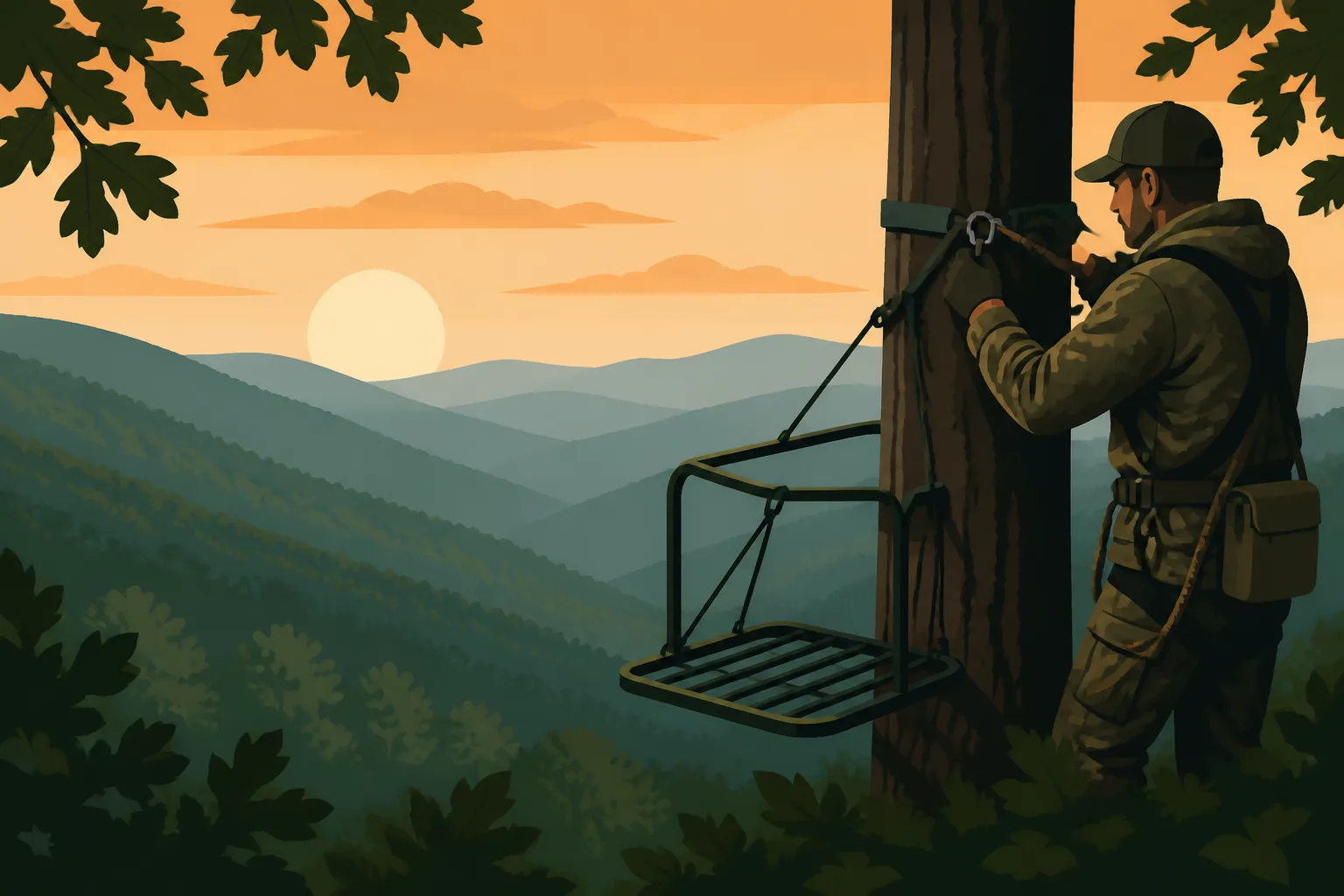
- Hang-on Stands: For many mountain hunters, a hang-on stand combined with climbing sticks is the preferred setup. These stands are incredibly versatile. You can attach them to almost any tree, regardless of its straightness or limb structure, provided it's sturdy. The initial setup requires more effort, involving carrying both the stand and multiple climbing sticks, but once installed, they are extremely solid and quiet. This allows you to position yourself precisely where the deer sign is strongest, even if it's on a less-than-perfect tree. They also tend to be lighter and less bulky than climbers when broken down for transport. Many hunters will set up multiple hang-on stands in different locations to capitalize on varying winds or deer patterns. For a deep dive into using these, check out Treestand Setups in George Washington National Forest.
- Saddle Hunting: This is arguably the most mobile and stealthy option for mountain hunting. A saddle is a minimalist harness that you wear, allowing you to essentially "lean" into the tree rather than sit directly on a platform. Combined with lightweight climbing sticks or a single-stick method, it offers 360-degree shooting angles and incredible adaptability. The learning curve is a bit steeper than traditional stands, but the benefits in rugged terrain are immense. You can quickly move locations, use smaller trees for cover, and reduce your overall gear weight. Many hunters find it to be a more comfortable all-day sit once accustomed to it. If you're interested in extreme mobility and stealth, exploring Saddle Hunting in Virginia Hardwoods could be a game-changer.
Here's a quick comparison of stand types for mountain hunting:
| Stand Type | Pros | Cons | Ideal Terrain/Tree |
|---|---|---|---|
| Climbing Stand | Portable, relatively quick setup | Requires straight, limb-free tree; can be noisy | Straight pines or smooth oaks |
| Hang-on Stand | Versatile, secure, quieter once installed | Requires climbing sticks; more setup effort initially | Any sturdy tree; good for irregular or gnarled trunks |
| Saddle | Extremely mobile, stealthy, 360° shooting | Learning curve; less comfortable for some; minimalist | Any sturdy tree, even smaller ones; excellent for steep terrain |
Safe and Strategic Stand Installation
Safety is paramount, especially when working at heights in remote, rugged terrain. Never skimp on safety gear or rush the process.
- Prioritize Safety First: Always, always use a full-body safety harness. This is non-negotiable. Before you even leave the ground, attach your lifeline or strap to the tree. As you ascend, remain connected. Many incidents occur during the ascent or descent, not just while in the stand. Familiarize yourself with your harness and practice using it at ground level. Consider products from brands like Hunter Safety System or Muddy Outdoors for reliable gear. You can learn more about general Treestand Safety Gear for Steep Ground.
- Tree Selection: Choose a live, healthy tree with a straight trunk. Avoid dead trees, leaning trees, or those with obvious damage or rot. Ideally, select a tree that offers natural cover (like thick branches or other trees) to help break up your silhouette. In the mountains, finding the perfect "cover tree" can sometimes be more challenging than finding a "stand tree."
- Minimalistic Clearing: Once you're at your desired height, trim only what is absolutely necessary for shooting lanes. Over-trimming can make your stand obvious and remove valuable cover. Think about the likely direction deer will approach and where you expect to take a shot. Also, clear any small branches or twigs around your platform that might snag your bowstring or create noise.
- Entry and Exit Routes: Before you even climb, identify your entry and exit routes. You want a path that is as quiet and discreet as possible, avoiding known bedding areas or major travel corridors. Your goal is to get to and from your stand without disturbing deer. This might mean walking a longer, circuitous route, using a creek bottom, or sticking to the very edge of a ridge away from the main deer trails. Having a quiet entry and exit can make or break your hunt, especially on pressured public land.
Hunting Strategies from Your Jefferson Forest Ridge Stand
Hanging the stand is just the first step. To truly capitalize on your hard work, you need to employ smart hunting strategies that account for the unique challenges and opportunities presented by a Jefferson National Forest ridge.
Playing the Wind and Thermals
As mentioned, mountain winds and thermals are incredibly complex and demand constant attention. Ignoring them is a surefire way to educate every deer in the area to your presence.
- Understanding Thermal Movement: In the mountains, air temperature differences cause thermals. As the sun rises and warms the earth, air on the slopes begins to warm and rise – this is an "updraft" or rising thermal. Deer bedded higher on the ridge will rely on this rising air to carry their scent up and away from anything below them. As the sun sets and the air cools, the colder, denser air flows down the slopes and into the hollows – a "downdraft" or falling thermal. Deer often utilize these falling thermals to approach feeding areas in the valleys or on lower benches, confident that their scent is flowing down ahead of them.
- Strategic Stand Placement for Thermals: This means that for a morning hunt, you often want to be positioned just below where you expect deer to come from, allowing your scent to rise above them as they move up or across the ridge. For an evening hunt, you might want to be higher than their expected travel path, so your scent flows down and away from them. However, it's never that simple. Ridge points can cause swirling, and crosswinds can complicate things further.
- The Role of Wind Direction: Always consider the prevailing wind on top of the thermals. A strong westerly wind will often override local thermals, pushing air eastward. You need to identify key stand locations for different wind directions. For example, if you're targeting a saddle, you might need a different stand on the north side for a south wind and another on the south side for a north wind. Always try to position your stand so that your scent cone is blowing away from where you expect deer to appear. Using a wind checker puff bottle religiously throughout your sit is a must. Knowing about Wind and Thermals on a Blue Ridge Slope is crucial for success.
Entry and Exit Routes for Minimal Impact
Busting deer on your way in or out of your stand can spoil an entire day's hunt, or even several days, as deer become aware of your presence. Thoughtful planning here is just as important as the stand location itself.
- Pre-Dawn and Post-Dusk Stealth: Your movement in and out of the stand should be as quiet and unseen as possible. This means walking in the dark, using a headlamp only when absolutely necessary (and on its lowest red-light setting if possible), and moving slowly. Listen for crunching leaves or snapping twigs. Consider using a path that is naturally noisy (like a rocky creek bed) if it provides a more direct, cover-laden route that keeps you off main deer trails.
- Avoid Bedding Areas: Never walk through or directly adjacent to known bedding areas during your entry or exit. This is a sure way to educate deer and push them out of your hunting zone. Circle wide around these areas, even if it adds significant time and effort to your walk. Your goal is to leave as little human scent and disturbance as possible.
- Use Topographical Features to Your Advantage: Just as deer use saddles and benches for travel, you can use them for stealthy access. A deep hollow can hide your approach, or the back side of a ridge can screen your movement from a target area. Sometimes, taking a ridge all the way around a hollow, even if it's a longer walk, is better than cutting straight through a potential deer sanctuary. This strategy is also vital for Deer Drives With Three or Four Hunters where you need to manage hunter movement effectively.
- Packs for a Jefferson Forest Day Hunt: When planning your entry and exit, consider how much gear you're carrying. A well-organized pack can prevent rattling or shifting gear that creates noise. Keeping your hands free for balance on steep terrain is also essential.
Making the Most of Your Ridge Stand
Once you’re settled into your stand, patience and observation become your primary tools. Deer movement in the mountains can be unpredictable, but there are ways to increase your odds.
- Patience is a Virtue: Mountain deer often move later in the morning and earlier in the evening than their agricultural counterparts. Don't get discouraged if the woods feel dead for the first few hours. Stay vigilant, scanning your shooting lanes and the surrounding cover. Remember, deer might pop out from unexpected places on a ridge.
- Calling Techniques: Don't be afraid to use calls, especially during the rut. A soft grunt or bleat can pique a deer's curiosity and draw them into range. If you're confident there are bucks in the area, light rattling might also work, mimicking two bucks sparring. Be realistic about the volume; in thick mountain cover, sounds don't travel as far as in open fields. If you're interested in aggressive calling, look into Rattling Volume in Thick Mountain Cover.
- Observe and Learn: Every sit is a learning opportunity. Pay attention to where deer appear from, their travel patterns, how they react to the wind, and what they're feeding on. Notice the smaller trails you might have missed during scouting. These observations can help you fine-tune your strategy for future hunts, perhaps even revealing the need to adjust your stand height or location slightly.
- Stay Prepared for the Shot: When hunting from a stand, especially with a bow, practice shooting from various angles and positions you might encounter. Be ready to draw your bow or shoulder your rifle smoothly and quietly. In the mountains, shot opportunities can be fleeting, so being prepared is key.
Remember, success on a Jefferson National Forest ridge often comes down to perseverance, meticulous planning, and a deep respect for the challenging yet rewarding environment.
Disclaimer
Hunting is an inherently dangerous activity. Always follow all local, state, and federal hunting regulations. Prioritize safety by using appropriate gear, understanding your equipment, and being aware of your surroundings. The information provided in this guide is for informational purposes only and should not replace professional instruction or local regulations.