Treestand Safety Gear for Steep Ground
Hunting steep ground in Virginia's mountains, whether it's the rugged Blue Ridge or the sprawling Jefferson National Forest, offers exhilarating opportunities to find those elusive mature deer. However, the unforgiving angles and challenging terrain demand an even higher level of vigilance when it comes to treestand safety. A simple slip that might be a nuisance on flat ground can quickly become a life-threatening ordeal on a steep slope. This guide is dedicated to arming you with the knowledge of essential safety gear and proven techniques to ensure your hunts on elevated terrain are as secure as they are successful.
The Unique Dangers of Treestand Hunting on Steep Terrain
Let's be real: hunting from a treestand is inherently risky. Add a significant incline to the equation, and those risks multiply. The ground is no longer a soft landing but a treacherous slide, often littered with rocks, roots, and uneven surfaces. Understanding these amplified dangers is the first step toward mitigating them and ensuring you return home safely after every hunt.
Gravity's Cruel Hand: Why Steep Angles Increase Risk
When you're on a flat piece of ground, a fall from a treestand is still serious, but the physics of it are relatively straightforward. On a steep incline, gravity becomes a much more formidable foe. Even a short fall can quickly turn into a tumble, potentially causing you to roll down the slope, hitting obstacles, and sustaining far worse injuries than a direct drop. Imagine falling just ten feet from your stand on a 45-degree slope. You don't just hit the ground; you might slide or roll another 20, 30, or even 50 feet before stopping. This extended distance and uncontrolled movement increase the likelihood of broken bones, head trauma, and internal injuries.
Furthermore, self-rescue becomes exponentially harder. If you're injured and dangling from your harness, the angle of the ground beneath you can make it impossible to get your feet under you or reach a self-rescue device. The effort required to regain a stable position against gravity on a steep face is immense, especially if you're disoriented or in pain. The clock starts ticking even faster for suspension trauma, making immediate and effective action absolutely critical.
Environmental Factors: Loose Soil, Rocky Outcroppings, and Wind
Steep ground isn't just about the angle; it's about what that angle often entails. In many parts of Virginia's mountains, you'll encounter loose, rocky soil that offers poor footing even for climbing. Setting up climbing sticks or a ladder stand on such unstable ground can be a nightmare. The base might shift, or the stick could pivot on a hidden rock, leading to a precarious ascent. Exposed roots, jagged rocks, and uneven terrain complicate every step, making it easy to lose your balance before you even reach your stand.
Wind is another factor that can play tricks on you in steep country. While wind always needs to be considered for scent, on a ridge line or mountain face, gusts can be much stronger and more unpredictable. A sudden strong gust can cause your stand to sway more than usual, momentarily throwing off your balance while you're transitioning from sticks to your platform. This isn't just a comfort issue; it's a stability issue. What might feel like a gentle breeze in the valley can be a significant force impacting your safety on a high perch. The subtle shifts in Wind and Thermals on a Blue Ridge Slope can be enough to make you wobble, and a wobbly hunter is a risky hunter.
Essential Treestand Safety Gear for Incline Hunts
When you venture onto steep ground, your safety gear isn't just an accessory; it's a mission-critical component of your hunt. Forget cutting corners here. Investing in the right tools and knowing how to use them can literally mean the difference between a successful hunt and a hospital visit. This isn't just about owning the gear, but about having the right gear for the conditions.
Full-Body Harnesses: Your Lifeline on a Ledge
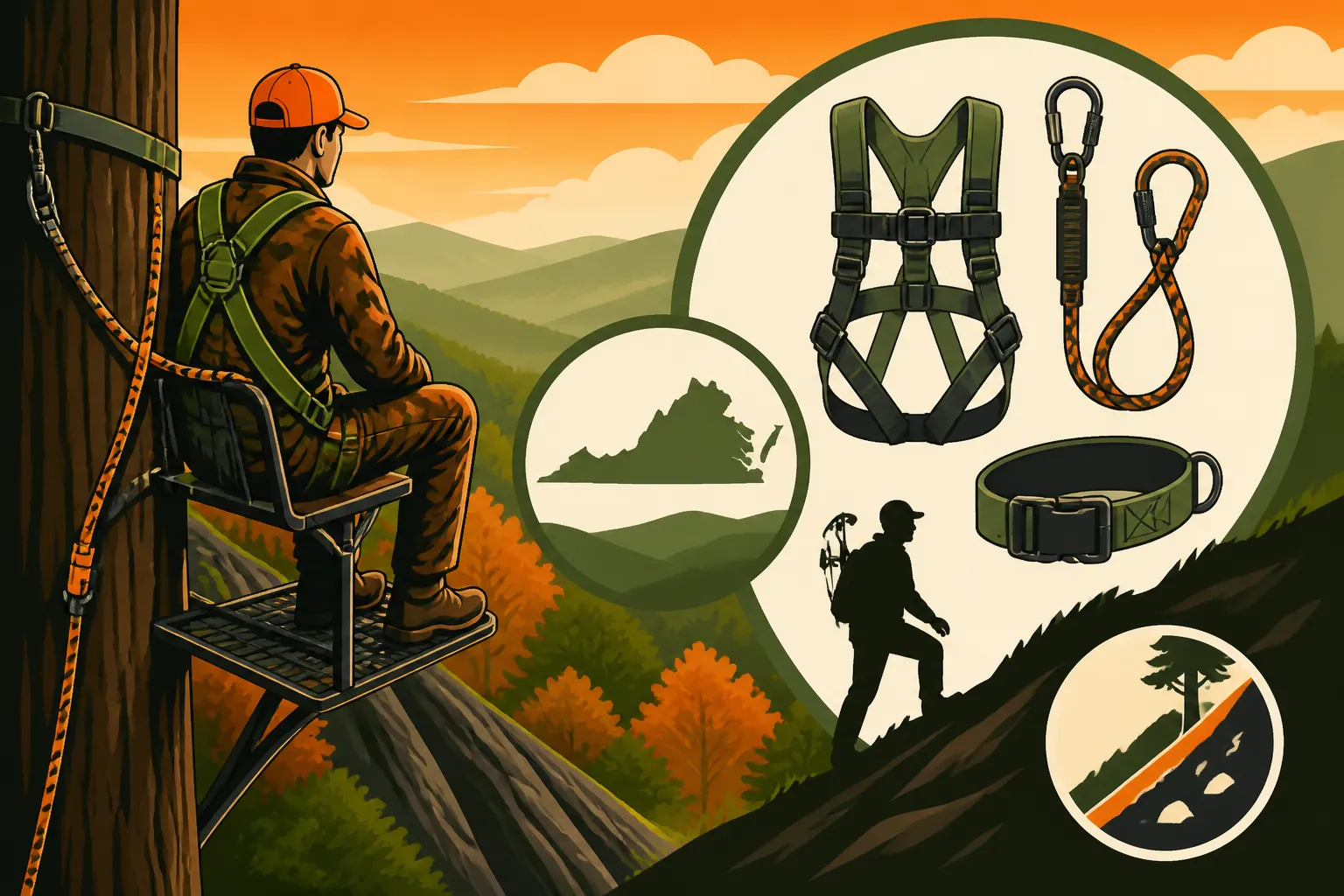
Let's be unequivocally clear: a full-body harness is non-negotiable every single time you leave the ground, especially on steep terrain. It's the single most important piece of safety equipment you own. A good harness is designed to distribute the forces of a fall across your entire body, preventing severe injury and giving you a chance to recover. Modern harnesses are comfortable, lightweight, and engineered for ease of use.
When choosing a harness, look for one that fits well and allows for full range of motion. Some hunters prefer vest-style harnesses, while others like a traditional full-body harness with leg straps and shoulder straps. The key is proper fit – it shouldn't be too loose, allowing you to slip out, nor too tight to restrict circulation. Always wear it correctly, with leg straps snug but not cutting off circulation, and the tether attachment point positioned properly between your shoulder blades. Your harness should always be connected to the tree from the moment your feet leave the ground until they are back on solid earth. This continuous attachment is achieved with a lifeline or a single rope system. Never, ever disconnect until you're completely out of the stand and on the ground. A short tether is also crucial; you want to be able to turn and maneuver, but not fall far enough to hit the platform or tree trunk below you. Many veteran hunters will tell you that a well-fitted harness, paired with a lifeline, is your best friend. For a deeper dive into these life-saving components, check out Safety Harnesses and Lifelines.
Climbing Sticks and Ladders: Stable Ascents on Uneven Ground
Getting up and down the tree on a steep slope requires more thought than on flat ground. Climbing sticks and sectional ladders are often superior to traditional climbing stands in these scenarios because they offer more flexibility in placement and a more secure ascent. When setting up sticks on an angled tree, you'll need to pay extra attention to ensuring each stick is level and securely anchored. Some hunters even bring small leveling wedges or use natural contours of the tree to achieve a flat step.
Look for sticks with dual strap systems or those that "bite" into the tree bark more aggressively. Longer straps can be beneficial to wrap around wider trees or to get a better angle of pull for stability. As you ascend, remember the "three points of contact" rule: always have two hands and one foot, or two feet and one hand, on the sticks at all times. This methodical approach minimizes the risk of a slip. It might take a little longer, but safety is paramount. When dealing with the rough, often twisted bark of mature hardwoods in the Jefferson National Forest, Climbing Sticks for Rough Bark become an even more critical piece of your gear.
Redundant Systems: Backup Straps and Ropes
On steep ground, the stakes are higher, so redundancy in your setup can be a lifesaver. This means having backup securing methods or ways to manage your gear that don't rely on just one point of failure. For example, some hunters will use not just the stand's primary strap, but also an additional secondary strap or chain to really cinch that stand to the tree. If you're setting up a hang-on stand, think about how it's resting against the tree. If it's on a slight angle, can you use a small block or shim to make it sit more flush and secure?
Additionally, when pulling up your bow, backpack, or other gear, use a sturdy haul rope that's securely tied to your gear and also to your harness or a strong branch above you. Don't just rely on a flimsy cord. If your primary haul rope fails, or if your gear gets snagged and pulls unexpectedly, you don't want to be caught off guard while trying to stabilize your stand on a slope. Consider a separate rope for your bow versus your pack, giving you even more control. A little extra preparation goes a long way when every inch of a fall matters.
Techniques and Considerations for Steep Ground Setups
Mastering the art of setting up a treestand on steep ground isn't just about having the right gear; it's about employing smart techniques and a meticulous approach. Every step, from scouting to anchoring, needs to be deliberate and focused on maximizing your stability and safety.
Scouting and Tree Selection: Stability is Paramount
Your hunt for a treestand location actually begins weeks or even months before the season. When Scouting Virginia Public Land Before Season, especially in areas like the George Washington National Forest, you're not just looking for deer sign; you're looking for the right tree. On steep terrain, this means finding a tree that offers a truly vertical line, or as close to it as possible, despite the slope of the ground. Avoid trees that visibly lean or have significant bends, as these will make it much harder to level your stand and could compromise its stability.
Also, examine the tree itself. Is it healthy? Are there any signs of rot, insect damage, or dead branches that could pose a risk? A dead or dying tree, no matter how perfectly positioned for a shot, is an absolute no-go. Pay attention to the ground at the base of the tree as well. Is it loose soil that could wash out with rain? Or is it firm, rocky ground where your sticks will find solid purchase? Using mapping apps, like those provided by GoHunt, to analyze topographical lines can give you an edge in identifying subtle benches and breaks in the terrain where a good, stable tree might be hiding. These apps often show terrain features that are perfect for Hunting a High Elevation Mountain Bench and can help you visualize the angle before you even step foot on the ground.
Anchor Points and Leveling: Building a Secure Platform
Once you've found your ideal tree, the real work begins. Getting your climbing sticks and stand level on a slope is perhaps the trickiest part. Start at the bottom: make sure your first climbing stick is anchored firmly, and try to get the steps as level as possible relative to the horizon, not the slope. As you ascend, adjust each stick. Some sticks have small built-in adjustments, or you might need to use a piece of wood or a small rock as a shim under one side of the step to achieve a level platform for your foot. This incremental leveling makes the climb safer and less tiring.
When you hang your stand, use your harness's lifeline to remain connected at all times. Many hang-on stands have adjustable platform angles specifically for uneven trees, which become essential on steep ground. Take your time to get it perfectly level. A wobbly or angled stand is not only uncomfortable but dangerous. You want to feel completely secure and stable, almost as if you were standing on flat ground. Cinch those straps down tightly, taking out any play or movement. Before putting your full weight on it, give it a good shake and step on it cautiously. Always ensure there's a clear "zone of fall" directly beneath you, free of sharp rocks or branches that could cause further injury if a fall were to occur, even while harnessed.
Emergency Preparedness: What to Do if the Worst Happens
Even with the best gear and techniques, accidents can happen. That's why being prepared for an emergency is paramount, especially when you're hunting in remote, steep country. The most immediate concern after a fall while wearing a harness is suspension trauma. This is where your legs become dependent, and blood pools in them, leading to a critical drop in blood pressure and potentially unconsciousness or worse. You need a way to relieve the pressure quickly. A self-rescue device, often a small strap or loop that you can deploy to stand on, is a must-have. Practice deploying it before you ever need it in an actual emergency.
Beyond a self-rescue device, always carry a sharp knife that is easily accessible. If your ropes or straps become entangled, you might need to cut yourself free. A reliable communication device is also non-negotiable. A fully charged cell phone is a start, but in many mountain areas, cell service is spotty or nonexistent. Consider a satellite messenger or a two-way radio if you're hunting with a partner. Before you head out, always tell someone exactly where you're going and when you expect to be back. And frankly, in steep, remote terrain, it's often wise not to hunt alone. Packs for a Jefferson Forest Day Hunt should always include these critical safety items.
Pre-Hunt Checks and Year-Round Maintenance
Just like you wouldn't drive a car without checking the oil, you shouldn't step into the woods without meticulously inspecting your treestand safety gear. This isn't a one-time thing; it's an ongoing commitment to your own safety. Neglecting maintenance is like rolling the dice, and that's a gamble no hunter should take.
Gear Inspection: Before Every Climb
Before every single hunt, and certainly before the season officially kicks off, give all your treestand safety gear a thorough once-over. This isn't just a quick glance; it's a systematic inspection.
- Harness: Check the webbing for any signs of fraying, cuts, or tears, especially around stress points and buckles. Inspect all stitching to ensure it's intact. Make sure all buckles and adjustment straps operate smoothly and securely. Look for any discoloration or stiff spots in the webbing, which could indicate UV damage. Check the manufacture date; some harnesses have a recommended lifespan.
- Lifeline/Single Rope System: Run your hands along the entire length of the rope. Feel for any nicks, cuts, abrasions, or flat spots that might indicate internal damage. Inspect all knots to ensure they are tight and properly tied. Check the carabiner for proper function, making sure the gate closes and locks securely.
- Climbing Sticks/Ladder Sections: Examine the straps or chains that secure them to the tree. Look for cracks, wear, or rust on chains, and fraying or cuts on straps. Check all welds and connection points on the metal frame. Ensure each step is solid and free of bends or damage.
- Treestand: Inspect the platform, seat, and frame for any cracks, bends, or loose bolts. Check the cables or chains that support the platform (on hang-ons and climbers) for any fraying, nicks, or kinks. Test all hinges and pivots.
- Self-Rescue Device: Ensure it's easily accessible and still in working order. Untangle any cords or straps.
Pay particular attention to components that are exposed to the elements, like straps and ropes, which can degrade over time due to UV exposure, moisture, and temperature fluctuations. A quick check might reveal a small issue that, if ignored, could lead to a catastrophic failure.
Practice and Proficiency: Knowing Your Gear Intimately
Owning the best safety gear in the world is useless if you don't know how to use it correctly and instinctively. Proficiency comes with practice. Set up your treestand and climbing sticks in your backyard or a safe area on your property. Practice ascending and descending while wearing your harness and remaining attached to your lifeline. Get comfortable with the movements, the feel of the gear, and the process.
Better yet, if you can, practice deploying your self-rescue device in a controlled environment. Have a spotter present. Attach your harness to a secure point a few feet off the ground and intentionally allow yourself to hang. This will give you a real-world feel for what it's like and how to quickly deploy your device. It might feel a little silly or uncomfortable at first, but knowing exactly what to do when adrenaline is coursing through you could be a lifesaver.
Familiarity with your gear breeds confidence, and confidence reduces panic in an emergency. Many hunting resources, including platforms like GoHunt, offer videos and articles that demonstrate proper setup and safety techniques. There are also community forums where experienced hunters share their wisdom on everything from Treestand Setups in George Washington National Forest to unique ways of dealing with difficult terrain. Don't be afraid to learn from others and refine your own practices.
A diligent approach to safety isn't about being paranoid; it's about being prepared and respectful of the dangers involved. By understanding the unique challenges of steep terrain and making your safety gear a priority, you can enjoy the thrill of hunting Virginia's vertical landscapes with peace of mind.
| Gear Item | Key Safety Feature for Steep Ground | Pre-Hunt Check |
|---|---|---|
| Full-Body Harness | Distributes fall impact, prevents suspension trauma | Check webbing for fraying, buckles for function, date |
| Lifeline/Single Rope | Continuous attachment during ascent/descent | Inspect rope for cuts/wear, knots for security |
| Climbing Sticks | Secure, level steps for vertical travel | Check straps/chains, step integrity, attachment points |
| Treestand | Level platform, secure attachment to tree | Inspect cables/chains, welds, platform stability |
| Self-Rescue Device | Allows descent in case of suspension trauma | Ensure accessibility, know how to deploy |
| Communication Device | Emergency contact in remote areas | Charged battery, signal strength check, emergency contacts |
| Sharp Knife | Cutting rope if entangled | Accessible, sharp blade |
| First Aid Kit | Addressing immediate injuries | Replenish supplies, check expiration dates |
Disclaimer
This article is for general informational purposes only and does not constitute professional advice. Laws, prices and regulations vary by location and change over time. Consult a qualified professional for guidance on your specific situation.