Why the Piedmont Grows Older Bucks
Many hunters in Virginia share a common quest: encountering a truly mature whitetail buck, one that has not only survived several hunting seasons but has also reached its full physical potential. While magnificent deer can be found throughout the Commonwealth, there's a certain reputation the Piedmont region holds for consistently producing older, heavier-antlered bucks. If you've ever felt that frustration of seeing younger bucks constantly, yet hearing whispers of giants roaming the rolling hills and farmlands of central Virginia, you're tapping into a very real phenomenon. This comprehensive guide delves into the specific ecological, environmental, and human factors that contribute to the Virginia Piedmont's exceptional capacity for growing and retaining older bucks, offering insights to help you understand and pursue these elusive animals.
Understanding the Piedmont Region's Unique Habitat
The Piedmont region of Virginia is a fascinating blend of agriculture, scattered woodlands, and ever-expanding suburban edges. It’s this dynamic mix, often overlooked by those who might envision vast, unbroken wilderness as the ideal deer habitat, that provides the perfect crucible for older bucks to not only survive but thrive. It's a landscape that demands adaptability from its deer, and in turn, rewards those that master it with longevity and impressive antler growth.
A Mosaic of Farmland, Forests, and Fringes
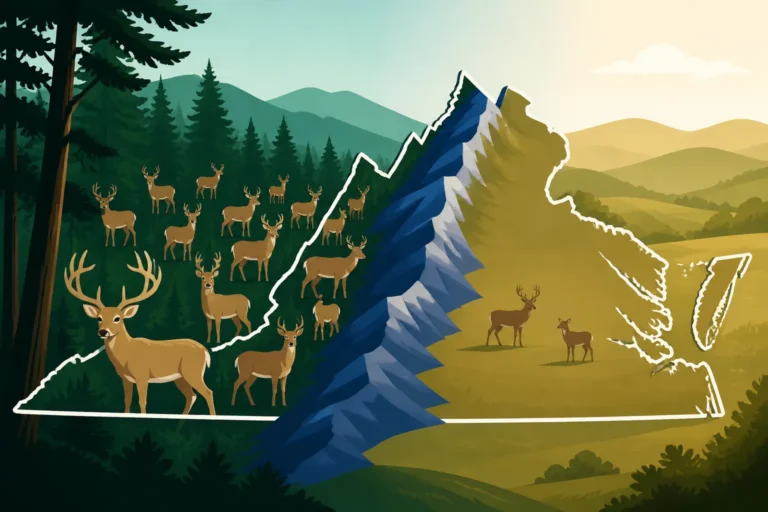
Unlike the sprawling, unbroken forests of the Appalachian Mountains to the west, or the expansive wetlands and pine plantations of the Tidewater to the east, the Piedmont presents a patchwork quilt of cover and forage. You'll find agricultural fields stretching for acres, interspersed with smaller woodlots, thick creek bottoms, and dense fencerows that act as natural travel corridors. This fragmented landscape means that deer rarely have to travel far to find everything they need. A buck might bed down in a secluded timber patch adjacent to a cut cornfield, then move to a creek bottom for water, and later browse on honeysuckle along a powerline right-of-way. This constant availability of diverse resources reduces the need for long, exposed movements, which in turn minimizes their exposure to both predators and hunters.
Consider a mature buck living in a county like Fauquier or Loudoun, which sits within the Northern Virginia CWD rules. He might spend his days tucked away in a small, overlooked woodlot, perhaps even one surrounded by suburban development. When night falls, he might slip out into manicured lawns or small farm fields, feeding on lush forage before retreating to the security of thick cover before dawn. This isn't the remote wilderness, but it’s precisely this "edge" habitat – where different ecosystems meet – that is so productive. These intricate patterns make it challenging for hunters to predict deer movement, often allowing older bucks to simply evade detection season after season. Tools like GoHunt can be invaluable here, allowing hunters to study aerial maps, identify these hidden sanctuaries, and plan their approach based on property lines and natural funnels.
Year-Round Nutrition and Diverse Forage
One of the most critical components for growing truly older, larger-bodied, and bigger-antlered bucks is consistent, high-quality nutrition throughout the year. The Virginia Piedmont excels in this department. Its rich, fertile soils support a wide array of agricultural crops, including corn, soybeans, alfalfa, and winter wheat, which provide an abundance of high-energy food sources, particularly during critical antler-growing periods and the pre-rut build-up. These calorie-dense crops are like rocket fuel for deer, supporting robust body growth and impressive antler development year after year.
Beyond agricultural fields, the Piedmont's natural vegetation also offers an incredibly diverse buffet. Think about the variety of mast crops—oaks dropping acorns, persimmons ripening in late summer, and wild grapes hanging heavy in the fall. These natural food sources complement the cultivated crops, ensuring that deer have a consistent diet regardless of the season. Creek bottoms are often lined with species like honeysuckle and greenbrier, providing excellent browse even in winter. This year-round access to a varied and nutritious diet means that bucks aren't just surviving; they're thriving, putting more energy into antler growth and body mass. This continuous nutritional support is a major reason Why the Piedmont Grows Big Bucks. It’s not just about one season; it’s about a constant supply of calories and minerals that allow a buck to maximize its genetic potential over several years.
Management Practices and Hunter Dynamics
While habitat and nutrition lay the biological groundwork, the human element—specifically how landowners manage their property and how hunters approach their sport—plays an equally significant role in the Piedmont's ability to cultivate older bucks. It's a delicate balance where collective choices directly impact the age structure of the deer herd.
Landowner Influence and Quality Deer Management
Many larger tracts of private land in the Virginia Piedmont are managed with a conscious effort towards quality deer management (QDM). This often translates into landowners, or groups of hunters, making deliberate decisions to pass on younger bucks, allowing them to mature and reach their prime. Instead, they focus on harvesting antlerless deer to manage herd numbers and maintain a healthy buck-to-doe ratio. This philosophy, whether formally adopted through programs or simply a cultural norm among hunters in the area, fundamentally shifts the odds in favor of bucks living longer. When fewer yearling and two-year-old bucks are harvested, more of them advance into the 3.5, 4.5, and even older age classes, where they can fully express their genetic potential in terms of antler size.
Furthermore, these landowners often invest in habitat improvements like planting food plots, managing timber, and creating sanctuary areas. A green field planted for deer or a carefully managed stand of clover can significantly enhance the local forage base, attracting and holding deer, particularly mature bucks, right on their property. This localized management creates pockets where older bucks can find consistent security and food, further insulating them from hunter pressure on adjacent, less-managed lands. This deliberate approach to deer management on private ground is a cornerstone of the Piedmont's reputation.
Hunter Access and Pressure Patterns
Hunter access in the Piedmont, especially on private land, tends to be more restricted than in vast public land tracts like the George Washington National Forest. This limited access means that many prime areas simply see less hunter traffic. Less pressure translates directly to higher survival rates for bucks. On a piece of land where only a few select individuals hunt, a mature buck has a much greater chance of avoiding detection and surviving multiple seasons. Compare this to heavily pressured public lands, where deer are constantly moving to avoid hunters, and their chances of making it through the general firearms season can be significantly lower.
However, even on public lands or smaller private parcels within the Piedmont, the type of hunting pressure also contributes. Often, hunters in the Piedmont are skilled and selective, choosing to pass on smaller bucks in hopes of encountering a larger one. There's a prevailing attitude of seeking quality over quantity, which reinforces the QDM principles described above. While Why Virginia's Gun Opener Draws the Biggest Crowds statewide, the pressure isn't always uniformly distributed, and many Piedmont properties offer enough cover and sanctuary that deer quickly learn to adapt. This adaptation, honed over generations, makes older bucks incredibly elusive, often moving primarily at night or utilizing escape routes that hunters rarely discover. The result is a population of deer that has learned how to survive in close proximity to human activity, leading to older animals.
Genetic Potential and Survival of the Fittest
Beyond food and management, the inherent biological characteristics of the deer themselves—their genetics and their ability to adapt to their environment—are crucial in explaining why the Piedmont consistently produces older bucks. It’s a subtle interplay between inherited traits and the natural selection pressures of the landscape.
The Role of Genetics in Antler Development
While nutrition and age are paramount, genetics undeniably play a role in the potential for antler development. The deer herd in the Virginia Piedmont has, over generations, developed a genetic pool that is conducive to growing larger antlers. This isn't to say every buck will be a Boone and Crockett contender, but the general genetic predisposition for robust antler growth exists within the population. When combined with the excellent nutrition available, these genetic traits are allowed to fully manifest as bucks age. If a buck with superior antler genetics lives long enough and eats well enough, he's more likely to produce impressive headgear.
Think about it like this: a healthy diet and proper exercise will help any person grow strong, but some people are genetically predisposed to be taller or more muscular. It's similar with deer. The Piedmont environment allows those "genetically gifted" deer to live long enough to show their full potential. This means that a buck surviving five or six seasons in the Piedmont, benefiting from a rich diet, is likely to have significantly larger and more complex antlers than a genetically similar buck of the same age who grew up in a nutritionally poor or heavily pressured environment. Understanding Virginia Deer Population Estimate and Virginia Annual Deer Harvest data can offer broad insights into herd health across regions, but local observations are key.
Adapting to Pressure and Natural Selection
The bucks that survive multiple hunting seasons in the Piedmont are, by definition, the fittest and most intelligent. They've learned to navigate the landscape, avoid detection, and adapt their behavior to human activity. This continuous process of natural selection ensures that the deer that live to an older age are those best equipped to survive. These bucks become incredibly wary, often nocturnal, and masters of utilizing subtle terrain features, thick cover, and wind currents to their advantage. They learn to avoid common hunter access points and to sense danger long before it arrives.
This learned wariness is passed down, in a sense, as younger bucks observe the behavior of older deer. The herd collectively becomes smarter and more adept at survival in a semi-developed, actively hunted landscape. This adaptation means that hunting an older Piedmont buck isn't just about finding him; it's about outsmarting an animal that has been honed by years of survival. These older bucks are often the ones found Hunting a Funnel Between Two Hollows or slipping through unnoticed areas that most hunters bypass.
Strategies for Pursuing Older Piedmont Bucks
Knowing why the Piedmont grows older bucks is one thing; actually connecting with one is another. These animals are smart, wary, and have learned to be ghosts in their own habitat. Success often hinges on a blend of meticulous preparation, understanding their behavior, and applying tailored tactics to the specific environment.
Intensive Scouting and Information Gathering
To consistently find and pursue older bucks in the Piedmont, intensive scouting is non-negotiable. This isn't just a casual walk in the woods; it's about becoming a detective. Start by studying aerial maps, both satellite imagery and topographic, using tools like GoHunt to identify potential bedding areas, travel corridors (like creek bottoms and fencerows), and feeding zones. Look for pinch points, subtle ridges, and isolated cover that might serve as a sanctuary. Understanding Reading Aerial Photos for Piedmont Deer is a fundamental skill here.
Once you have potential spots identified, it’s time for boots on the ground, but be mindful of your intrusion. During the off-season, look for older sign: large rub lines, big tracks, and worn trails leading into dense cover. Pay close attention to subtle shifts in elevation, changes in vegetation, and areas where deer might feel secure moving during daylight. Trail cameras can be incredibly useful, but deploy them strategically to minimize disturbance, focusing on travel corridors or secluded food sources. Combine your map study with on-the-ground confirmation to build a comprehensive picture of how deer, especially mature ones, utilize the terrain. Also, paying attention to Late-Season Food Sources for Virginia Whitetails can reveal hidden patterns when other food is scarce.
Employing Diverse Hunting Tactics
Older Piedmont bucks are rarely taken by chance; they require thoughtful, adaptive hunting strategies. Still-hunting can be incredibly effective in the fragmented cover of the Piedmont, allowing you to slowly pick apart small woodlots and creek bottoms, looking for bedded deer or those moving cautiously between feeding and bedding. The ability to move silently, read the wind, and interpret fresh sign on the fly is paramount. When still-hunting, remember that you're hunting an animal that knows its home intimately, so look for the unexpected.
For stand hunting, whether from a treestand or a ground blind, placement is everything. Don't just set up on the edge of a field. Instead, focus on transition areas, subtle funnels, or secluded food sources well within the timber, where a mature buck might feel comfortable moving in daylight. Setting Up on a Piedmont Field Edge means more than just a visible spot; it means finding the invisible approach and exit routes they use. Utilize the available cover to your advantage, whether it’s a dense fencerow or a patch of thick briars. The Virginia deer season structure is varied, so understanding Virginia Deer Season Structure Explained can help you tailor tactics to specific periods like the rut or late season.
Finally, consider the timing. Older bucks are often most active during low-light hours and during the peak of the rut, especially for Hunting the Rut East of the Blue Ridge. Being in your stand well before dawn and staying until after dusk, particularly during key moon phases or cold fronts, increases your odds. Be patient, disciplined, and adaptable. A single encounter with an older Piedmont buck can make all the effort worthwhile.
Piedmont vs. Mountain Region Buck Characteristics
To better illustrate the unique characteristics of bucks in the Virginia Piedmont, let’s compare them to their counterparts in the mountainous regions to the west. While both areas hold impressive deer, the environmental and management factors lead to notable differences.
| Feature | Virginia Piedmont | Virginia Mountain Region |
|---|---|---|
| Habitat Type | Mixed agriculture, scattered woodlots, suburban fringe, creek bottoms, fencerows | Large, unbroken forests, steep terrain, dense cover, oak ridges, hollows |
| Primary Food Sources | Agricultural crops (corn, soybeans), mast (acorns, persimmons), varied browse | Mast (primarily acorns, hickory nuts), limited browse, some clear-cuts |
| Deer Density | Often moderate to high, can be locally dense | Generally lower, but can vary by specific area |
| Hunter Pressure | Variable; often low on private land, moderate on public | Can be high on accessible public land, lower in remote areas |
| Average Buck Age | Tendency for higher percentage of older bucks (3.5+ years) due to QDM and restricted access | Generally younger age structure (1.5-2.5 years) due to higher harvest rates |
| Antler Potential | Excellent, due to superior nutrition and age; larger racks, heavier mass | Good, but often limited by nutrition and age; typically smaller frames |
| Body Size | Often larger body weights due to rich diet | Generally smaller body weights, leaner |
| Behavioral Traits | Highly nocturnal, wary, utilizes diverse cover, adapts to human presence | Wary of open areas, utilizes elevation, seeks deep cover, less accustomed to human proximity |
Disclaimer
This article is for general informational purposes only and does not constitute professional advice. Laws, prices and regulations vary by location and change over time. Consult a qualified professional for guidance on your specific situation.