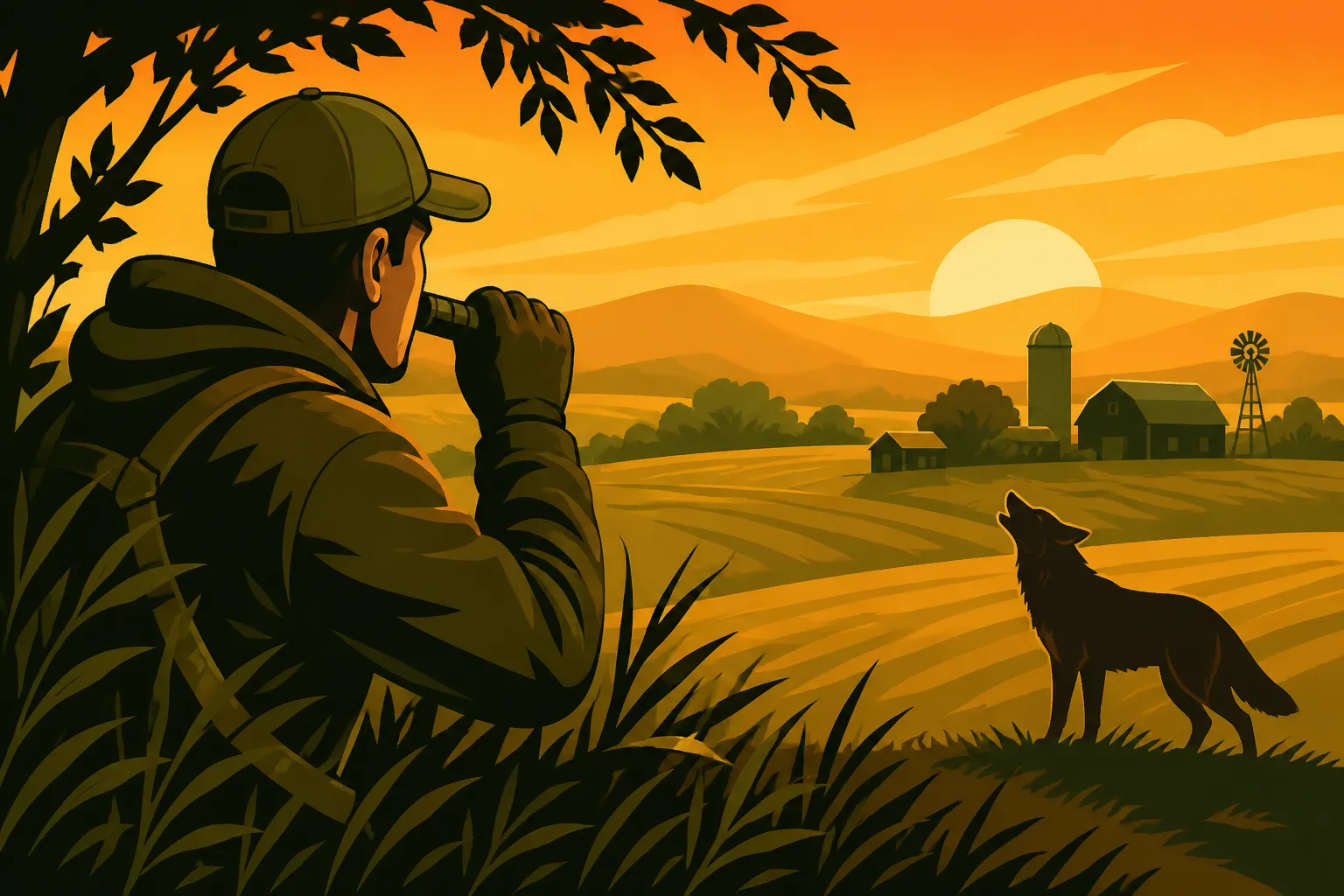
Predator Calling Virginia Farm Country
If you've spent any time at all around Virginia's sprawling farmlands, you know there's a constant, often unseen, battle being waged by local wildlife. For many landowners and even hunters looking to help manage local populations, the rising numbers of coyotes, foxes, and other opportunistic predators can be a real headache, impacting deer fawns, turkey poults, and even domestic livestock. This guide is all about equipping you with the knowledge and tactics to effectively use predator calling to your advantage in Virginia's diverse agricultural landscapes.
Understanding Your Quarry in Virginia's Farmlands
Before you even think about setting up a stand or blowing a call, you’ve got to get inside the head of the animals you’re pursuing. Virginia’s farm country isn't a single, uniform environment; it’s a mosaic of open fields, woodlots, creek bottoms, and thick fencerows. Each predator species interacts with this landscape differently, and understanding their habits is the cornerstone of successful calling.
The Elusive Coyote: Behavior and Habits
Coyotes are the undisputed champions of adaptability, and Virginia's farmlands offer them an ideal buffet. They’re smart, wary, and have an uncanny ability to learn and avoid danger. In farm country, coyotes often operate along the edges of fields, using fencerows and woodlines for cover as they patrol for rodents, rabbits, and even deer fawns. Their territories can be quite large, encompassing several farms, and they’re often most active during dawn, dusk, and throughout the night, though hungry coyotes will move anytime.
One of the biggest frustrations for hunters is how quickly coyotes become "call shy." If you’re just blasting away with generic sounds, you might call in a young, naive coyote once, but the older, wiser ones will often skirt wide or disappear altogether. They've heard it all before, especially in areas with moderate hunting pressure. Understanding their social structure—packs, pairs, or lone individuals—can also inform your calling strategy. A lone coyote might respond to a challenge howl, while a pack might be drawn in by a distressed rabbit sound, eager for an easy meal. This keen awareness of their surroundings is why simply showing up and making noise often fails; you need a strategy rooted in their natural tendencies.
Fox Species: Red and Gray Dynamics
While coyotes grab a lot of the headlines, don't underestimate the presence of foxes in Virginia's agricultural zones. Both red and gray foxes are common, each with slightly different preferences and behaviors. Red foxes tend to favor more open country, like the expansive crop fields and pastures of the Piedmont, making them more likely to respond to a visual decoy or a long-range call. They’re often seen gracefully trotting across fields, using their excellent eyesight and hearing to pinpoint prey. Their diet is similar to coyotes, focusing on small mammals and birds, but they generally pose less of a threat to larger game.
Gray foxes, on the other hand, are masters of the thick cover. You'll find them more frequently in dense woodlots, brushy creek bottoms, and the overgrown fencerows that dissect many Virginia farms. Their semi-retractable claws even allow them to climb trees, an impressive feat for a canid! This means calling for gray foxes often requires a different setup, focusing on stands within or very near dense cover rather than wide-open spaces. They might respond to similar distress calls as reds, but their approach will likely be stealthier and from unexpected angles. Knowing the terrain and which fox species is likely present can significantly improve your odds.
Other Opportunistic Predators
While coyotes and foxes are the primary targets for calling in Virginia’s farm country, you might occasionally attract other animals. Bobcat sightings are on the rise in some areas, and these elusive felines can be incredibly receptive to distress calls, particularly those mimicking bird or small rodent sounds. However, Bobcats are incredibly cautious; they’ll often circle downwind and approach with extreme stealth. Raccoons and opossums, while not typically "called," are frequently drawn to distress sounds, especially at night, as they’re opportunistic scavengers. While you might not be actively targeting these, their presence can sometimes be a clue that there’s a food source attracting predators to the area, or they might simply be a byproduct of your calling efforts. Being aware of all potential visitors allows you to better read the situation and react accordingly.
Essential Gear for Calling Virginia Predators
Just like any other type of hunting, having the right gear is paramount to success when predator calling in Virginia’s farm country. It's not just about having a call; it's about a complete system that allows you to be effective, safe, and ethical. From the device that makes the sound to the optics that help you see in low light, every piece plays a crucial role.
Calls: Electronic, Hand, and Mouth Options
The heart of predator calling is, of course, the call itself. You've got a few main categories, each with its own advantages and learning curve. Electronic calls, like those from FOXPRO or Lucky Duck, are incredibly versatile. They allow you to play a wide range of sounds – rabbit distress, bird distress, coyote howls, pup distress, even fawn bleats – at varying volumes and with realistic delivery. They can be especially effective for beginners or when you need to project sound across large fields. Many modern e-calls also come with remote controls, allowing you to place the call away from your position, drawing the predator's attention away from you. A feature often integrated into these systems, and very helpful for scouting, is the ability to map and mark areas where you've had success, which integrates well with mapping tools like GoHunt, helping you build a comprehensive understanding of productive spots.
Hand calls require more skill and practice, but they offer unparalleled realism and nuance once mastered. Open-reed calls are fantastic for mimicking rabbit and fawn distress, allowing for subtle variations in tone and volume that can fool a wary coyote. Closed-reed calls are often used for bird distress or squeakers. Howler calls, whether diaphragm or open-reed, are essential for communicating with coyotes on a social level, challenging them or locating their positions. Many experienced callers carry a mix of electronic and hand calls, using the e-call for initial attraction and then switching to a hand call for close-in, realistic finishing touches. Don't forget, practicing these calls at home, away from the hunting grounds, is crucial to sounding convincing.
Optics and Illumination for Night Hunts
Given that predators are often most active during low-light hours, good optics and appropriate illumination are non-negotiable. Binoculars, typically 8x or 10x power, are essential for scanning fields and woodlines for incoming animals, especially during twilight. You'll want good light-gathering capabilities to pick out subtle movements against fading light. For night hunting, which is legal for coyotes on private land in Virginia, you'll need specialized equipment. Red or green lights are popular choices, as many predators are less sensitive to these colors. High-powered LED spotlights with adjustable beams are commonly used, sometimes mounted on a scope or headlamp.
However, the game-changer for night hunting has been thermal and night vision optics. While an investment, a good thermal imager or monocular allows you to spot heat signatures in complete darkness, detecting coyotes and foxes that would be completely invisible to the naked eye or even traditional spotlights. Be sure to check Virginia’s specific regulations on Thermal and Night Vision Rules in Virginia for hunting, as these technologies often have specific legal guidelines. Using a combination of thermal for detection and a red/green light for positive identification and shooting is a common and effective strategy, allowing for much greater success and reducing the risk of misidentifying your target.
Firearms and Ammunition Considerations
When it comes to putting down a called-in predator, your choice of firearm and ammunition is critical. For coyotes and foxes, you're generally looking for accuracy and minimal pelt damage if you plan to save the hide. Many hunters favor small-caliber, high-velocity rifles such as the .223 Remington, .22-250 Remington, or even a .204 Ruger. These calibers offer flat trajectories and enough punch to humanely dispatch animals out to several hundred yards in open farm fields. Specific ammunition designed for varmint hunting, like V-Max or ballistic tip bullets, are excellent choices as they expand rapidly, delivering maximum energy while minimizing over-penetration, which is a key consideration when shooting in populated areas or near structures in farm country.
Shotguns, particularly 12-gauge or 20-gauge, loaded with buckshot or heavy magnum turkey loads, can be incredibly effective at closer ranges, especially in brushy areas or for quick-moving animals. When hunting in a mixed environment of open fields and dense woodlots, a shotgun might be a more versatile option for close encounters. Always be mindful of Virginia’s Virginia Legal Firearms for Deer Hunting and other game laws, as well as the immediate surroundings. Farm country often means barns, houses, and roads are closer than in vast wilderness areas. Therefore, practicing good backstop discipline and understanding your bullet's effective range are not just safety recommendations, they are ethical imperatives. You can review discussions on appropriate calibers in articles like Choosing a Rifle Caliber for Virginia Deer to ensure you're making a responsible choice for both effectiveness and safety.
Strategic Calling Techniques for Farm Country
Calling predators isn't just about making noise; it's a strategic chess match where you’re trying to outsmart a highly intelligent and wary animal. In Virginia’s farm country, where predators are often used to human activity, your setup, call choice, and patience are more critical than ever.
Setting Up for Success: Wind, Cover, and Visibility
The setup is arguably the most crucial part of any predator stand. First and foremost, always hunt with the wind in your favor. Predators, especially coyotes, have an incredible sense of smell and will almost always try to circle downwind to get a whiff of whatever is making the enticing sound. If your scent drifts into their approach path, they'll bust you every time, often without you even knowing they were there. Use a wind checker frequently. Understanding Wind and Thermals on a Blue Ridge Slope can give you a good foundation for interpreting wind direction and how it interacts with terrain, even in flatter farm environments.
Next, choose your cover wisely. You want to be hidden, but still have a clear line of sight over the area where you expect the predator to appear. This often means setting up against a fencerow, a large hay bale, a brush pile, or the edge of a woodlot. A good ground blind can be incredibly effective in providing concealment, especially in open fields, and offers the added benefit of breaking up your silhouette. Ensure you have a clear shooting lane but also some natural breaks to blend into. A popular strategy, enhanced by tools like GoHunt, is to scout potential stand locations on aerial maps, looking for natural travel corridors like creek beds, drainage ditches, and fencerows that connect woodlots. These are the highways predators use, and setting up to intercept them is key.
Finally, consider your visibility and the animal's approach. If you’re calling with an electronic call, place it 50-75 yards away from your position, preferably upwind, to draw the predator’s attention there, not directly to you. This gives you a better chance to get a shot off before they detect your presence. Always keep the sun at your back if possible, especially during morning or evening hunts, to reduce glare and make it harder for the predator to see your movements.
Mastering the Sounds: Distress, Howls, and Barks
The sounds you use are your primary tool for communication, and in farm country, variety and realism are key. Distress calls, mimicking an injured or trapped rabbit, squirrel, or bird, are generally the most effective and widely used. These tap into a predator’s instinct for an easy meal. Start with a series of loud, frantic distress calls to grab attention, then taper down to softer, intermittent whimpers and squeals to draw them in closer. Pay attention to how the sound carries across open fields versus through thick cover; adjusting your volume is critical.
Howls are another powerful tool, particularly for coyotes. Lone howls can be used as a locator call to get a response and pinpoint where coyotes are. Challenge howls or group howls can ignite a territorial response, sometimes bringing in an entire family group. This is where mastering hand calls can really shine, as the subtle inflection in a howl can make all the difference. Sometimes, a series of short, sharp barks—known as "pup distress"—can elicit a strong maternal or protective response from adult coyotes. Don't be afraid to experiment with different sequences and sounds during a stand, but generally, stick to one type of primary distress sound per stand to avoid confusing incoming animals. Remember that animals in Virginia farm country are often exposed to a lot of human noise, so your calls need to cut through that and sound undeniably natural.
Duration and Patience: The Art of the Stand
Patience truly is a virtue in predator calling, especially with seasoned farm country coyotes. Many beginners give up too soon. A typical stand should last at least 20-30 minutes, and sometimes even longer, particularly during colder weather or if you’re using more subtle calls. It's common for predators to take their sweet time, circling widely, pausing to listen, or waiting for things to feel "safe." A well-placed electronic call with a remote can keep the sound going while you remain perfectly still and ready.
Vary your calling sequence throughout the stand. Start with a loud, aggressive series for the first few minutes to cover distance, then pause for several minutes to listen and scan. If nothing shows, try a softer, more subtle sequence. Repeat this cycle, always listening for responses – a distant howl, a bark, or even the faint rustle of leaves. Sometimes, the most cautious animals will only commit after a long period of silence, thinking the "prey" has succumbed or the danger has passed. Don't fidget, don't move your head excessively, and certainly don't stand up until you're absolutely sure nothing is coming. It's that moment of relaxing vigilance when a ghost-like coyote often materializes from thin air.
Navigating Access and Regulations in Agricultural Zones
Virginia’s farm country isn’t just open land; it’s largely private property, and that comes with its own set of challenges and responsibilities. Understanding how to legally and ethically access these areas, as well as the specific hunting regulations, is non-negotiable for anyone looking to call predators.
Securing Private Land Permission
Unlike hunting vast stretches of George Washington National Forest Hunting or other public lands, predator hunting in Virginia’s farm country almost always requires securing private land permission. This can be one of the biggest hurdles, but it’s also where some of the best opportunities lie, as these areas often have less hunting pressure than public tracts. The golden rule is simple: always ask permission, even if you think the land is unposted or abandoned. Many landowners are more than happy to grant access for predator control, especially if coyotes are impacting their livestock, deer, or turkeys.
When approaching a landowner, be polite, respectful, and professional. Introduce yourself, explain why you want to hunt (e.g., to help control coyote populations affecting their livestock or deer), and show that you understand and respect their property. Offering to share game, or even just offering a helping hand with a chore, can go a long way. Having a specific plan of when and where you’d like to hunt can also be helpful. Be sure to clarify property boundaries, access points, and any specific rules the landowner might have (e.g., no hunting near houses, certain fields off-limits). Tools like GoHunt or onX Maps, which show property lines and landowner information, can be invaluable for identifying who owns what and preparing for these conversations. For a deeper dive into this often-tricky process, check out our guide on Getting Private Land Permission in Virginia.
Virginia's Night Hunting and Lighting Rules
Night hunting for certain species is a unique aspect of predator control, particularly for coyotes, as they are largely nocturnal. In Virginia, it is generally legal to hunt coyotes at night on private land with the aid of an artificial light. However, there are critical nuances you must be aware of to stay legal and safe. For instance, while you can use lights for coyotes, using them for other species like deer or bear at night is strictly prohibited. The specific regulations regarding the type of light (e.g., handheld, weapon-mounted) and any wattage restrictions should be checked annually with the Virginia Department of Wildlife Resources (DWR).
Remember that while legal for coyotes, night hunting carries additional responsibilities. Visibility is severely reduced, increasing the risk of misidentification or unsafe shot placement. Always have a clear understanding of your target and your backdrop. Never shoot towards roads, houses, or livestock you haven't identified. Having a hunting partner for night hunts can increase safety and effectiveness, as one person can run the light while the other operates the firearm. Staying informed on Night Hunting Rules for Virginia Coyotes is paramount; regulations can change, and ignorance is never a valid excuse.
Safety Considerations and Ethical Hunting
Safety should always be your top priority, whether you’re hunting during the day or night. This is especially true in farm country, where houses, outbuildings, roads, and potentially curious onlookers might be closer than you're accustomed to in more remote areas. Always practice the four fundamental rules of firearm safety: treat every firearm as if it's loaded, never point the muzzle at anything you're unwilling to destroy, keep your finger off the trigger until ready to shoot, and be sure of your target and what is beyond it.
Ethical hunting also plays a huge role. This means aiming for humane, quick kills and making every effort to recover any animal you shoot. Don't take shots you're not confident in, especially at night or at long ranges. If you wound an animal, track it relentlessly. Leave the land better than you found it, picking up any trash, spent casings, or other signs of your presence. Building a reputation as a safe, ethical, and responsible hunter will not only ensure your continued access to private land but also help promote a positive image of hunting in the wider community. Be mindful of Virginia Firearms Discharge Setback Rules which dictate how close you can discharge a firearm to roads or occupied dwellings; these distances are critical in often-dense farm landscapes.
Advanced Tactics and Common Challenges
Once you've got the basics down, it's time to refine your approach. Virginia's farm country coyotes and foxes are not always easy to fool, and adapting your tactics to changing conditions and pressure can make all the difference between an empty-handed walk back to the truck and a successful hunt.
Decoys and Scent Control for Wary Predators
Adding a visual element to your calling setup can be a game-changer, especially for those more cautious predators. Motion decoys, often resembling a rabbit or a wounded bird, provide visual confirmation of the distress sounds you’re making. This can distract an incoming predator, drawing their eyes away from your position and giving you a precious extra moment for a shot. Place the decoy 30-50 yards from your calling position, usually upwind or crosswind from where you expect the predator to approach. Battery-operated decoys that twitch or spin are particularly effective at grabbing attention.
Scent control is another critical, yet often overlooked, aspect of predator hunting. Even if you hunt with the wind in your favor, a shift in thermals or an unexpected swirl of wind can carry your human odor to a wary animal. Wear clean hunting clothes, use scent-eliminating sprays, and store your gear in airtight containers. Avoid strong-smelling foods, colognes, or laundry detergents on hunting days. While you can't eliminate all human odor, reducing it significantly can buy you crucial seconds before a coyote or fox makes you out. Integrating good scent control practices with careful wind evaluation is a powerful combination for fooling these keen-nosed animals.
Adapting to Pressure and Seasonal Changes
Predators in Virginia’s farm country are often exposed to significant pressure, whether from hunters, farmers, or even just routine human activity. This means they learn quickly and can become extremely wary. If you’re hunting an area that’s been called frequently, you might need to adjust your approach. This could mean using different, less common distress sounds, varying your calling sequence to be more subtle, or even employing social sounds (like howls) more frequently to appeal to their territorial instincts rather than just their hunger.
Seasonal changes also play a huge role in predator behavior. In the spring, during denning season, pup distress calls can be highly effective at bringing in protective adults. During the late summer and fall, when young coyotes are dispersing and everyone is getting hungry, general rabbit distress calls are usually a safe bet. During the breeding season (late winter), more aggressive howls and challenge barks can be productive. Food availability also shifts; after harvest, coyotes and foxes will heavily patrol cut fields for rodents and dropped grains. Knowing Virginia Coyote Diet in Farm Country can help you select the most appropriate and tempting calls. Adjusting your strategy not just to the time of year, but to the specific conditions of the farm and the pressure it receives, is key to consistent success.
Dealing with Non-Target Species
It's inevitable when predator calling that you’ll attract non-target species. Raccoons, opossums, and even domestic dogs or cats can respond to distress calls, especially at night. It’s crucial to positively identify your target before taking a shot, and this is where quality optics and patience become invaluable. Never assume every pair of glowing eyes is a coyote or a fox. This is another reason why a hunting partner with an additional set of eyes and a separate light source can be a huge asset during night hunts.
If you encounter domestic animals, stop calling and let them leave the area. If they persist, you may need to relocate your stand. Accidental shooting of domestic animals is a serious offense and can severely damage your relationship with landowners and the broader community. Sometimes, deer or even wild turkeys will come to a distress call out of curiosity, especially young ones. Enjoy the show, but obviously refrain from shooting outside of legal seasons and regulations for those specific game animals. Understanding your surroundings and being prepared for the unexpected is part of the challenge and excitement of predator calling in Virginia’s diverse farm country.
| Predator Species | Primary Call Type | Best Time to Hunt | Preferred Habitat | Key Strategy Notes |
|---|---|---|---|---|
| Coyote | Rabbit Distress, Howls, Pup Distress | Night, Dawn/Dusk | Field Edges, Woodlots, Fencerows | Use e-calls for range, scent control crucial, patience. |
| Red Fox | Rabbit Distress, Bird Distress, Mouse Squeaks | Night, Dawn/Dusk | Open Fields, Pastures | Decoys effective, long-range visibility, subtle approaches. |
| Gray Fox | Bird Distress, Mouse Squeaks, Rabbit Distress | Night, Dawn/Dusk | Thick Brush, Woodlots, Creek Bottoms | Close-range calling, set up in dense cover, expect stealthy approach. |
| Bobcat | Bird Distress, Mouse Squeaks, Fawn Bleats | Night, Dawn/Dusk | Heavy Cover, Timber | Extremely wary, slow and silent approach, thermal often helpful. |
Disclaimer
The information provided in this article is for educational and informational purposes only and does not constitute legal advice. Hunting regulations in Virginia can change frequently. It is the responsibility of every hunter to consult the most current Virginia Department of Wildlife Resources (DWR) regulations guide and any applicable local ordinances before engaging in any hunting activities. Always prioritize safety, ethical practices, and adherence to all laws.