Muzzleloaders Under Virginia Rules
Navigating the specific rules and regulations surrounding muzzleloader hunting in Virginia can feel like trying to hit a bullseye with a flintlock in a fog. Between traditional black powder enthusiasts and modern inline rifle users, the nuances of legal equipment, ammunition, and season dates often leave hunters scratching their heads. This comprehensive guide is here to demystify Virginia's muzzleloader regulations, helping you understand precisely what you need to know to hunt safely and legally.
Virginia's Designated Muzzleloader Seasons
Virginia provides specific opportunities for muzzleloader hunters, giving them a unique window to pursue deer and other game. These seasons are distinct from general firearms or archery seasons, and understanding their timing is crucial for planning your hunts. It’s not just about what equipment you use, but when you can use it.
Early Muzzleloader Season for Deer
The Early Muzzleloader Season is a much-anticipated time for many hunters, offering a chance to get into the woods after archery season but before the rush of general firearms. This season is typically held in November, strategically placed to coincide with, or just precede, the peak of the deer rut in many areas. This timing is a huge draw, as it allows hunters to capitalize on increased deer movement and aggressive buck behavior with a powerful, single-shot firearm.
During this period, the rules are often quite specific about the type of muzzleloader that can be used, and it's generally restricted to traditional muzzleloading firearms, meaning no modern optical sights on many public lands or specific game management units. Always check the current DWR regulations for any county-specific differences or public land rules. For instance, while some private lands might allow more flexibility, certain Wildlife Management Areas (WMAs) or National Forests might have stricter interpretations of what constitutes a "legal muzzleloader" during this specific window. It’s important to understand these distinctions to avoid any accidental violations, which can really put a damper on your hunting trip.
Late Muzzleloader Opportunities
Beyond the dedicated Early Muzzleloader Season, there are often additional opportunities to hunt with a muzzleloader. These typically occur during the general firearms season, where muzzleloaders are generally permitted alongside modern rifles, shotguns, and handguns. This means if you prefer hunting with your muzzleloader, you aren't necessarily limited to just the early season. Many hunters who enjoy the challenge and tradition of muzzleloading will carry their smoke pole right through the general firearms season, embracing the single-shot discipline even when other options are available.
Additionally, in some areas, particularly in certain urban archery zones or during specific extended seasons, muzzleloaders might be allowed under very particular conditions. These can be areas with high deer populations requiring additional harvest methods. It’s critical to remember that if you're hunting with a muzzleloader during a season that also allows modern firearms, the blaze orange requirements for general firearms season will almost certainly apply. Always verify these details with the Virginia Deer Season Structure Explained for your specific county and hunt area to ensure you’re in compliance.
Legal Muzzleloader Equipment in Virginia
Virginia's Department of Wildlife Resources (DWR) has clear guidelines on what constitutes a legal muzzleloader for hunting. This isn't just about whether it loads from the muzzle; it includes specifics about ignition, bore size, and even sights. The intention is often to preserve a certain level of primitive hunting challenge, while also acknowledging modern advancements in muzzleloader technology.
Types of Muzzleloaders Allowed
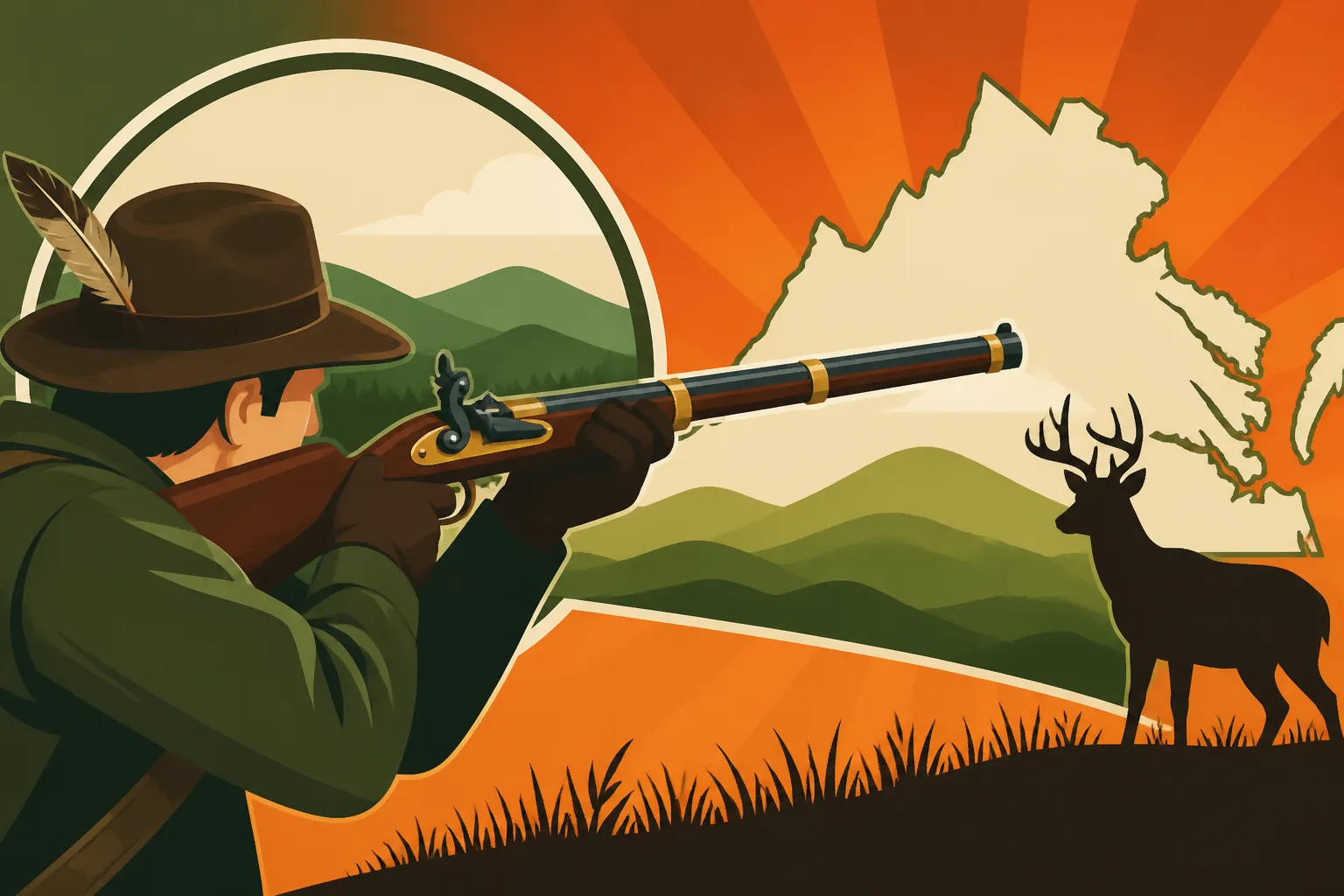
Virginia law generally permits both traditional and modern inline muzzleloaders. A "muzzleloader" is defined as a firearm loaded from the muzzle, where the powder and projectile are separately loaded. This includes traditional flintlock and percussion cap rifles, as well as the popular inline muzzleloaders that use 209 primers for ignition. The key is that they must be single-shot firearms. You cannot have a repeating muzzleloader or one that uses a magazine.
For deer hunting, the minimum bore size is typically .45 caliber, and for bear, it's generally .50 caliber. This ensures sufficient knockdown power for ethical harvesting. However, during the dedicated Early Muzzleloader Season, there might be specific restrictions. For instance, some regulations may require the use of exposed percussion caps or flintlock mechanisms, effectively excluding 209 primer inline systems during that specific window, particularly on certain public lands. Always double-check the current regulations to ensure your specific firearm is legal for the season and location you plan to hunt. Muzzleloader Deer Hunting in Virginia further details these distinctions.
Scopes, Sights, and Other Attachments
This is where many hunters find themselves asking the most questions. For general firearms season, when muzzleloaders are allowed, scopes are generally permissible. Many modern inline muzzleloaders come drilled and tapped for scope mounts, and hunters often opt for low-power variables or fixed scopes to enhance accuracy at typical muzzleloader ranges.
However, during the Early Muzzleloader Season, the rules can be different and often restrict the use of scopes. Many areas require open, iron, or peep sights only during this period, reinforcing the "primitive weapon" spirit of the hunt. This means hunters must rely on their basic marksmanship skills, which adds to the challenge and reward. Devices that project a beam onto the target, like laser sights, are generally prohibited. Always be sure to consult the DWR's latest regulations regarding specific sight restrictions, especially if you plan to hunt during the early muzzleloader season on public land, where regulations might be more stringent. Using a good mapping tool like GoHunt can help you quickly reference specific WMA or National Forest rules regarding allowed equipment.
Ammunition and Propellant Regulations
The unique nature of muzzleloaders extends to their ammunition and propellants. Unlike modern cartridge firearms, muzzleloaders require separate components—powder, projectile, and primer/ignition source. Virginia has specific rules governing these components to ensure safety and compliance with the spirit of muzzleloader hunting.
Black Powder and Substitutes
At the heart of any muzzleloader is the propellant. Virginia generally permits the use of traditional black powder (FFg, FFFg, etc.) and modern black powder substitutes (such as Pyrodex, Triple Seven, or Blackhorn 209). These substitutes are designed to burn cleaner and be less corrosive than true black powder, while still providing comparable performance. The key is that they must be loaded from the muzzle as a granular powder charge.
What you cannot use are smokeless powders designed for modern cartridge firearms. These powders burn at a much higher pressure and can be extremely dangerous, leading to catastrophic failure of a muzzleloader designed for black powder pressures. Always follow the manufacturer's recommendations for powder type and charge weight for your specific muzzleloader. Overloading or using the wrong type of powder is incredibly risky. Storing your powder properly is also vital, especially when keeping it dry during Cold-Weather Sitting Strategy in the Mountains.
Projectiles and Primers
Virginia's regulations also cover the projectiles you can use. Generally, any projectile loaded from the muzzle is permitted, including round balls, conical bullets (like Minnie balls), and saboted projectiles. Sabots are plastic sleeves that allow a smaller-diameter bullet (like a .45 caliber pistol bullet) to be fired through a larger bore muzzleloader (like a .50 caliber rifle), improving accuracy and ballistic performance.
For ignition, flintlock mechanisms are, of course, legal, using a spark to ignite the pan primer and then the main charge. Percussion caps (like #11 caps or musket caps) are also widely used. Modern inline muzzleloaders almost exclusively use 209 shotgun primers for reliable ignition, especially in adverse weather conditions. While 209 primers offer superior reliability, as mentioned earlier, some specific seasons or locations during the Early Muzzleloader Season might restrict them, favoring the more traditional exposed cap or flintlock systems. Always confirm these details with the DWR, and remember to carry plenty of primers or flints; a misfire can ruin a hunt.
Understanding the Hunter Orange and Pink Rules
Safety is paramount in hunting, and blaze orange (or pink) serves as a critical visual cue to alert other hunters to your presence. While archery hunters often have more lenient requirements, muzzleloader seasons, especially when overlapping with general firearms, typically have strict rules about visible safety colors.
Mandatory Blaze Orange Requirements
During the muzzleloader season, if it overlaps with or occurs at the same time as a general firearms season for deer, bear, or elk, blaze orange or blaze pink is almost always mandatory. This means wearing an outer garment above the waist that is at least 100 square inches in solid blaze orange or pink and visible from 360 degrees. This applies to both hunters and accompanying individuals, even if they are not actively hunting. The reasoning is clear: with more powerful firearms in the woods, visibility becomes a non-negotiable safety measure.
Even if you are hunting during a dedicated muzzleloader season where general firearms are not yet allowed, many public lands or specific regulations may still require blaze orange. It's always better to err on the side of caution and wear it, especially if there's any chance other hunters might be present. Imagine setting up for a shot and being mistaken for game by another hunter – it's a terrifying thought, and blaze orange is the simplest way to mitigate that risk. For more details on the exact dimensions and placement, refer to Virginia Blaze Orange Requirements.
Exceptions and Considerations
While the rule for blaze orange is widespread, there are a few exceptions, though they generally don't apply to muzzleloader deer hunting. For instance, waterfowl hunters in their blinds, or archery hunters not participating in a general firearms season, often have different requirements. However, for a deer hunter out with a muzzleloader, it's safest to assume you'll need blaze orange or pink.
Remember that blaze orange is about being seen by other people, not by deer. Deer are largely red-green colorblind, so they don't perceive blaze orange as a bright, unnatural color in the same way humans do. What might look like a blinding orange vest to you appears as a dull gray or brownish hue to a deer, making it an effective safety tool without compromising your camouflage from the perspective of your quarry. Using a tool like GoHunt's mapping features can also help you see hunting pressure on public land, further highlighting the need for high visibility.
Bag Limits and Reporting During Muzzleloader Season
Hunting with a muzzleloader in Virginia, whether during a dedicated season or alongside general firearms, still falls under the overall statewide and regional bag limits for deer. It's crucial to understand how your muzzleloader harvest contributes to your annual totals and the mandatory reporting requirements.
Antlered and Antlerless Deer Limits
Virginia's deer bag limits are divided into antlered (bucks) and antlerless (does) deer, with different limits for the Eastern and Western regions of the Blue Ridge. During muzzleloader season, any deer you legally harvest will count towards these regional limits. For example, if you shoot an antlered buck during the Early Muzzleloader Season, it counts as one of your allotted bucks for the year in that region, typically two in the Eastern Region and one in the Western.
Antlerless deer opportunities are generally more generous, especially in the Eastern Region, to help manage deer populations. Some muzzleloader seasons might even prioritize antlerless harvests through specific regulations. It’s imperative to know your Eastern Region Antlered Buck Limits or Western Region limits and how many antlerless deer you can take before heading afield. Keeping a tally of your harvests is important, especially if you hunt multiple seasons or regions, to ensure you don't exceed your annual bag limit.
Mandatory Deer Reporting
One of the most important responsibilities for any Virginia hunter is reporting their harvest. This isn't just a suggestion; it's a mandatory legal requirement for all deer and turkey harvests. The DWR uses this data to monitor deer populations, assess herd health, and make informed management decisions, which ultimately benefits all hunters.
After you harvest a deer with your muzzleloader, you must report it to the DWR by 5:00 PM the day after it was killed, or prior to processing if that occurs sooner. This can be done online through the DWR website, by phone, or via the official DWR mobile app. The process is straightforward, requiring information such as the county of harvest, sex of the deer, and whether it was antlered or antlerless. Neglecting to report your harvest can result in fines and other penalties, so make it a part of your post-hunt routine. A quick check of the GoHunt app often provides a direct link to the reporting system, streamlining the process even in remote locations.
Here's a quick summary of some key muzzleloader regulations in Virginia:
| Category | Early Muzzleloader Season (Deer Specific) | General Firearms Season (Muzzleloaders Allowed) |
|---|---|---|
| Ignition Types | Flintlock, Percussion Cap (often exposed) | Flintlock, Percussion Cap, 209 Primer |
| Bore Size (Deer) | Minimum .45 caliber | Minimum .45 caliber |
| Bore Size (Bear) | Minimum .50 caliber | Minimum .50 caliber |
| Projectile Types | Round Ball, Conical, Saboted | Round Ball, Conical, Saboted |
| Propellant | Black Powder or Approved Substitutes (no smokeless) | Black Powder or Approved Substitutes (no smokeless) |
| Sights Permitted | Often Iron/Peep Sights Only (check county/WMA) | Scopes, Iron/Peep Sights Permitted |
| Blaze Orange/Pink | Recommended; mandatory if concurrent with firearms season | Mandatory |
| Bag Limits | Counts towards regional/state annual limits | Counts towards regional/state annual limits |
| Reporting | Mandatory within 24 hours | Mandatory within 24 hours |
Practical Considerations for Muzzleloader Hunting in Virginia
Beyond the written rules, there are practical aspects of muzzleloader hunting in Virginia that can greatly impact your success and enjoyment. From weather preparation to shot placement, understanding these nuances will make you a more effective and responsible hunter.
Keeping Powder Dry in Wet Weather
Virginia weather in November can be unpredictable, swinging from crisp, sunny days to cold, damp, and rainy conditions. For a muzzleloader hunter, keeping your powder dry is absolutely paramount. Moisture is the enemy of black powder and its substitutes, and even a small amount can lead to a squib load, a hang-fire, or a complete misfire.
Many experienced muzzleloader hunters take extra precautions. This might include using waterproof covers over the muzzle and breech, especially for inline rifles, or carrying extra percussion caps/flints in a waterproof container. Some even use a piece of electrical tape over the muzzle to prevent moisture and debris from entering the bore. If you're hunting with a traditional flintlock, keeping your pan powder dry is a constant battle, often requiring a pan cover and careful attention. There’s nothing more frustrating than having a trophy buck step out and only hear a "click" or a "fizz" because your powder got damp. This is especially true when still-hunting Jefferson Forest Ridges in a drizzly rain.
Effective Range and Shot Placement
Muzzleloaders, while powerful, generally have a more limited effective range compared to modern centerfire rifles. For most hunters, an ethical shot with a muzzleloader on deer is typically within 100-150 yards, though some skilled shooters with well-tuned inline systems might stretch that a bit further. The key is knowing your rifle and your own capabilities.
Practicing regularly at the range is crucial to understand your muzzleloader's trajectory and recoil. Unlike a repeating rifle, you typically only get one shot with a muzzleloader. This places a greater emphasis on patience, shot placement, and waiting for the absolute best opportunity. Aim for the vital organs – the lungs and heart – just as you would with any other firearm. The large-diameter, heavy projectiles from a muzzleloader create impressive wound channels, but precise placement is still necessary for a quick, humane kill. Always consider factors like wind and thermals on a Blue Ridge Slope, as these can affect projectile trajectory.
Maintenance and Cleaning After a Wet Hunt
Black powder and its substitutes are notoriously corrosive, especially to modern steel. If you get your muzzleloader wet during a hunt, or even if it's just a damp day, it's absolutely critical to clean it thoroughly and promptly. Neglecting this step can lead to rust, pitting in the bore, and damage to the action that can permanently impair your firearm.
A thorough cleaning involves disassembling the breech plug (on an inline), scrubbing the bore with a black powder solvent, and then drying it completely. Many hunters follow up with a light coat of rust preventative oil. Don't forget to clean the action, the ramrod, and any other metal components that may have been exposed to moisture. If you’ve been hunting hard in damp conditions, perhaps Dragging a Deer Out of a Mountain Hollow, your muzzleloader has likely taken a beating. Proper maintenance isn't just about preserving your investment; it ensures your muzzleloader is reliable and safe for your next hunt. Regularly checking the DWR website or a robust hunting app like GoHunt for maintenance tips from other experienced hunters can also be beneficial.
Disclaimer
This article is for general informational purposes only and does not constitute professional advice. Laws, prices and regulations vary by location and change over time. Consult a qualified professional for guidance on your specific situation.