Zeroing at 100 Yards for Woods Hunting
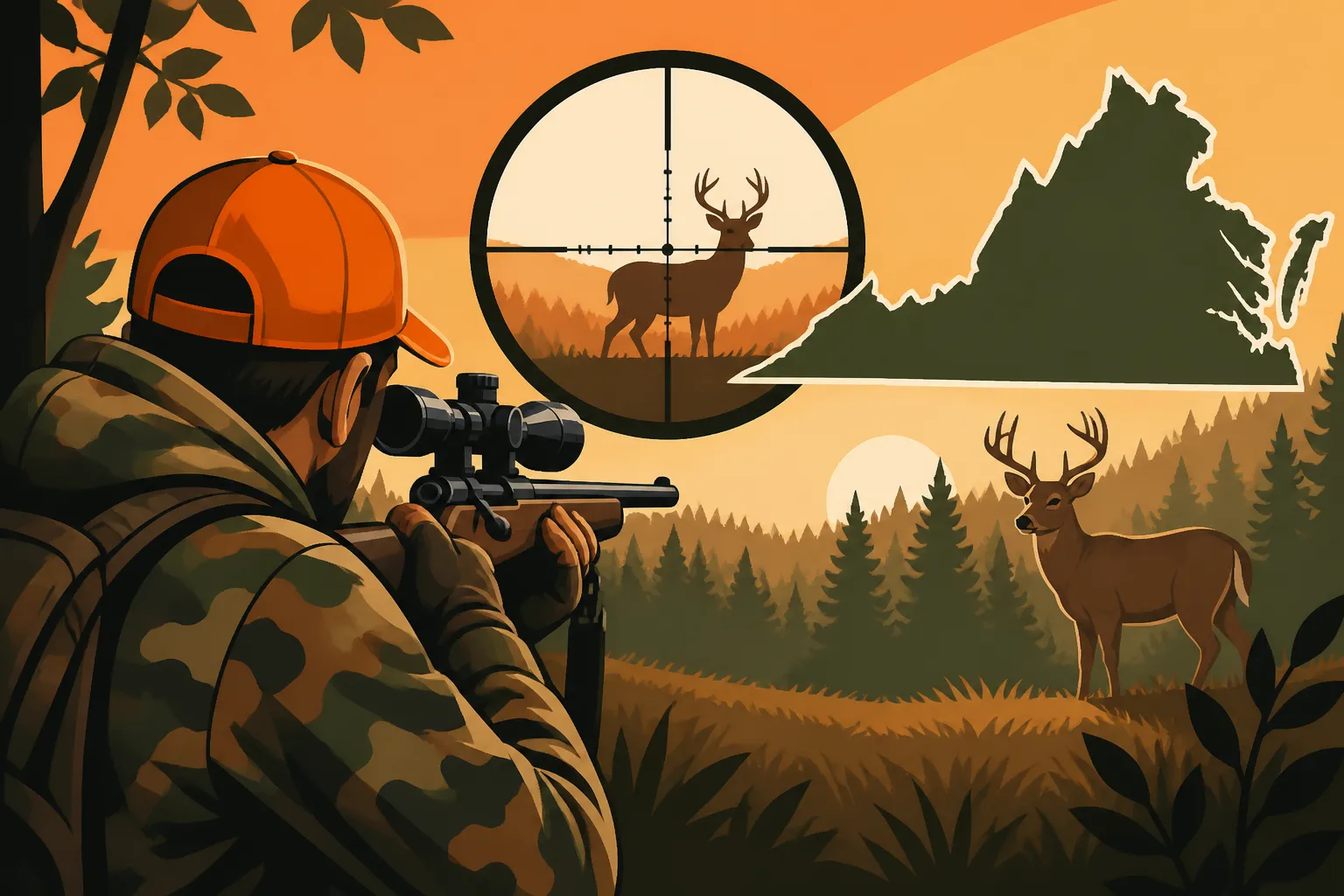
One of the most common frustrations for deer hunters in Virginia is feeling unprepared for the actual shot in the dense timber or rolling hills of our beautiful state. While it's easy to get caught up in discussions about long-range shooting, the reality for most of us is that deer encounters in our woods happen much closer than you might think. This guide is all about simplifying your rifle setup by focusing on the tried-and-true 100-yard zero, ensuring you're confident and ethical when that whitetail steps out at typical woods ranges.
Why 100 Yards is Your Go-To Zero for Virginia Woods
Let's face it, Virginia isn't the open plains of the Midwest or the vast canyons of the West. Our hunting grounds are often characterized by thick stands of hardwoods, dense pine plantations, and terrain that can vary from gradual slopes to steep, broken hollows. Thinking you'll routinely take 300-yard shots here is often a pipe dream, and setting your rifle up for such distances can actually complicate closer, more common opportunities.
Understanding Typical Shot Distances in Virginia's Terrain
When you're still-hunting through a Jefferson Forest ridge or sitting in a treestand overlooking a Piedmont creek bottom, how often do you really have a clear, unobstructed shot beyond 150 yards? For most of us, the answer is "not very often." The reality of hunting in Virginia means you're more likely to encounter deer at 25, 50, 75, or 100 yards. The dense cover and undulating topography naturally limit visibility and the distance at which you can confidently identify and shoot a deer.
Imagine you're tucked away in a stand on public land, trying to pick apart the shadows in a hardwood flat. A deer might materialize almost silently from behind a thicket, giving you a small window for a shot before it vanishes again. That shot is almost certainly going to be inside 100 yards. If you've spent all your range time obsessing over a 200-yard zero, you might find yourself overthinking holdovers or hold-unders at these closer, more common distances. A 100-yard zero cuts through that confusion. For more insights on this, check out Rifle Ranges Realistic in Piedmont Woods.
The Ballistic Sweet Spot: Point Blank Range and Bullet Drop
A 100-yard zero is a fantastic choice for Virginia's woods because it offers an excellent "point blank range" for most common deer cartridges. What does that mean? It means that your bullet's trajectory, from the muzzle out to a certain distance, stays within the vital zone of a deer without needing significant holdover or hold-under adjustments.
With a 100-yard zero, your bullet will typically rise a small amount above your line of sight between, say, 25 and 75 yards, before coming back down to impact exactly where you aim at 100 yards. Beyond 100 yards, the bullet begins to drop. For a deer's vital zone, which is roughly 8-10 inches in diameter, a 100-yard zero keeps your point of impact within that zone out to a very respectable distance for the vast majority of our hunting scenarios. This means less guesswork, less time trying to remember ballistic charts in the heat of the moment, and more confidence in making an ethical shot. This principle applies whether you're using a classic .30-30 or a modern 6.5 Creedmoor.
The Practical Steps to Achieving a Perfect 100-Yard Zero
Getting your rifle perfectly zeroed at 100 yards isn't rocket science, but it does require patience, a methodical approach, and attention to detail. Skipping steps or rushing the process can lead to frustration and, more importantly, missed opportunities in the field.
Setting Up Your Range Session for Success
Before you even load a round, make sure your range session is set up for optimal success.
- Stable Rest: This is non-negotiable. Use a sturdy bench rest with sandbags for both the forend and buttstock, or a quality shooting vice. The goal is to eliminate as much human error as possible during the zeroing process. Any wobble or instability will translate directly to inconsistent groups, making it impossible to determine if your adjustments are effective.
- Good Target: Don't skimp on targets. Use targets with clear aiming points, like a bullseye or a small square. Many hunters prefer targets with a grid pattern, which makes calculating adjustments much easier. Black-on-white or orange-on-white targets offer good contrast, especially if you're shooting during an overcast day.
- Ammunition: Crucially, use the exact ammunition you plan to hunt with. Different bullet weights, brands, and even different lots of the same brand can have varying points of impact. Zeroing with cheap practice ammo and then switching to premium hunting rounds is a recipe for disaster. Buy a box or two of your preferred hunting ammo and dedicate it to sighting in.
- Tools: Have the right tools on hand: a small screwdriver or coin for scope adjustments, a cleaning rod and patches for barrel breaks (if new), and a spotting scope or good binoculars to see your impacts without walking downrange constantly.
- Patience: This isn't a race. Take your time, let your barrel cool between groups, and focus on consistent shooting form. Trying to rush through it will only lead to poor results. If you're using a phone app like GoHunt for mapping your hunting spots, you might find some local ranges also listed there, making planning easier.
The Process: From Boresighting to Fine-Tuning
Here's a step-by-step approach to get you dialed in:
- Boresight First: If you're mounting a new scope or haven't shot the rifle in a while, boresighting is a huge time and ammo saver. You can use a laser boresighter that fits into the muzzle or chamber, or, if your rifle allows, manually boresight by removing the bolt and looking down the bore at a target 25 yards away. Adjust your scope's reticle until it aligns with what you see through the bore. This gets you "on paper" quickly.
- First Shots (25 Yards): Even after boresighting, I recommend taking your first shots at a closer distance, like 25 yards. This ensures you'll definitely hit the target, preventing frustrating "where did it go?" moments. Fire three shots, aiming consistently at the same spot. If your group is tight but off-center, make adjustments to move the point of impact towards your point of aim. Remember, if your scope clicks are 1/4 MOA at 100 yards, they'll be 1/16 MOA at 25 yards (meaning 4 times less adjustment per click).
- Move to 100 Yards: Once you're consistently hitting the bullseye at 25 yards, move your target out to 100 yards.
- Fire a Group (100 Yards): Take another three-shot group, again aiming at the center of your target with a consistent hold. Let the barrel cool between shots if possible, especially with lighter barrels.
- Analyze and Adjust:
- Measure: Carefully measure the distance from the center of your group to your point of aim (the bullseye). For example, if your group is 2 inches high and 1 inch left of the bullseye.
- Calculate: Most scope adjustments are in MOA (Minutes of Angle) or MRAD (milliradians). A common scope has 1/4 MOA clicks. This means each click moves the bullet's impact 1/4 inch at 100 yards.
- To move 2 inches down, you'd need 8 clicks (2 inches / 0.25 inches per click = 8 clicks).
- To move 1 inch right, you'd need 4 clicks (1 inch / 0.25 inches per click = 4 clicks).
- Adjust: Make the necessary adjustments to your scope's turrets. Always adjust in the direction you want the bullet to move (e.g., if it's hitting high, turn "down").
- Confirm: Fire another three-shot group after making adjustments. Your goal is for this group to be centered around the bullseye. Repeat steps 4-6 until your groups are consistently hitting dead-on at 100 yards. Don't be afraid to take your time. This confirmation step is critical, as sometimes a scope's internal mechanics don't track perfectly on the first adjustment.
Practice, Practice, Practice: Beyond the Bench
Achieving a perfect 100-yard zero from a stable bench rest is a crucial first step, but it’s not the whole story. Real-world hunting rarely offers the luxury of a padded bench and perfectly calm conditions. To truly be confident in your setup, you need to practice shooting from field positions.
- Standing, Kneeling, Sitting: Practice shooting off-hand, from a kneeling position, and sitting with your elbows braced on your knees. These are far more realistic positions you'll find yourself in when a deer presents itself in the timber or along a logging road. You might be Hunting a Ridge-Top Saddle for Rutting Bucks and need to take a shot quickly from an awkward position.
- Using Natural Rests: Practice using tree trunks, rocks, or even your backpack as improvised rests. This mimics how you'll naturally stabilize your shot in the woods. Getting comfortable with these helps build muscle memory and confidence.
- Simulate Hunting Scenarios: If your range allows, practice quick target acquisition. You won't always have minutes to set up. Simulating a deer walking through a small opening can help you learn to quickly get on target, acquire a sight picture, and make a clean shot. This kind of practice is invaluable for building true hunting proficiency.
What a 100-Yard Zero Means for Different Calibers in Virginia
The beauty of the 100-yard zero is its versatility, but it's still important to understand how different cartridges behave with this zero, especially when considering bullet drop at slightly longer distances that might arise, even in dense woods.
Common Deer Cartridges and Their Trajectories
Let's look at some popular deer cartridges often used in Virginia and how a 100-yard zero affects their trajectory within those crucial woods ranges.
| Caliber | Muzzle Velocity (approx.) | Zero Range (Yards) | Impact @ 50 Yards (inches) | Impact @ 100 Yards (inches) | Impact @ 150 Yards (inches) | Impact @ 200 Yards (inches) |
|---|---|---|---|---|---|---|
| .30-30 Win | 2200 fps | 100 | +1.2 | 0 | -3.5 | -10.0 |
| .270 Win | 3000 fps | 100 | +0.7 | 0 | -1.5 | -4.5 |
| .308 Win | 2800 fps | 100 | +0.8 | 0 | -1.8 | -5.0 |
| 6.5 Creedmoor | 2700 fps | 100 | +0.8 | 0 | -1.7 | -4.8 |
(Note: These figures are approximate and can vary based on specific bullet weight, type, and barrel length. Always confirm with your actual ammunition and rifle.)
As you can see from the table, with a 100-yard zero, most common deer calibers will be slightly high at 50 yards (less than an inch, usually). This small rise is perfectly acceptable, as it will still place your bullet well within the vital zone of a deer. Beyond 100 yards, the bullet begins to drop. However, at 150-200 yards, the drop is typically manageable for a quick holdover, especially with flatter-shooting cartridges like the .270 or 6.5 Creedmoor. This is why a 100-yard zero is so versatile for Virginia hunters; it simplifies the closer shots while still providing reasonable accuracy for those slightly longer, but still common, woods distances. For a deeper dive into caliber choices, see Choosing a Rifle Caliber for Virginia Deer or compare specific options like .308 Versus .270 for Whitetails.
Accounting for Obstacles and Angled Shots
Hunting in Virginia often means dealing with more than just distance. Our terrain presents unique challenges like shooting through light brush or navigating steep angles.
- Bullet Deflection (Branch Busting is a Myth): A common misconception is that a powerful bullet will "bust through" light brush and stay on course. This is almost never true. Even a small twig can significantly deflect a bullet, causing it to completely miss your target or, worse, wound an animal. The best practice is always to wait for a completely clear shot. No amount of zeroing will compensate for a deflecting bullet. Patience is your best tool here.
- Angled Shots (Uphill/Downhill): When hunting in mountainous regions, like those found when Hunting West of the Blue Ridge or even steep Piedmont ravines, you'll inevitably encounter uphill or downhill shots. The rule of thumb for angled shots is to always aim "lower" than you might instinctively. Gravity affects a bullet perpendicular to the earth, not necessarily along your line of sight. For any significant angle (above 15-20 degrees), the effective horizontal distance to the target is shorter than the actual straight-line distance.
- Uphill: If shooting steeply uphill, you should aim slightly lower than you would for a flat shot at the same range.
- Downhill: Similarly, if shooting steeply downhill, you should also aim slightly lower.
The good news is that for typical woods ranges (under 150 yards), the difference is usually negligible for deer-sized vitals. However, it's something to be aware of, especially if you get a slightly longer shot at a steep angle. Using an app like GoHunt that provides an angle compensation feature can be useful here.
Beyond the Zero: Ethical Considerations and Confidence
A perfectly zeroed rifle is an excellent start, but it's only one piece of the ethical hunting puzzle. True preparedness comes from knowing your equipment, understanding your limitations, and building unwavering confidence through consistent practice.
Knowing Your Rifle and Your Limitations
Every rifle and hunter combination is unique. Just because your rifle is zeroed at 100 yards doesn't mean you should automatically take every 150-yard shot that presents itself.
- Rifle's Accuracy: What kind of groups does your rifle consistently shoot at 100 yards? If it's a 1-inch rifle, you have a lot more wiggle room than if it's a 3-inch rifle. Know its capabilities.
- Your Personal Accuracy: More importantly, what kind of groups can you consistently shoot from various field positions? Be honest with yourself. If you can only group 4 inches from a kneeling position, then a 150-yard shot, even with a technically capable rifle, might be pushing your ethical limits.
- Shot Placement: A precise zero enables precise shot placement, but you are responsible for putting the bullet where it needs to go. Always aim for the vital organs – the heart and lungs. This area offers the largest margin for error and ensures a quick, humane harvest.
- Practice Under Pressure: While you can't perfectly replicate the adrenaline of a hunting situation, you can practice quick, decisive shooting. Set up targets at varying distances, present them unexpectedly, and practice your breathing and trigger control as if it were the real thing. This helps ingrain the habits needed for ethical shots when it counts. For information on specific setups, explore articles like Rifle Setups for Virginia Deer Hunting.
Building Confidence Through Repetition
Confidence isn't something you're born with; it's earned through repetition and positive reinforcement. The more you practice with your 100-yard zero, the more confident you'll become in your abilities and your equipment.
- Regular Range Time: Make regular trips to the range, even outside of hunting season. This isn't just about maintaining your zero; it's about maintaining your shooting proficiency and comfort with your rifle. A familiar rifle feels like an extension of yourself in the woods.
- Record Keeping: Keep a log of your range sessions. Note the date, temperature, ammunition used, group sizes, and any adjustments made. This can help you track performance, identify trends, and troubleshoot any issues that arise.
- Visualize Success: Beyond the physical practice, take time to mentally rehearse successful hunting scenarios. Visualize yourself making a clean, ethical shot with your 100-yard zero. This mental preparation can be surprisingly effective in boosting confidence.
- Embrace the Journey: Hunting is a journey of continuous learning. Even seasoned veterans learn new things every season. Embrace the process of improving your shooting skills, scouting techniques, and understanding of deer behavior. Your 100-yard zero is a solid foundation, allowing you to focus on other critical aspects of the hunt, like reading sign or understanding Wind and Thermals on a Blue Ridge Slope.
Ultimately, the goal of zeroing your rifle at 100 yards for woods hunting in Virginia is to build an unshakeable confidence in your ability to make a clean, ethical shot when the moment arrives. It simplifies the ballistics, focuses your practice on realistic scenarios, and allows you to concentrate on the hunt itself, rather than worrying about complex holdovers. So, get to the range, dial in that 100-yard zero, and get ready for a successful season in the Virginia woods!
Disclaimer
This article is for general informational purposes only and does not constitute professional advice. Laws, prices and regulations vary by location and change over time. Consult a qualified professional for guidance on your specific situation.