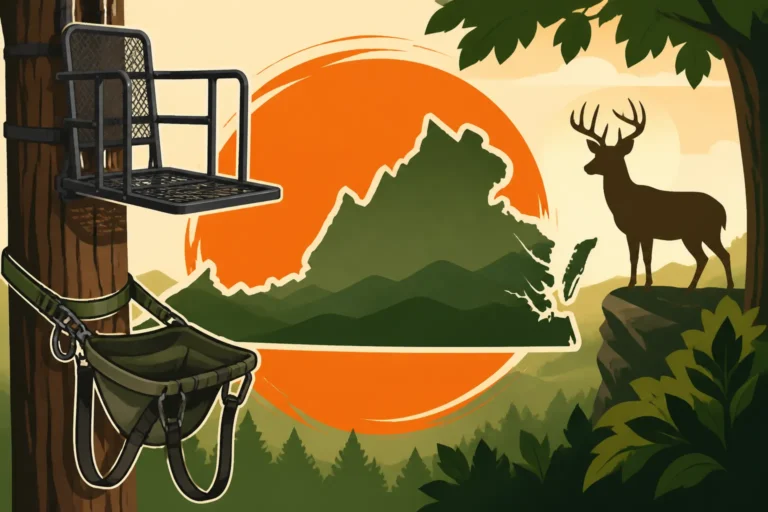
Portable Stands for Public Land Mobility
One of the biggest headaches for any hunter who spends time on Virginia's public lands is the sheer challenge of adapting to ever-changing conditions and pressured deer. You scout a spot, hang a stand, and by opening day, the deer have either moved, or another hunter has beaten you to it. It’s a frustrating cycle, but it doesn't have to define your season. This guide is all about embracing mobility on public ground, diving deep into how portable stands can transform your hunting strategy, giving you the edge to stay nimble and effective, no matter what the woods throw your way.
Why Portable Stands are Key for Public Land Hunters in Virginia
Hunting Virginia’s public lands, whether it’s the vastness of the national forests or the more contained Wildlife Management Areas, means dealing with pressure. Deer are on the move, food sources change, and competition for prime spots can be fierce. Relying on a single, permanent setup often leads to disappointment. That's where the beauty of portable stands truly shines. They give you the flexibility to react, relocate, and stay one step ahead of both the deer and other hunters.
The Need for Adaptability in Changing Conditions
Think about it: one week, the acorns are dropping heavily on a ridge in George Washington National Forest Hunting, drawing deer in like a magnet. The next, a heavy rain washes them out, or the deer have eaten them all, and suddenly, they're browsing on honeysuckle in a lowland thicket. If your stand is bolted to a tree on that depleted ridge, you're stuck waiting for a deer that might never come. With a portable setup, you can be packed up and relocated to that fresh sign, sometimes in a matter of hours. This adaptability isn't just a luxury; it's a necessity when you're working public ground.
It's not just about food sources, either. Weather patterns, especially those unpredictable Virginia cold fronts or warm spells, can drastically shift deer movement. A cold snap might push deer into thick, thermal cover, while warmer weather could have them lingering on sunny, south-facing slopes. Having a lightweight hang-on stand and a set of Climbing Sticks for Rough Bark means you’re not tied to one particular tree. You can scout fresh sign, observe deer movement, and set up in the optimal spot that day, rather than hoping the deer come to you. This responsive approach is what separates consistently successful public land hunters from those who struggle.
Minimizing Pressure and Maximizing Stealth
Public land deer are educated deer. They've seen trucks, heard ATVs, and smelled human scent. A stand that's been in the same tree for weeks or even months quickly becomes a red flag to them. Portable stands allow you to minimize your impact. You can scout an area, identify a precise location based on fresh tracks, droppings, and rubs, and then hang your stand with minimal disturbance, often on the same day you hunt it. This "one-and-done" approach reduces the amount of time human scent lingers in an area and keeps deer from patterning your presence.
Furthermore, the very act of moving a portable stand teaches you to be stealthier. You're constantly evaluating your entry and exit routes, focusing on wind and thermals, and paying attention to every twig underfoot. This heightened awareness carries over into every aspect of your hunt, making you a more effective hunter overall. Whether you're hunting a small woodlot near suburban Richmond or deep in the Jefferson National Forest Hunting, reducing your footprint is paramount. Tools like the GoHunt app can also help you identify less pressured areas by overlaying public land boundaries with terrain features, guiding you to those hidden pockets where a portable stand can shine.
Types of Portable Stands and Their Best Use Cases
Choosing the right portable stand for Virginia’s diverse public land hunting scenarios involves understanding the strengths and weaknesses of each type. What works perfectly for a quick morning sit on a Piedmont field edge might be a nightmare to use on a steep Blue Ridge slope.
Hang-On Stands and Climbing Sticks
Hang-on stands are arguably the most versatile option for public land hunters. They are typically lightweight, relatively compact, and can be hung on almost any tree with a straight enough trunk, regardless of limbs or bark texture, provided you have a good set of climbing sticks. The real magic of a hang-on is its ability to be tucked into tight cover, around bends in trails, or in irregular trees that a climber stand simply wouldn't work on. When you're trying to get into those sneaky spots, sometimes the only option is a hang-on.
The downside is that they require a bit more effort to set up than a climber, as you're hauling both the stand and multiple sticks up the tree. However, with practice, this becomes very efficient. I often use a hang-on with three or four sticks, leaving the sticks on the tree if I plan to hunt that spot again soon, or pulling them down if I'm relocating entirely. Brands like Lone Wolf Custom Gear or X-Stand Treestands offer ultra-light options that make carrying them deep into the backcountry a breeze. For hunting tricky transitions or funnels where deer movement is concentrated, especially in dense Virginia hardwoods, a hang-on paired with climbing sticks gives you unmatched precision in placement.
Climbing Stands for Quick Vertical Mobility
Climber stands are a fantastic choice when you're hunting areas with abundant, straight trees, such as mature pine plantations or even some of the more open hardwood bottoms. Their major advantage is speed and simplicity: one piece of equipment gets you up the tree and provides your platform. This makes them ideal for run-and-gun tactics, especially when you're exploring new areas or chasing active deer. When you need to get up and down quickly, perhaps scouting in the morning and hunting a different spot in the afternoon, a climber is hard to beat.
However, climbers have their limitations. They require a relatively branch-free, straight tree to ascend safely and effectively. In many parts of Virginia, especially the gnarly, limby oaks of the mountains or the brushy, overgrown tracts of the Piedmont, finding a suitable tree can be a real challenge. They also tend to be a bit noisier than a hang-on to set up if you're not careful, as the metal parts can clang together during ascent. For situations like Still-Hunting Jefferson Forest Ridges where you might need to quickly ascend a prime oak or pop up on a travel corridor, they're excellent, but always scope out your trees first.
Saddle Hunting: The Ultimate in Lightweight Mobility
Saddle hunting has exploded in popularity, and for good reason: it offers the absolute pinnacle of lightweight portability and adaptability. Instead of a large platform to sit on, you wear a harness-like saddle and lean into it while attached to a tree via a tether. Your feet are on small platforms or steps. The whole setup—saddle, platform, sticks—can often weigh less than 10-15 pounds, making those long hikes into remote public land spots much more manageable. The ability to shoot 360 degrees around the tree is another huge advantage, perfect for those times a deer pops up unexpectedly from a direction you weren't expecting.
The learning curve for saddle hunting can be steeper than traditional stands, and it certainly feels different, but the benefits for public land hunters are immense. You can effectively hunt trees that are too small, too crooked, or too limby for traditional stands. This opens up a huge amount of previously unhuntable terrain. When you need to get into a super thick bedding area or perch high on a ridge where only a small sapling offers cover, a saddle is often the only viable option. Saddle Hunting in Virginia Hardwoods is a game-changer for those seeking to truly disappear into the landscape. Many hunters use mapping tools like GoHunt to identify potential saddle locations deep within large public tracts.
Ground Blinds: When Trees Aren't an Option
While technically not a "stand," portable ground blinds are an essential part of a mobile public land strategy, especially when hunting open areas or places with sparse, unsuitable trees. Imagine a wide-open field edge, a cut-over section, or even a marshy area where trees are nonexistent. A compact, pop-up ground blind can provide instant concealment, allowing you to hunt spots that would otherwise be impossible. They're also a great option for hunters who prefer not to be elevated or for youth hunters where safety on the ground is paramount.
The key with ground blinds on public land is ensuring you have adequate cover to brush them in naturally. A blind plopped in the middle of an open field will stick out like a sore thumb. Look for natural breaks, fencerows, standing corn, or thick brush lines to set up your blind and then use natural vegetation to break up its outline. While they don't offer the scent dispersion benefits of an elevated stand, they provide excellent concealment and comfort, especially in foul weather. For Using a Ground Blind on Virginia Public Land, remember that blending in is everything, so take the extra time to make it look like part of the landscape.
Key Features to Look for in a Virginia Public Land Stand
When you're outfitting yourself for public land hunting in Virginia, every piece of gear needs to pull its weight. A portable stand is no exception. Focusing on specific features will ensure your investment pays off in terms of effectiveness, comfort, and safety.
Weight and Packability
This is arguably the most critical factor for a portable stand on public land. Every ounce matters when you're hiking a mile or two (or more!) deep into a WMA or national forest. A heavy stand that's cumbersome to carry will deter you from using it to its full potential, limiting your mobility. Look for stands made from aluminum or other lightweight alloys. Many modern hang-on stands are designed with minimalist platforms and frames to shave weight.
Consider the stand's profile when packed. Does it sit flush against your pack, or does it snag on every branch? Can it be easily secured to your frame pack along with your sticks and other gear? A compact, streamlined design not only makes it easier to carry but also quieter as you move through thick timber. My general rule of thumb for a hang-on and sticks is to aim for a combined weight under 20 pounds, allowing me to comfortably carry Packs for a Jefferson Forest Day Hunt without feeling like I'm lugging a small car. The GoHunt app can help you map out realistic distances, giving you a better idea of how far you might actually be packing your gear.
Quietness and Stealth during Setup
Public land deer are hypersensitive to noise. The clanging of metal on metal during setup can blow your hunt before you even get settled. Pay close attention to how well a stand is designed for quiet operation. Does it have silent attachment points? Are there rubber or felt pads on contact points to minimize noise? Even small details, like cam-buckle straps instead of noisy chains or cables, can make a huge difference.
Before you take your stand into the field, spend time in your backyard practicing setting it up silently. Identify any parts that might rattle or squeak and address them with tape, shrink wrap, or rubber stoppers. This pre-season prep is crucial. When you're trying to Find Ground Others Walk Past or sneak into a tight bedding area, every bit of silence during your ascent counts. A noisy stand will educate deer to your presence, making future hunts in that area exponentially harder.
Ease of Setup and Take Down
Time is of the essence when you're trying to intercept a deer moving through a temporary travel corridor or quickly shift positions during a morning hunt. A stand that's complicated or fiddly to set up will waste precious hunting time and potentially create more noise and frustration. Look for stands with intuitive attachment systems that can be quickly and securely fastened to a tree, even in low light. Quick-attach climbing sticks that nest together for transport also speed up the process.
Practice, practice, practice! Getting proficient with your setup in daylight at home will make a world of difference when you're doing it in the dark before dawn, with cold fingers, in the middle of nowhere. Some stands are designed with a single strap or chain that makes attachment a breeze. For saddles, getting used to your rope attachments and platform adjustments is key. The faster and smoother your setup, the less disturbance you create, and the more confident you'll be in relocating throughout the day if needed.
Mastering Mobility: Tactics for Setting Up and Moving Your Stand
Having a portable stand is one thing; effectively using it to boost your success on public land is another entirely. It requires a mindset shift towards continuous adaptation and a mastery of efficient movement.
Pre-Season Scouting and In-Season Adaptations
Your mobility strategy starts long before opening day. Scouting Virginia Public Land Before Season is paramount. Use mapping tools like GoHunt to identify promising areas: pinch points, funnels between hollows, benches on ridgelines, or specific oak flats. But don't just find one spot; identify multiple potential stand locations within an area. Look for multiple entry and exit routes that consider Wind and Thermals on a Blue Ridge Slope. Mark a few "hot zones" where you anticipate deer movement, giving you options.
Once the season starts, your scouting never really ends. Every time you're in the woods, you're gathering intelligence. Did deer move differently because of the rain? Did pressure from other hunters push them into a new area? Are they hammering a new food source that just became available? Be willing to move. If your spot isn't producing, don't waste days there. Pack up your portable stand and relocate to where the deer are. This might mean pulling up your stand mid-day and moving it a quarter-mile, or it could mean driving to a completely different part of the WMA the next morning.
Optimizing Entry and Exit Routes
This is where the true art of public land mobility comes into play. You can have the best stand in the world, but if your entry and exit spook deer, it's all for naught. When selecting a new stand location, always consider how you'll get in and out undetected. Use terrain features like creek beds, ditches, or ridge lines for cover. Avoid walking through known bedding areas or across open fields in daylight. Your approach should be silent, scent-free, and as invisible as possible.
For a morning hunt, plan to arrive at your stand well before daylight, giving the woods time to settle after your entry. For an evening hunt, ensure your exit path won't bump deer out of their feeding areas. Sometimes, the best exit route is the longest one, taking you far around a feeding area to avoid detection. GoHunt's mapping features can be incredibly helpful for visualizing these routes, allowing you to draw paths that skirt sensitive areas and take advantage of topography. Remember, a portable stand means you're not locked into a single approach; you can change your route as conditions dictate.
Strategic Relocation and Hunting Pressure
One of the biggest frustrations on public land is dealing with other hunters. You scouted a killer spot, hung your stand, and arrive opening morning only to find another truck parked at the trailhead or even another hunter in your tree. It happens. This is precisely when your portable stand becomes your best friend. Instead of throwing in the towel, you can quickly pivot. Have a backup plan, or better yet, a backup to your backup.
Maybe that means moving a few hundred yards down the ridge to an overlooked saddle. Perhaps it means packing up entirely and driving to a different section of the forest you've scouted. The ability to quickly and efficiently relocate is your ultimate defense against hunting pressure. Rather than letting the presence of others ruin your hunt, it simply triggers your contingency plan. Knowing how to quickly Deer Drives With Three or Four Hunters or Posting a Drive Around a Mountain Hollow also benefits from this mobile mindset, ensuring you're always in a high-percentage spot when the deer are moving.
Portable Stand Comparison Chart
To help you visualize the trade-offs, here’s a quick comparison of the common portable stand types for public land.
| Stand Type | Pros | Cons | Ideal Public Land Use Cases |
|---|---|---|---|
| Hang-On | Versatile, lightweight, quiet, precise | More setup components (sticks), can be slower to move | Dense cover, crooked trees, specific ambush points, Hunting a Funnel Between Two Hollows |
| Climber | Fast setup on ideal trees, self-contained | Requires straight, branch-free trees; can be noisy | Mature pine stands, open hardwood bottoms, scouting expeditions |
| Saddle | Ultra-light, 360-degree shooting, flexible | Steeper learning curve, different feel, minimal platform | Thick bedding areas, small or awkward trees, deep backcountry, extreme stealth |
| Ground Blind | Instant concealment, comfortable, no trees needed | Limited visibility, scent containment issues, requires brushing in | Field edges, clear-cuts, marshy areas, Hunting a Standing Cornfield in Farm Country, youth hunts |
Remember, the "best" stand isn't a one-size-fits-all answer. It's the one that best suits your hunting style, the specific terrain you'll be hunting, and your willingness to adapt.
Disclaimer
This article is for general informational purposes only and does not constitute professional advice. Laws, prices and regulations vary by location and change over time. Consult a qualified professional for guidance on your specific situation.