Setting Up on a Piedmont Field Edge
Hunting Virginia's Piedmont can be incredibly rewarding, but figuring out where to position yourself, especially along those tempting field edges, can feel like a constant puzzle. You see the deer moving into the fields at dusk, only for them to vanish into thin air if your setup isn't absolutely dialed in. This guide dives deep into the nuances of effectively setting up on a Piedmont field edge, helping you understand deer movement, master concealment, and choose the perfect spot for success.
Understanding the Piedmont Field Edge Dynamics
The Piedmont region of Virginia is a unique tapestry of rolling hills, mixed hardwoods, pine thickets, and agricultural fields. These field edges are often deer magnets, drawing them in like clockwork, but they also present unique challenges for hunters trying to intercept that movement. It’s not enough to just pick the biggest oak overlooking a cornfield; you need a strategy.
The Allure and The Pitfalls of Field Edges
Field edges are inherently attractive to deer for a few simple reasons. First and foremost, they provide a consistent, high-quality food source. Whether it's standing corn, a lush soybean field, winter wheat, or a clover plot, deer are hardwired to seek out these nutritional buffets. Second, these edges act as critical transition zones. They're the natural highways between bedding areas deep in the woods or thickets and the open fields where deer feed. You'll often see deer staging along these edges, browsing on acorns or saplings before committing to the open. This makes them prime locations for intercepting a mature buck moving from cover to feed.
However, the very thing that makes them attractive also creates significant pitfalls. Field edges, by their nature, are exposed. The open expanse of a field offers deer an unparalleled view of their surroundings, making them incredibly wary of anything out of place. This means human scent, sight, and sound are magnified. I can't tell you how many times I've watched deer casually step out of the timber, only to stop dead in their tracks, scent-checking the wind, or peering intently into the shadows of the tree line, seemingly knowing something wasn't right. If you're not meticulously careful with your approach, concealment, and wind management, those deer will bust you before you even know they're there, leaving you frustrated and empty-handed.
Reading the Landscape: What Deer Sign to Look For
Before you even think about hanging a stand or setting up a blind, you've got to become a detective. The woods surrounding a Piedmont field edge are full of clues, if you know how to read them. Start by looking for heavy trails. These aren't just faint deer paths; we're talking about compacted earth, sometimes a foot wide, where generations of deer have traveled. Pay close attention to where these trails enter and exit the field. Are there multiple entry points, or does it seem like most deer funnel through one or two key areas? Often, deer will use the path of least resistance, especially if it provides cover, like a natural ditch, a small knoll, or a thick fencerow.
Beyond trails, look for more immediate sign. Fresh tracks in the mud or soft dirt at the field edge are golden. Are they heading into the field, out of the field, or both? Are there different sizes of tracks, indicating multiple deer or perhaps a larger buck? Scat, or deer droppings, can tell you not only that deer are present but also what they're eating and how recently they've been there. Fresh, dark, moist scat means deer were there very recently.
Then, there are rubs and scrapes. While rubs might be more sporadic along a field edge, a series of fresh rubs on small trees or saplings leading into a field can indicate a buck's preferred travel corridor. Scrapes, those tell-tale pawed-out areas with an overhanging licking branch, are absolute magnets. Bucks use them to communicate their presence, and they're often found just inside the timber line, close enough to the field to be seen and scented, but offering the buck a bit of cover. Finding a cluster of fresh scrapes along an edge is like hitting the jackpot. You'll want to prioritize these spots, as they show consistent buck activity. These signs give you a much clearer picture of how deer are using that particular field edge and where you should focus your efforts. For example, if you see a well-used trail winding along a creek bottom and entering a standing cornfield, you know that’s likely a high-traffic area. If you want to dive deeper into understanding these pathways, reading Virginia mud for fresh deer movement can provide even more insights into current patterns.
Strategic Stand Placement and Entry/Exit Routes
Once you've done your scouting homework and identified potential hotspots along the Piedmont field edge, the real challenge begins: selecting the perfect stand location and ensuring your approach and departure don't blow your hunt. This is where many hunters make critical mistakes, often choosing convenience over stealth and strategic positioning.
Optimizing for Wind and Thermals in Open Areas
If there’s one golden rule for hunting any game animal, it’s "hunt the wind." Along a Piedmont field edge, this rule becomes even more paramount. Deer rely heavily on their sense of smell, and in the relatively open environment of a field border, your scent can carry far. Always position yourself downwind of where you expect deer to approach or feed. This sounds simple, but it requires careful planning and often means you might have to forego a "perfect" looking tree if the wind isn't right.
The challenge is compounded by thermals, especially in the rolling topography of the Piedmont. In the mornings, as the air warms, thermals tend to rise. This means your scent will lift upwards and then carry over ridge tops or across open areas. In the evenings, as the air cools, thermals drop and sink into hollows and low-lying areas. So, if you're set up on a hillside overlooking a field, your scent might actually drift down into the field as the evening progresses, even if the prevailing wind is blowing across. Understanding these subtle shifts is crucial. For instance, if you're hunting a field bordered by a small creek bottom, the cool air settling into that bottom at dusk can carry your scent right down the drainage, even if your wind checker shows the wind blowing away from the field at your stand level. I've found using a tool like GoHunt to plot wind and thermal predictions for specific times and locations can be a game-changer for these nuanced situations. It helps you visualize how your scent cone will travel, allowing for smarter stand placement.
Concealment and Approach: Minimizing Your Footprint
Choosing the right tree or blind location isn't just about the view; it's about blending in completely. For a treestand, look for a tree with good natural cover—think evergreens like cedars or pines, or a thick oak with plenty of limbs. Position yourself so you have shooting lanes but are also silhouetted against a busy background, not a clear sky. A classic mistake is hanging a stand in a lone tree on a field edge, making you stick out like a sore thumb. Instead, find a cluster of trees, or a tree within a thicker fencerow that offers more concealment. If you're using a ground blind, ensure it's brushed in thoroughly. A commercially available blind plopped in the middle of a sparse field edge will scream "human presence" to a wary whitetail. You’ll want to gather local foliage—branches, tall grasses, cornstalks—and weave it into the blind's exterior to break up its outline.
Perhaps even more critical than stand placement is your entry and exit route. This is where countless hunts are ruined before they even begin. You need a path to your stand that keeps you out of sight and scent-free from the deer's perspective. Think about using natural barriers like creek beds, ditches, fencerows, or the backside of a ridge to shield your movement. If you're hunting a standing cornfield in farm country, for example, walking along the edge of the corn can offer fantastic concealment. Always approach and leave your stand in the dark, well before dawn and well after dusk, to avoid bumping deer that might be feeding in the field or staging nearby. Remember, any deer you spook on your way in or out might be gone for good. If you're setting up on a field edge bordered by a dense thicket, your entry might involve a long, winding walk through that cover to emerge at your stand location unnoticed. This meticulous attention to your approach is a cornerstone of successful hunting, and understanding entry routes through standing soybeans or even working a fencerow for late-season deer can make all the difference in consistently getting into position without alerting game.
Gear and Tactics for Piedmont Field Edge Success
Having the right gear and an adaptable tactical mindset are what separate consistent success from frustrating close calls when hunting Virginia’s Piedmont field edges. These aren't just minor details; they're integral components that enable you to capitalize on the deer activity you've scouted.
Essential Gear for Field Edge Hunting
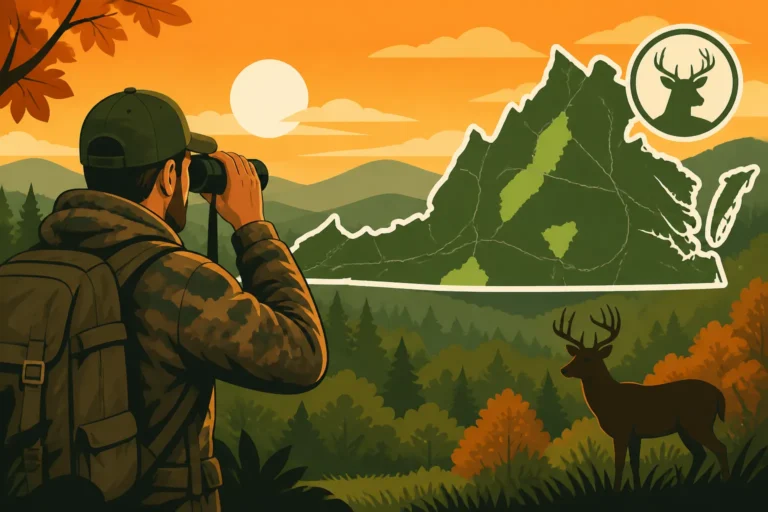
When it comes to field edge setups, your gear selection needs to be thoughtful. First, for optics, a good pair of binoculars is non-negotiable. Whether you're glassing the field at first light to identify deer emerging from cover or scanning for movement within the timber line as dusk settles, clear optics make a massive difference. An 8x or 10x magnification is usually perfect for the typical distances you'll encounter on a Piedmont field edge. A rangefinder is also incredibly useful, especially if you anticipate shots across the open field. Knowing exact distances helps you make ethical shots and avoid misjudging yardage in low light.
For your stand, you have options. A hang-on treestand combined with climbing sticks offers excellent versatility for reaching mature trees with good cover. This setup allows you to get high enough to see over field edge vegetation and can be adjusted quickly if you need to move based on new sign or changing wind. If you prefer to stay on the ground, a ground blind can be incredibly effective, especially if you're hunting with a crossbow or muzzleloader. The key with a ground blind is to set it up well in advance of your hunt, preferably weeks, and brush it in meticulously to allow deer to get accustomed to its presence. For more on this, checking the specific ground blind rules on Virginia WMAs can be helpful even for private land, ensuring you understand best practices for concealment and placement.
Scent control is another huge factor. Since field edges often have less dense cover, your scent can be a major liability. Invest in good scent-eliminating sprays, wash your hunting clothes in scent-free detergent, and consider storing them in airtight bags. While no system is 100% foolproof, minimizing your human odor is crucial. Using GoHunt's mapping features can help you pick stand locations that best leverage prevailing winds, but even then, meticulous scent control is essential to avoid alarming deer that are approaching the field. Don't forget other small but important items like a headlamp for dark entries and exits, a small pack for snacks and water, and a comfortable seat cushion for those long, patient waits. For those hunting in more developed areas, good scent control gear for urban archery hunts applies just as much to field edges in agricultural zones, where deer are often more accustomed to human smells but still react strongly to direct, unfamiliar odors.
Adapting to Deer Behavior and Pressure
Deer behavior around field edges isn't static; it changes dramatically with the season, hunting pressure, and the availability of different food sources. Early in the season, when temperatures are warm and crops like soybeans and corn are still standing, deer often feed in the fields during daylight hours, especially if pressure is low. They might emerge confidently shortly before sunset. During this time, setting up closer to their suspected bedding areas or primary entry points can be highly effective.
As hunting pressure increases, or as crops are harvested, deer become more nocturnal and wary. They might wait until full dark to enter fields, or they might "stage" longer just inside the timber line, browsing on acorns or other natural forage before committing to the open. This is when your stand needs to be positioned for these staging areas, rather than directly overlooking the field itself. During the rut, bucks might cruise field edges at any time of day, scent-checking for does, making these areas prime for opportunistic encounters.
Come late season, after the leaves have fallen and many crops are gone, deer will focus heavily on remaining food sources. This could be leftover corn, winter wheat, brassicas, or acorns if available. Understanding late-season food sources for Virginia whitetails becomes critical. If a particular field has a standing patch of unharvested corn, or a planted food plot, that will be a magnet. Your tactics need to adapt: perhaps moving your stand to cover a more subtle entry point, or shifting your focus to an area where deer feel more secure moving during daylight. Hunting a standing cornfield in farm country, for instance, requires different positioning than hunting an open cut bean field. It’s all about constantly observing, adapting, and being willing to move your setup based on what the deer are telling you through their patterns and the sign they leave behind.
Real-World Scenarios and Troubleshooting
Even with the best planning, hunting Piedmont field edges often throws curveballs. Deer are masters of adaptation, and successful hunters must be too. Knowing how to troubleshoot and adjust your strategy on the fly can turn a frustrating outing into a triumphant one.
The Overlooked Edges: Finding Less-Pressured Spots
One of the biggest frustrations with hunting popular field edges is the sheer amount of pressure they receive. Everyone wants to hunt where the deer are, and often, that means everyone ends up in the same general areas. When deer feel pressured, they change their patterns almost immediately, often becoming nocturnal or abandoning high-traffic areas altogether. This is where finding less-pressured spots becomes paramount.
Instead of focusing solely on the largest, most obvious agricultural fields, start looking for smaller, more secluded pockets of food. This could be a tiny, overgrown half-acre plot of clover tucked away behind a logging road, a narrow strip of standing corn missed by the combine, or even a forgotten persimmon patch along an old fencerow. These "mini-fields" often get overlooked by other hunters because they're not as prominent, yet they can hold deer that are looking for a sense of security while they feed. Use high-quality mapping tools, like those offered by GoHunt, to identify these subtle variations in land use. Look for aerial photos that show breaks in large timber blocks, small clearings, or old homesteads that might have remnant fruit trees. These are the kinds of places where you can often find unpressured deer.
Another strategy is to hunt the "backside" of a major field—the side furthest from easy road access or popular parking areas. While it might mean a longer, more challenging walk, you're significantly increasing your chances of encountering deer that haven't been harassed. Sometimes, deer will utilize a large field but only enter from the most secluded corner, especially a corner that offers a thick, brushy entry point rather than an open, exposed one. Being willing to put in the extra effort to find ground others walk past can be the key to consistent success on pressured public and private lands alike. It's about thinking like a deer and asking yourself, "Where would I feel safest eating?"
Dealing with Changing Conditions
The Piedmont environment is dynamic, and conditions can change rapidly, forcing you to adapt your field edge strategy.
Crop Rotation and Harvest: A field that was a prime feeding spot during the early season might be completely barren after harvest. If soybeans or corn have been cut, the primary draw is gone. In this scenario, deer will shift their focus. You'll need to scout for new food sources: recently planted winter wheat, brassica plots, or natural mast like acorns if it's been a good year. If a field has been cut, deer might still visit to glean overlooked grains, but their movement patterns will likely change, possibly becoming more hesitant or visiting during darker hours. Your stand might need to be repositioned to a nearby patch of timber that still holds food, or to a funnel between a new food source and bedding cover.
Weather Fronts: A cold front can drastically increase deer activity, often prompting them to feed more aggressively during daylight hours. This is an excellent time to be in your stand overlooking a field. Conversely, a warm front or persistent rain can make deer lie low. You might need to adjust your timing, focusing on the brief windows of activity around dawn and dusk, or moving to heavier cover where deer might feel more secure during inclement weather. For instance, after a poor acorn year, deer will be much more reliant on planted crops or browse, making field edges even more critical.
Wind Shifts: Perhaps the most frustrating change is an unexpected wind shift. You've meticulously picked your stand based on the forecast, only for the wind to swirl or completely reverse directions. In these cases, it's almost always better to abandon your current setup and find an alternative, even if it's a less ideal spot, that keeps the wind in your favor. Pushing through with a bad wind will inevitably result in busted deer. This is where having a few backup stand locations or ground blind setups for different wind directions can save your hunt. Always have a plan B, and even a plan C, for various conditions. Being adaptable and willing to move is a hallmark of a successful Piedmont field edge hunter.
Disclaimer
Hunting is an inherently dangerous activity. Always prioritize safety by adhering to all local, state, and federal hunting regulations. Ensure you understand and follow proper firearm and archery safety, wear appropriate blaze orange or pink when required, and inform someone of your hunting location and expected return time. This guide is for informational purposes only and does not substitute for professional training or direct instruction. Always check the current Virginia Department of Wildlife Resources (DWR) regulations before heading afield, as rules and seasons can change.