Virginia Legal Firearms for Deer Hunting
There's nothing quite like the crisp air of a Virginia autumn morning, or the anticipation of stepping into the woods for deer season. But before you even think about climbing into a stand or still-hunting a ridge, you need to be absolutely sure your gear is legal. Navigating Virginia's deer hunting regulations, especially concerning firearms, can feel like trying to untangle a stubbornly knotted fishing line. Many hunters, new and old, often find themselves wondering about caliber restrictions, whether shotguns can use buckshot, or if their handgun is truly allowed in the deer woods. This guide aims to cut through that confusion, providing clear, actionable information on what firearms are legal for deer hunting in Virginia, so you can hunt confidently and within the bounds of the law.
Understanding Virginia's Core Deer Hunting Regulations
Getting ready for deer season in Virginia means more than just scouting and practicing your shot. It means understanding the rules that govern what you can legally carry into the field. These regulations are designed to promote safety, ensure fair chase, and manage the deer population effectively. Disregarding them, even accidentally, can lead to serious consequences, so a solid grasp of the fundamentals is absolutely essential.
The Basics of Legal Deer Hunting Firearms
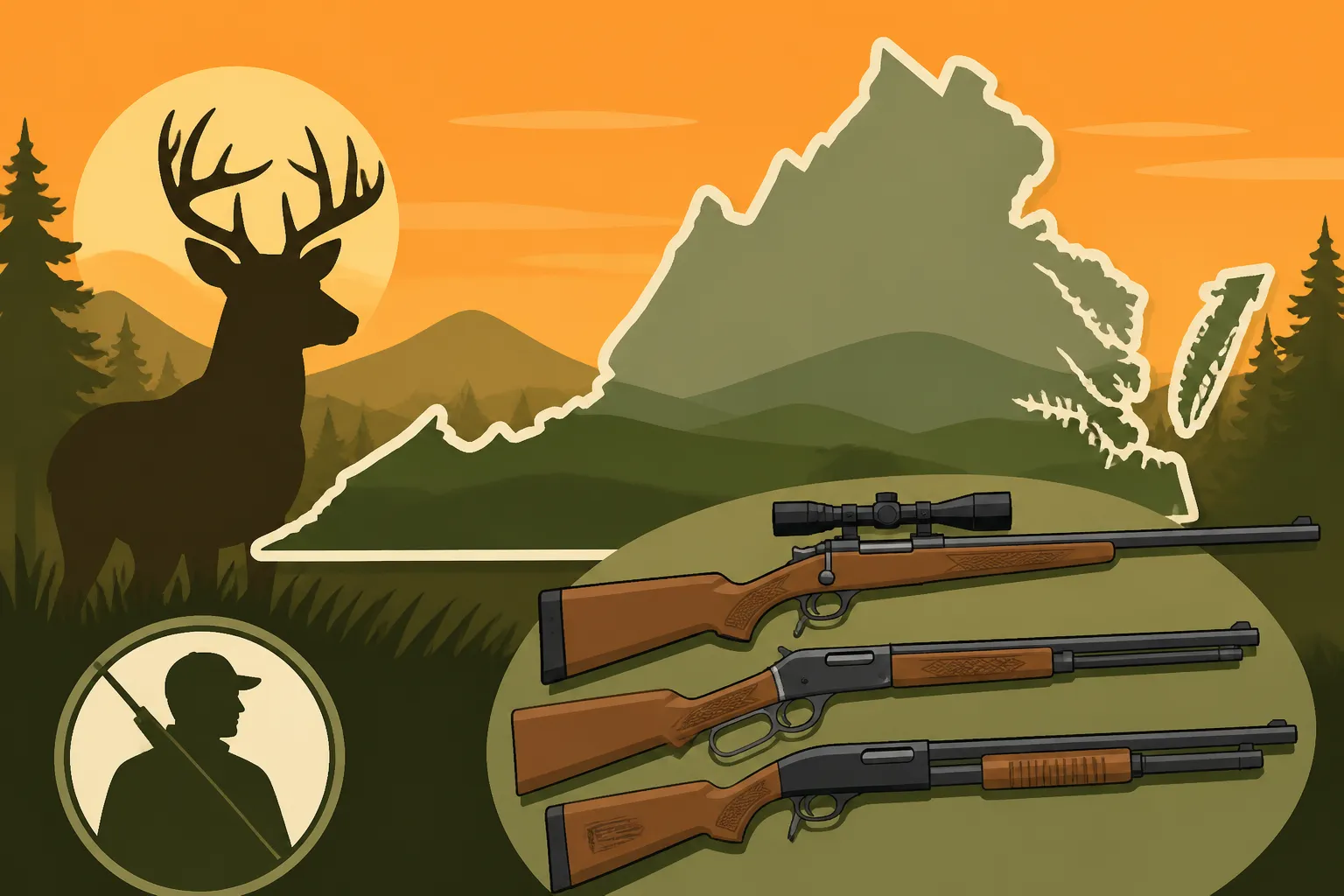
Virginia offers a range of options for deer hunters when it comes to firearms, accommodating various hunting styles and preferences. Broadly speaking, you're looking at rifles, shotguns, muzzleloaders, and handguns. However, each category comes with its own set of specific parameters you need to adhere to. The Virginia Department of Wildlife Resources (DWR) sets these rules, and they are regularly updated, so staying informed is key. For a comprehensive overview of when and where you can hunt, refer to the larger guide on Virginia Deer Season Structure Explained.
When we talk about "legal firearms," we're really discussing a combination of factors: the type of firearm, its caliber or gauge, and the kind of ammunition it uses. For instance, while a high-powered rifle might be perfectly legal in one county, another county might restrict hunters to shotguns with slugs for safety reasons, especially in more populated areas. It's a patchwork, and understanding your specific hunting location is paramount.
General Principles and Safety First
Beyond the specific firearm types, there are overarching principles that apply to all deer hunting in Virginia. Safety is always, always the number one priority. This means not only handling your firearm responsibly but also understanding its capabilities and limitations. A safe hunter is an informed hunter. This includes being aware of your surroundings, identifying your target absolutely before taking a shot, and knowing what lies beyond your target.
Another critical aspect is the concept of "fair chase." This means using equipment that gives the deer a reasonable chance to escape while still ensuring a quick, humane kill if a shot is taken. This is why certain calibers might be restricted, or why fully automatic weapons are prohibited for hunting. The goal is to provide a sporting opportunity, not just to harvest an animal by any means necessary. Always remember that possessing the proper hunting license is also a fundamental requirement for anyone heading into the woods, so make sure you're up to date on Virginia Hunting Licenses and What They Cost.
Deeper Dive into Specific Firearm Types
Now let's get into the nitty-gritty of what’s permissible in each major firearm category for deer hunting across the Commonwealth. Virginia's diverse landscapes, from the dense mountain forests to the sprawling open fields of the Piedmont and the more suburban archery zones, often dictate the type of firearms that are most practical and, importantly, legal.
Rifles: Caliber, Cartridge, and Barrel Length
Rifles are a popular choice for deer hunters in Virginia, especially in the more rural and expansive areas where longer shots might be common. They offer precision and range, making them highly effective when used responsibly.
The key to legal rifle use revolves around caliber and ammunition. Generally, any centerfire rifle .22 caliber or larger is legal for deer. This encompasses a vast array of popular deer cartridges like the .243 Winchester, .270 Winchester, .30-06 Springfield, .308 Winchester, and many others. These calibers are widely accepted because they deliver sufficient energy for a humane kill on a white-tailed deer. If you're wondering, "Is a .243 Enough for Virginia Whitetails?", the answer is generally yes, provided you use appropriate ammunition and place your shot well.
However, there are nuances. Full metal jacket (FMJ) ammunition is prohibited for hunting deer in Virginia, as it doesn't expand sufficiently to ensure a quick kill and can lead to wounded game. You must use expanding bullets, such as soft point or hollow point, designed for hunting. Barrel length generally isn't a specific legal restriction for deer hunting with rifles, but practical considerations like maneuverability in thick cover definitely come into play.
For those curious about Virginia Minimum Rifle Caliber Rules, the .22 centerfire is the smallest allowed. This means your .22LR squirrel rifle won't cut it for deer, but a .22-250 Remington or .223 Remington (using expanding bullets) would be legal, though many hunters prefer larger calibers for deer to ensure ethical kills. It's always best practice to consult the current DWR regulations or use a mapping tool like GoHunt's public land layers to double-check local rules before heading out.
Shotguns: Slugs, Buckshot, and County-Specific Rules
Shotguns are another workhorse for Virginia deer hunters, particularly in counties where rifle use might be restricted due to population density or terrain. This is where things can get a bit more localized.
- Slugs: Shotguns loaded with a single projectile, known as a slug, are universally legal for deer hunting across Virginia. Slugs deliver substantial knockdown power at closer ranges, typically out to 100-150 yards, depending on the shotgun and slug type (rifled slug vs. sabot slug). Many hunters in shotgun-only counties opt for rifled barrels and sabot slugs for enhanced accuracy.
- Buckshot: This is where the county-specific rules become critical. While legal in many areas, buckshot (large pellets designed for deer) is restricted in certain counties, especially in the western mountains and some northern Virginia counties. These restrictions are often in place to prevent accidental injury to non-targets in more populated or fragmented habitats. Always check the DWR regulations for your specific county before heading afield with buckshot. Using GoHunt's interactive maps can often help pinpoint these local restrictions quickly.
- Gauge: Any shotgun 20 gauge or larger, including 12 gauge and 16 gauge, is legal. There are no restrictions on barrel length for shotguns used for deer, though shorter barrels can be more advantageous in dense cover.
It’s crucial to know that shotguns are often the only firearm option in what are known as "shotgun-only" counties or in certain suburban archery-only zones that open to shotguns during general firearms season. Make sure you understand the nuances of Virginia's General Firearms Deer Season and how it might impact your choice of weapon.
Muzzleloaders: The Traditional Option
Muzzleloaders represent a rich tradition in Virginia hunting, offering a unique challenge and a distinct season. Virginia's early muzzleloader season is a fantastic opportunity for hunters to get out before the general firearms rush.
- Legal Muzzleloaders: Both traditional flintlock and percussion cap muzzleloaders, as well as modern in-line muzzleloaders, are legal. They must be .45 caliber or larger for deer. This means your grandfather's .36 caliber squirrel rifle won't pass muster for a deer hunt.
- Ammunition: You must use a single projectile. This can be a patched round ball, a conical bullet, or a sabot slug designed for muzzleloaders. Black powder or approved black powder substitutes (like Pyrodex or Triple Seven) are required. Smokeless powder is strictly prohibited in muzzleloaders used for hunting in Virginia.
- Optics: During the designated muzzleloader-only season, telescopic sights are permitted. This is a common point of confusion for new muzzleloader hunters, as some states restrict optics during their primitive weapons seasons. In Virginia, you can use modern optics on your muzzleloader.
Muzzleloader hunting provides a distinct experience, forcing you to focus on shot placement and often closer encounters. For more detailed strategies on this method, check out Muzzleloader Deer Hunting in Virginia.
Handguns: Close-Range Precision
Handgun hunting for deer is a specialized pursuit in Virginia, but it's a legal and often rewarding one for those who master it.
- Legal Calibers: For deer, any centerfire handgun .22 caliber or larger is legal. This opens up a wide range of options, from common revolvers in .357 Magnum, .44 Magnum, and .45 Colt, to semi-automatic pistols in calibers like 10mm Auto. As with rifles, you must use expanding ammunition.
- Ammunition: Similar to rifles, only expanding bullets are allowed. Full metal jacket handgun ammunition is prohibited for deer hunting.
- Barrel Length: There are no specific legal minimum or maximum barrel length requirements for handguns used for deer hunting in Virginia. However, longer barrels generally aid in accuracy and can increase bullet velocity, which are practical considerations for ethical hunting.
- Restrictions: Handgun hunting often requires closer ranges and a higher degree of marksmanship compared to rifle hunting. It's a challenging but effective method. For those specifically looking into this niche, a deeper dive into Handgun Hunting Rules in Virginia would be incredibly beneficial.
Important Restrictions and Considerations
Beyond the specifics of each firearm type, Virginia has a few other critical rules and considerations that every deer hunter must be aware of. Overlooking these can not only lead to legal trouble but also compromise safety for yourself and others.
Prohibited Firearms and Ammunition
It’s just as important to know what you cannot use as what you can. Virginia’s hunting regulations are pretty clear on these prohibitions:
- Fully Automatic Weapons: These are strictly illegal for hunting any game in Virginia. Hunting is a sporting pursuit, and fully automatic weapons undermine the principles of fair chase and responsible harvesting.
- Shotguns Smaller Than 20 Gauge: While 20 gauge is legal, smaller gauges like the .410 bore or 28 gauge are not permitted for deer hunting. These generally don't deliver sufficient energy to ensure a humane kill on a deer.
- Rimfire Ammunition: Except for certain exceptions for nuisance wildlife with specific permits, rimfire ammunition (like .22LR) is illegal for deer hunting. The .22 centerfire is the smallest centerfire caliber allowed, as discussed earlier.
- Non-Expanding Bullets (FMJ): This bears repeating because it's so important for ethical hunting. Full metal jacket or other non-expanding bullet types are illegal for deer. You must use ammunition designed to expand upon impact, like soft points, hollow points, or bonded bullets, to create a quick, humane kill.
- Certain Cartridge Types: While many centerfire rifle cartridges are legal, there's a growing discussion around Straight-Wall Cartridge Options in Virginia. These are often favored in states with stricter rules regarding projectile travel distance due to population density. While Virginia is generally more lenient than some Midwestern states on this front for rifle calibers, understanding the nuances of different cartridge types is still part of being a well-informed hunter.
Always consult the most recent Virginia DWR regulations summary. It's your official guide and can be found on their website or picked up at most license vendors.
Blaze Orange and Safety Requirements
Safety is paramount, and blaze orange (or blaze pink) is a critical component of hunter safety, especially during general firearms season.
- When It's Required: Anyone hunting deer with a firearm (and some other species) during the general firearms season must wear blaze orange or blaze pink. This applies to hunters on public and private land.
- How Much is Required: The requirement is for at least 100 square inches of solid blaze orange or pink above the waist, visible from 360 degrees. This typically means wearing a vest or jacket. For specific details, you might want to look into How Much Blaze Orange Virginia Requires.
- Exceptions: Blaze orange is generally not required during archery-only or muzzleloader-only seasons, though many hunters still choose to wear it for an added layer of safety when moving to and from stands or when other hunters might be present. It's also not required when hunting from an enclosed ground blind with a full roof and walls, or when hunting waterfowl.
- General Safety: Beyond the orange, always follow the four fundamental rules of firearm safety: treat every firearm as if it were loaded, always point the muzzle in a safe direction, keep your finger off the trigger until ready to shoot, and be sure of your target and what is beyond it. Consider taking a hunter education course if you haven't already; for information, check out Virginia Hunter Education Requirements.
Understanding Public Land Versus Private Land Rules
While many firearm regulations are statewide, there can be subtle differences depending on where you hunt.
- Public Lands: Virginia's extensive public lands, including National Forests like George Washington and Jefferson, and numerous Wildlife Management Areas (WMAs), follow the statewide regulations unless otherwise specified. Always check the specific rules for the WMA or National Forest district you plan to hunt, as some might have additional restrictions or special hunt opportunities. For instance, some WMAs might have restrictions on motor vehicle use or specific hunting hours, so understanding Virginia Public Land Hunting Hours is crucial. Using the GoHunt app to overlay public land boundaries with county regulations can save you a lot of headache.
- Private Lands: On private land, the statewide regulations still apply, but you also need to adhere to any specific rules set by the landowner. Always obtain permission before hunting on private land, and respect their wishes regarding firearm use, entry/exit routes, and even how you retrieve game.
Planning Your Hunt: Beyond the Firearm
Having the right legal firearm is just one piece of the puzzle for a successful and ethical deer hunt in Virginia. A well-planned hunt considers everything from scouting to shot placement and game recovery.
Preparing for Your Specific Hunt Location
Virginia is incredibly diverse, and the tactics you employ, and even the type of firearm you favor, will shift dramatically depending on whether you're hunting the rugged mountains, the rolling Piedmont, or the coastal plain.
- Mountain Terrain: In the George Washington National Forest or Jefferson National Forest, shots might be long across hollows or steep ridges, but more often they are closer in the dense timber. A scoped rifle or a well-sighted shotgun with slugs can be excellent choices. You'll need to consider how far you're willing to walk and what you can comfortably carry up and down those slopes. Many hunters utilize a setup that's reliable for mixed distances, requiring them to practice Zeroing a Rifle for Mixed Distances.
- Piedmont Farms: The Piedmont often features a mix of agricultural fields, woodlots, and thick creek bottoms. Shots can range from long field edges to very close encounters in brushy cover. This mixed environment often lends itself well to either a versatile rifle or a shotgun, depending on county regulations.
- Urban Archery Zones: While primarily for archery, some urban areas allow special firearms seasons or are surrounded by general firearms zones. Always be extra cautious with your backstop and know the specific discharge limitations in these areas. For more details on these specialized zones, check out Hunting a Virginia Urban Archery Zone.
No matter where you hunt, thorough scouting is essential. Tools like the GoHunt app can give you invaluable aerial views, property boundary lines, and public land overlays to help you plan your approach and identify potential deer bedding and feeding areas. This helps you choose not just the right firearm, but the right position for an ethical shot. Understanding Scouting Virginia Public Land Before Season is a huge advantage.
Ethical Considerations and Fair Chase
Ultimately, being a responsible hunter extends beyond merely following the letter of the law regarding firearms. It's about respecting the animal, the land, and your fellow hunters.
- Shot Placement: Regardless of the caliber or firearm you choose, a poorly placed shot can lead to a wounded animal and a lost game. Practice with your chosen firearm and ammunition at realistic hunting distances. Know your effective range and stick to it. If you're using a specific Rifle Setups for Virginia Deer Hunting, make sure you've spent plenty of time at the range with it.
- Game Recovery: A successful shot is only half the battle. Knowing how to efficiently track and recover your deer is paramount. This includes understanding blood trailing techniques and having the right gear like a good headlamp and sturdy knife.
- Conservation: Legal firearms regulations are part of a larger conservation effort. By adhering to these rules, and by obtaining the proper licenses and tags, you're directly contributing to the management and health of Virginia's deer herd, ensuring that future generations can enjoy the same rich hunting traditions.
Hunting in Virginia is a privilege, and using legal firearms responsibly is a cornerstone of that privilege. By understanding the regulations, practicing good ethics, and preparing thoroughly, you're set for a rewarding season in the Commonwealth's beautiful wild places.
Disclaimer
The information provided in this guide is for general informational purposes only and is not intended as legal advice. Hunting regulations in Virginia can change frequently. Always consult the most current Virginia Department of Wildlife Resources (DWR) regulations manual or website before engaging in any hunting activities. It is the hunter's responsibility to know and comply with all applicable federal, state, and local laws and regulations.