Rifle Scopes for Low-Light Mountain Hollows
Hunting in Virginia's mountains presents a unique set of challenges, and perhaps none is more vexing than the elusive light in those deep, shadowed hollows. When you're spending your hard-earned mornings and evenings tucked into steep terrain, trying to spot that big buck moving through the rhododendron thickets, standard rifle scopes often leave you wishing for more. This guide is all about helping you understand how to choose and use rifle scopes specifically designed to gather every last photon of available light, ensuring you have the clearest, brightest sight picture when it matters most in those critical low-light conditions.
Why Low Light Hunting is a Mountain Reality in Virginia
Let's be real, if you've ever hunted west of the Blue Ridge, you know exactly what I'm talking about. The mountains here aren't always gentle rolling hills; they can be brutal, with steep, deep hollows that never seem to see full sun, even at midday. This challenging environment makes effective low-light optics not just a luxury, but a necessity for ethical and successful hunting.
The Challenge of Deep Hollows and Dense Cover
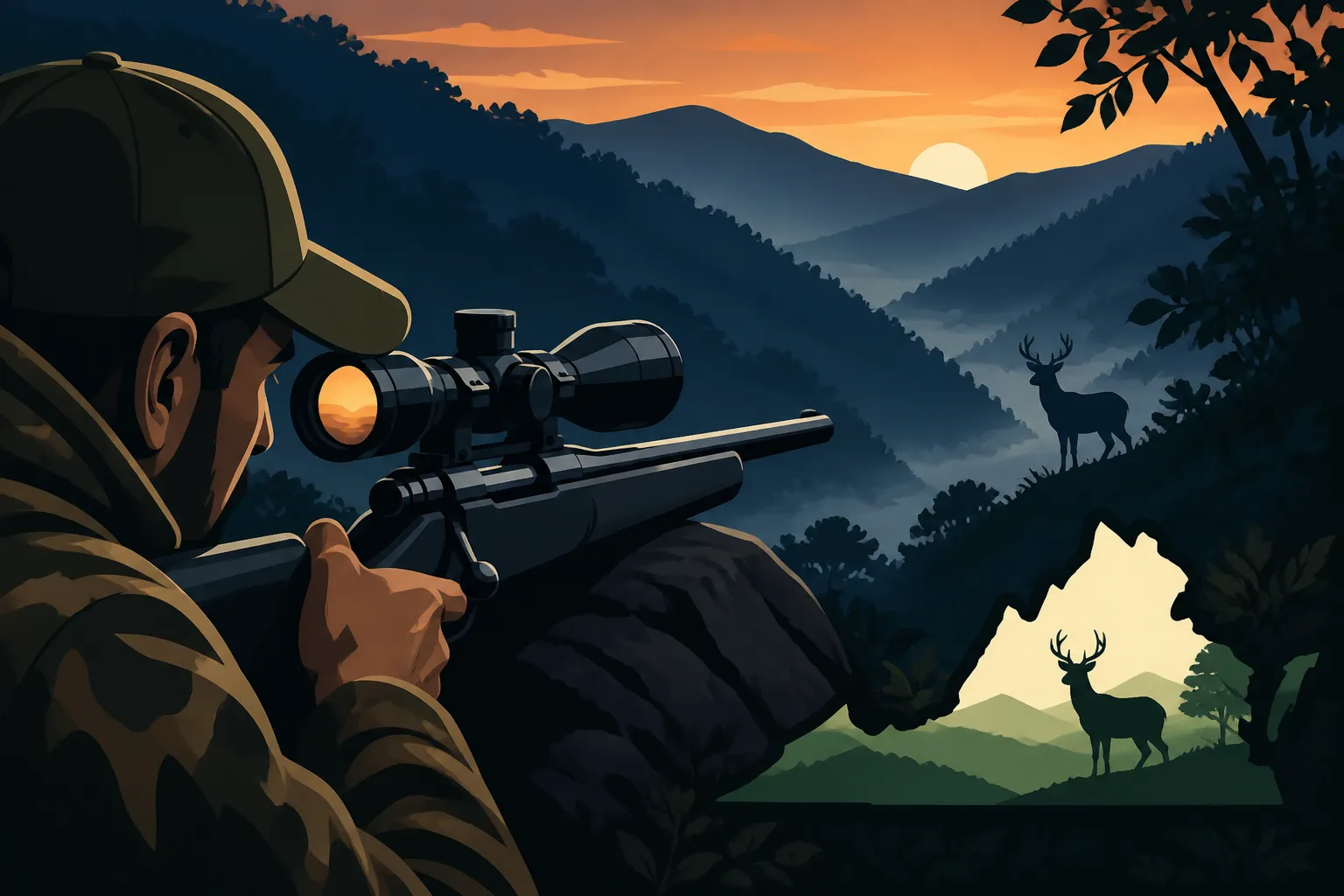
Virginia's western mountains, from the George Washington National Forest down to the Jefferson National Forest, are characterized by incredibly steep terrain, deep ravines, and hollows that are often choked with mature timber, thick mountain laurel, and rhododendron. Sunlight struggles to penetrate these dense canopies, especially during the early morning and late evening hours when deer are most active. You might be set up on a beautiful ridge-top saddle, glassing into a hollow that feels like perpetual twilight, even an hour after sunrise.
This isn't just about spotting a deer; it's about identifying it clearly, assessing antler points if required by regional regulations, and ensuring you have a clean, ethical shot. A dark, muddy image through your scope can lead to misidentification, a missed opportunity, or worse, a poorly placed shot. The difference between a marginal shot and a confident one often comes down to how much light your optic can deliver to your eye, helping you pick out a branch from a leg, or an antler tine from a sapling in that gloomy cover.
Maximizing Legal Hunting Hours at Dawn and Dusk
Virginia hunting regulations allow for hunting from one-half hour before sunrise to one-half hour after sunset. These bookend times are, without a doubt, the prime feeding and movement periods for whitetail deer, especially older, wiser bucks. However, these are also the periods when natural light is at its absolute lowest.
Imagine sitting on your stand as the first hint of gray light paints the eastern sky. You know the deer are moving, perhaps already feeding in a secluded bench below you. Without a scope capable of truly gathering that faint light, you're effectively losing valuable hunting time. The same goes for the evening. As the sun dips behind a western ridge, those last 15-20 minutes can be the most productive. If your scope dims out before legal shooting light ends, you're missing opportunities. A good low-light scope extends your effective hunting window, allowing you to confidently take a shot when others might be forced to pack it up due to poor visibility.
Virginia's Varied Timber and Topography
Virginia's mountain regions aren't uniform. You'll find mixed hardwoods, vast tracts of pines, dense undergrowth, and open timber. Each presents its own lighting challenges. Open hardwoods might offer a bit more light, but the shadows cast by mature oaks and hickories can be stark. Pine thickets can be incredibly dark, even at noon. When you're still-hunting Jefferson Forest ridges or navigating a thick clear-cut regrowth edge, your eyes are constantly adjusting to changing light conditions, and your scope needs to keep up.
The topography itself, with its constant undulations, creates natural light traps. One minute you're on a sunny slope, the next you're peering into a north-facing hollow that sees almost no direct sunlight. This variability demands an optic that performs consistently, drawing in whatever meager light is available to give you a clear, crisp image, regardless of whether you're scanning a distant ridgetop or looking into the depths of a dark hollow.
Essential Features of a Top-Tier Low-Light Scope
Not all scopes are created equal, and when it comes to maximizing performance in those dim mountain hollows, specific features really make a difference. It's not just about cranking up the magnification; it's about the scope's ability to transmit light efficiently and present a usable image to your eye.
Objective Lens Size and Light Gathering Capability
The objective lens is the large lens at the front of your scope, and it's your window to the world. Its primary job, particularly for low-light performance, is to gather ambient light. Generally, a larger objective lens can gather more light than a smaller one. This is why you often see scopes marketed for low-light conditions with objective lenses in the 50mm or even 56mm range, compared to a more common 40mm or 42mm for general hunting.
More light gathered means a brighter image when that light is scarce. However, it's not simply a "bigger is better" scenario. A larger objective lens also adds weight and can necessitate higher rings, which affects the rifle's balance and your cheek weld. For the steep climbs and long walks common when Hunting West of the Blue Ridge, weight is always a consideration. A 56mm objective might give you superior low-light performance, but if it makes your rifle feel like a lead pipe after a few miles, it might not be the right trade-off. It’s about finding that sweet spot between light-gathering ability and practical portability, especially on public land where you might be Packs for a Jefferson Forest Day Hunt.
Glass Quality and Advanced Lens Coatings
This is where the magic really happens. You can have the biggest objective lens in the world, but if the glass itself is cheap or the coatings are poor, much of that precious light will be lost before it reaches your eye. High-quality optical glass, often referred to as "ED" (Extra-low Dispersion) or "HD" (High Definition) glass, minimizes chromatic aberration, which is the unsightly color fringing that can make an image blurry and indistinct, particularly around edges. Good glass ensures that colors are true and details are sharp, even in challenging light.
Just as important are the multi-coatings applied to all air-to-glass surfaces. These coatings are designed to reduce reflection and increase light transmission. Think of it: every time light hits a glass surface, a small percentage is reflected away, diminishing the overall brightness. High-quality, multi-layered coatings can push light transmission efficiency well into the 90% or even 95% range. This means more of the light your objective lens gathers actually makes it through the scope to your eye. Without these coatings, even premium glass won't perform to its potential. When you're trying to resolve a deer in deep shadows, every percentage point of light transmission counts.
Exit Pupil and Eye Relief for Comfortable Viewing
The "exit pupil" is the circle of light that comes out of the eyepiece and enters your eye. To calculate it, you divide the objective lens diameter by the magnification. For example, a 3-9×40 scope set at 4x magnification has a 10mm exit pupil (40/4=10). At 9x, it's about 4.4mm. Our pupils dilate in low light, up to about 7mm in young adults, shrinking with age. To see the brightest image, your scope's exit pupil should be at least as large as your eye's dilated pupil. This is why lower magnification settings often appear brighter in low light.
For mountain hunting, you want a scope that offers a generous exit pupil, especially at the lower to mid-range magnifications you'll likely use in dense cover. This makes it easier to quickly acquire a target and get a full, bright sight picture without having to perfectly align your eye.
"Eye relief" is the distance your eye needs to be from the eyepiece to see the full image. This is crucial for safety and comfort, especially when shooting rifles with heavier recoil. You want enough eye relief to avoid getting "scoped" by your optic under recoil. A scope offering 3.5-4 inches of eye relief is generally considered good. For quick, instinctive shots in heavy cover, consistent and forgiving eye relief can make all the difference, allowing you to snap the rifle to your shoulder and find your target without fumbling. Don't underestimate the value of a comfortable and safe sight picture when that once-in-a-lifetime buck steps out.
Understanding Scope Specifications for Low-Light Performance
Diving a little deeper into the numbers and design choices can really help you differentiate between scopes that just claim to be good in low light and those that truly deliver. It's more than just the size of the objective; it's about the entire optical system working in harmony.
Magnification Ranges for Mountain Shots
While it might seem counterintuitive for low light, lower magnification often translates to a brighter image because it results in a larger exit pupil. For the close-to-medium range shots common in Virginia's dense timber and mountain hollows, a scope with a versatile low-end magnification is key. A 2.5-10x, 3-9x, or even a 2-12x scope can be excellent choices. The ability to drop down to 2x or 3x magnification in the deepest, darkest cover will give you a wider field of view and a significantly brighter image, making target acquisition faster and clearer.
Higher magnifications (10x, 12x, or more) are fantastic for long-range target identification or open country hunting, but in the dim light of a mountain hollow, they often make the image appear darker and can narrow your field of view considerably. This is a crucial trade-off. While it's nice to have the option for higher power, prioritize the low-end performance and light transmission for typical mountain hunting scenarios where shots might be within 100-150 yards in thick woods. Remember, even with a 6.5 Creedmoor for Blue Ridge Ridges, your practical shooting range in dense cover is often limited by visibility, not cartridge performance.
Reticle Types for Low-Light Contrast
The reticle is your aiming point, and its design has a huge impact on its visibility in low light. Traditional thin crosshairs can disappear against a dark background of timber or a deer's hide. You need a reticle that offers good contrast and isn't so fine that it gets lost.
Some popular choices for low-light include:
- Duplex Reticles: These have thicker posts on the outer edges that thin out towards the center, drawing your eye to the aiming point. The thicker sections provide good visibility even when the center is fine enough for precise aiming.
- German #4 Reticles: Similar to a duplex, but often with a thicker bottom post and thinner horizontal crosshairs, providing an uncluttered view with a strong aiming point.
- Illuminated Reticles: This is perhaps the biggest game-changer for true low-light performance. An illuminated reticle, typically a red dot or crosshair in the center, allows you to dial in just enough brightness to provide a crisp aiming point against any dark background. It doesn't rely on ambient light for visibility, making it invaluable at dawn and dusk. Modern illuminated reticles often have multiple brightness settings and auto-off features to preserve battery life. Many hunters swear by them, and for good reason—they solve the age-old problem of a disappearing reticle. Learn more about Illuminated Reticles for Dark Timber.
When choosing a reticle, think about the specific types of shots you anticipate. Will you be picking through brush at short range or aiming for a longer shot across a small clearing? A good reticle should be quick to acquire but still allow for precision.
Tube Diameter and Durability
The main tube of a rifle scope houses the erector system and internal components. The most common diameters are 1-inch (25.4mm) and 30mm, though you'll occasionally see 34mm or even 35mm on more specialized long-range optics.
While it's a common misconception that a 30mm tube automatically means more light transmission, that's not necessarily true. The tube diameter dictates how much adjustment range (windage and elevation) is available internally and can contribute to overall durability and robustness. A 30mm tube can allow for larger, more durable internal components and a wider range of adjustments, which is a benefit if you plan on dialing for long shots.
For rugged mountain hunting, durability is paramount. Your scope will take knocks and bumps, whether you're climbing over blowdowns or packing it out. A robust main tube, coupled with quality construction, ensures your scope holds zero and continues to perform under tough conditions. While a 1-inch tube is perfectly capable, many hunters opt for 30mm for the perceived durability and increased adjustment range, especially if they might be adjusting for varying ranges in steep terrain.
Practical Considerations for Mountain Hunting Scopes
Beyond the raw optical performance, there are real-world factors that heavily influence how well a scope performs when you're actually out there in the Virginia mountains. These are the details that separate a good scope from a great hunting companion.
Weight and Balance for Steep Climbs
Hunting in Virginia's mountains often means covering significant ground, climbing steep grades, and navigating rough terrain. Every ounce on your rifle matters, especially if you're humping it up and down ridges all day. A heavy scope can throw off the balance of your rifle, making it awkward to carry, slower to shoulder, and less natural to shoot.
While larger objective lenses often mean heavier scopes, modern manufacturing techniques and materials (like aircraft-grade aluminum) are helping to reduce weight. Look for scopes that offer a good balance of optical performance and manageable weight. A scope weighing around 16-24 ounces is generally a good sweet spot for a mountain rifle. When you're picking out a Rifle Setups for Virginia Deer Hunting, remember that the scope is a significant part of the overall weight. Before committing, consider how the scope feels on your rifle, not just in the store. Try shouldering it quickly, swinging it, and imagining a long day of hiking. Sometimes, a slightly smaller objective lens or a less feature-laden scope can be a better choice if it means a more agile and comfortable rifle in the field.
Weatherproofing and Fog Resistance
Virginia weather can be notoriously unpredictable, especially in the mountains. One minute it's crisp and clear, the next a thick fog rolls in, or a sudden downpour hits. Your scope absolutely must be able to withstand these conditions without compromising performance.
- Waterproofing: Look for scopes that are advertised as fully waterproof. This typically means O-ring seals prevent moisture from entering the scope's interior.
- Fogproofing: Scopes are usually purged of air and filled with an inert gas like nitrogen or argon. This prevents internal fogging caused by rapid temperature changes (e.g., taking a cold rifle into a warm cabin or truck). Fogged Optics in Virginia Cold can ruin a hunt faster than almost anything else.
- External Coatings: Some manufacturers apply hydrophobic (water-repelling) coatings to the external lenses. These cause water droplets to bead up and roll off, making it easier to see through rain or dew.
Before you trust a scope in the field, make sure it has robust weatherproofing. There’s nothing more frustrating than having a deer step out and finding your scope filled with fog or water just because the weather turned. Quality brands understand these demands and build their optics to meet them.
Mounting and Ring Choices for Rugged Use
A fantastic scope is only as good as the rings and base holding it to your rifle. For mountain hunting, where bumps, drops, and general abuse are more likely, a rock-solid mounting system is non-negotiable.
- Durable Rings: Invest in high-quality steel or robust aluminum rings. Avoid anything flimsy. Rings should match your scope's main tube diameter (1-inch or 30mm) perfectly.
- Solid Base: A one-piece scope base or quality two-piece bases are usually preferred over cheaper options. Many hunters favor a Picatinny rail for its versatility and strength.
- Proper Height: Ring height is crucial for comfortable shooting and a consistent cheek weld. With larger objective lenses, you might need higher rings to clear the barrel, but don't go unnecessarily high. Your eye should naturally align with the scope without craning your neck. Find a good balance of clearance and low-profile mounting. Consider adjustable rings to fine-tune your setup.
Mounting needs to be done correctly, preferably by a skilled gunsmith or with careful attention to torque specifications. Loose rings or bases are a primary cause of zero shift and frustration. If you're going to rely on your rifle in challenging conditions, don't skimp on the Scope Mounting and Ring Height.
Comparing Scope Types for Low-Light Performance
The world of rifle scopes offers a bewildering array of options. Understanding the fundamental differences between scope types can help you narrow down your choices and select the best tool for those dim Virginia hollows.
Fixed vs. Variable Power Scopes
This is one of the most basic distinctions, and each has its place, even for low-light scenarios.
- Fixed Power Scopes: These scopes have a single, non-adjustable magnification (e.g., 4x, 6x). Their primary advantages are simplicity, often superior optical clarity and brightness for their price point (fewer moving parts, less glass), and exceptional durability. With fewer lenses and mechanisms, there's less to go wrong and often better light transmission. For a dedicated mountain hunter who knows their typical shot distances are within a certain range in thick cover, a high-quality fixed 6x or 8x could be an excellent low-light option, offering a bright image and robust construction. The downside is obvious: no versatility in magnification. If a deer steps out at 25 yards in dense brush, 8x might be too much, but if it's 150 yards across a clearing, 8x might feel a little underpowered for precise shot placement.
- Variable Power Scopes: These are by far the most popular choice today, offering a range of magnifications (e.g., 3-9x, 2-12x, 4-16x). Their main benefit is versatility – you can dial down for a wider field of view and brighter image in thick, low-light cover, and dial up for longer shots or more precise target identification. For mountain hunting, a variable scope with a low-end magnification of 2x or 3x and a top end around 10x-12x is often ideal. This provides the flexibility needed to adapt to different light conditions and shot presentations that can vary wildly within a single hunt. While they might not be quite as bright as a comparable fixed power scope at the same magnification due to more internal glass, the best variable scopes with premium glass and coatings come very close.
For the dynamic nature of mountain hunting in Virginia, a good variable power scope typically offers the best all-around solution, allowing you to optimize for low-light situations while retaining the flexibility for clearer conditions or longer shots.
Illuminated Reticles: A Game Changer for Dark Timber?
We touched on this earlier, but it's worth a deeper dive. An illuminated reticle can genuinely be a "game changer" when hunting dark timber or deep hollows.
- How they work: A small LED light source illuminates part or all of the reticle (usually the center dot or crosshairs) with a red or green glow. This illumination is powered by a small battery and can typically be adjusted for brightness.
- Benefits:
- Visibility in Extreme Low Light: When even a thick duplex reticle starts to wash out against a dark deer or shadowed background, an illuminated reticle provides a distinct, clear aiming point.
- Contrast Control: You can adjust the brightness to match ambient conditions. A subtle glow at dawn, brighter as light fades to provide perfect contrast.
- Speed of Acquisition: A brightly illuminated point can be picked up almost instantly by your eye, speeding up target acquisition in fast-paced hunting scenarios.
- Considerations:
- Battery Life: Remember to turn it off! While modern scopes often have excellent battery life and sometimes auto-off features, it's still an extra component to manage. Always carry a spare battery.
- Cost: Scopes with illuminated reticles typically cost more than non-illuminated versions.
- Distraction: Some hunters find a bright reticle distracting. The key is to use the lowest brightness setting that provides adequate contrast.
For Virginia's mountain conditions, where deep shadows are the norm, an illuminated reticle is a powerful tool. It transforms what might be an impossible shot into a confident one. When considering Optics for Blue Ridge and Piedmont Hunting, prioritize a scope with a reliable illuminated reticle if low-light performance is your top concern.
Budget vs. Premium Glass Performance
The price tag on scopes can range from under $100 to several thousand dollars, and a huge portion of that difference comes down to glass quality and coatings.
- Budget Scopes: Entry-level scopes might appear functional in bright daylight, but their limitations become glaringly obvious in low-light conditions. Lower quality glass, fewer and less effective coatings, and poorer manufacturing tolerances mean less light transmission, more chromatic aberration, and softer images. While they might get you by, they often won't deliver the crucial clarity needed at dawn and dusk.
- Mid-Range Scopes: This is often the sweet spot for many hunters. Brands like Leupold, Vortex, Bushnell, and Nikon offer excellent value. You get good quality ED glass, robust multi-coatings, and reliable construction. These scopes perform admirably in moderate low light and represent a significant step up from budget options without breaking the bank.
- Premium Scopes: Brands like Swarovski, Zeiss, Leica, Nightforce, and high-end Leupold models are the pinnacle. Their glass is virtually flawless, coatings are multi-layered and proprietary, and light transmission is optimized to the absolute maximum (often 95% or higher). In truly dark conditions, the difference between a premium scope and a mid-range one becomes apparent. Edges are sharper, colors are truer, and shadows reveal more detail. This performance comes at a premium price, but for those who hunt challenging low-light conditions regularly, the investment often pays dividends in confidence and extended hunting time.
It's tempting to save money, but for those critical low-light moments in a Virginia mountain hollow, investing in the best glass you can afford for your Rifle Scopes for Low-Light Mountain Hollows will genuinely improve your hunting experience and success.
Setting Up and Maintaining Your Low-Light Scope
Even the most expensive, high-performing low-light scope won't do you any good if it's not properly set up and cared for. A little attention to detail before and during the season can ensure your optic performs flawlessly when you need it most.
Proper Zeroing for Variable Light Conditions
Zeroing your rifle isn't a one-and-done task; it's an art, especially when you consider varying light. While light conditions don't directly change your bullet's trajectory, they can affect your sight picture and how well you see your reticle and target.
- Range Zeroing: Always zero your rifle in conditions that mimic your actual hunting environment as closely as possible. If you hunt in low light, try to zero during dawn or dusk at the range.
- Consistent Point of Aim: Pay attention to how your reticle appears in different light. If you have an illuminated reticle, practice with it at various brightness settings. Ensure you can consistently place your aiming point precisely where you want it on the target, even when the light is dim.
- Magnification Impact: While zeroing at your preferred hunting magnification is good practice, be aware of how dropping to a lower power might change your perceived point of impact if your scope exhibits any parallax shift at varying magnifications (though modern scopes minimize this). Test your zero at different useful magnifications if you often switch.
- Distance Considerations: For mountain hunting, a 100-yard zero is a solid starting point. However, understanding your bullet's trajectory at 50, 150, and 200 yards is crucial. A simple ballistics app can help you map this out. Knowing your holds for typical shots means less time fiddling with turrets in a low-light moment, allowing you to use the scope's full light-gathering potential for the shot.
Cleaning and Protecting Your Lenses in the Field
Lens care is often overlooked, but dirty or scratched lenses dramatically reduce light transmission and clarity, effectively negating all the money you spent on good glass.
- Field Cleaning Kit: Carry a small lens cleaning kit with you. This should include a lens brush (like a retractable make-up brush or a dedicated lens pen with a brush), a microfiber cloth, and perhaps a small bottle of lens cleaning solution.
- Gentle Approach: Never wipe dust or grit off a dry lens with a cloth – you'll scratch the coatings. Always brush off loose debris first. If there's smudging or dried water spots, breathe lightly on the lens to fog it, then gently wipe with a clean microfiber cloth in a circular motion, working from the center outwards.
- Lens Caps: Always use high-quality flip-up or bikini-style lens caps when your rifle is not actively in use. They protect against scratches, dust, rain, and snow. Good caps are worth their weight in gold for protecting your investment.
- Scope Covers: A full scope cover or even a piece of old sock can offer additional protection from bumps and moisture when carrying your rifle through brush or in a vehicle.
Regular, gentle cleaning and proactive protection will ensure your lenses remain pristine, allowing your scope to perform at its peak for years to come. It’s part of the essential care that ensures you don’t end up with Fogged Optics in Virginia Cold or obscured vision when you need it most.
Pre-Season Checks and Field Care Tips
Before the season kicks off, give your scope and rifle a thorough once-over.
- Mounting Security: Check all scope ring and base screws. Ensure they are snug (use a torque wrench if you have one, to manufacturer specs) and haven't loosened during the off-season.
- Zero Check: Take a few shots at the range to confirm your zero. Even if you haven't changed anything, bumps and vibrations can cause slight shifts.
- Turret Functionality: Operate your windage and elevation turrets through their full range of motion. Ensure they turn smoothly and the clicks are positive and repeatable. If you have an illuminated reticle, check the battery and carry a spare.
- Eyepiece Focus: Adjust the eyepiece (diopter) to perfectly focus the reticle for your eye. This is a personal setting and crucial for sharp sight picture. Do this by looking at a plain background (like the sky or a wall) and quickly glancing at the reticle until it's perfectly crisp.
- Field Habits: When hiking, carry your rifle in a way that minimizes impacts to the scope. Use a good sling, and if leaning the rifle against a tree, ensure the scope is protected. When you get back from a hunt, especially in wet weather, give your rifle and scope a wipe down with a dry cloth, as you would when Cleaning a Rifle After a Wet Sit.
By diligently caring for your low-light scope, you're not just protecting your investment; you're ensuring that you're always ready when that wary mountain buck finally steps out into the fading light of a Virginia hollow. You'll find many useful tools and insights for preparing your gear and strategy on platforms like GoHunt, helping you stay ahead of the game.
Conclusion
Hunting in Virginia's mountain hollows is an incredible experience, but it demands respect for the terrain and a keen understanding of how to overcome its challenges. When it comes to optics, simply having a scope isn't enough; you need the right scope. A quality low-light optic, with its ability to gather and transmit every precious photon, can truly extend your effective hunting day and ensure that when a deer presents itself in those dim, shadowed woods, you're ready to make a clean, ethical shot.
Remember, it's a combination of features: a generously sized, high-quality objective lens, superior glass, advanced multi-coatings, a practical magnification range, and a visible reticle—especially an illuminated one. Pair that with a robust mounting system, diligent care, and mindful practice, and you'll find yourself confidently hunting those elusive hours of dawn and dusk, turning what once felt like a disadvantage into a productive part of your hunt. Don't let the shadows win; arm yourself with the right optics and embrace the challenge of the mountains. Many seasoned hunters will tell you that the performance of their GoHunt optimized optics is the single biggest factor in their success during those critical low-light periods.
Disclaimer
This article is for general informational purposes only and does not constitute professional advice. Laws, prices and regulations vary by location and change over time. Consult a qualified professional for guidance on your specific situation.