Rabbit Hunting Thick Virginia Brush
There's a special kind of challenge, and a unique reward, that comes with rabbit hunting in Virginia's thick, unforgiving brush. If you've ever tried to push through a dense honeysuckle tangle or a briar patch that seems to go on forever, you know the frustration of feeling rabbits flush unseen, or worse, just sitting tight, letting you walk right by. It's a game of patience, stealth, and often, relying on the keen senses of a good dog. This guide will walk you through everything you need to know to tackle those seemingly impenetrable covers and fill your vest with cottontails across the Old Dominion.
Understanding Virginia's Rabbit Habitat and Behavior in Thick Cover
Virginia's landscape offers a diverse range of habitats, and where you find thick cover, you're almost guaranteed to find cottontails. These little dynamos are masters of evasion, and they thrive in places where predators struggle to follow. Knowing what constitutes prime rabbit cover and how rabbits use it is the first step to becoming a more successful brush hunter.
Identifying Prime Rabbit Holding Areas in Dense Vegetation
When we talk about "thick brush" in Virginia, we're not just talking about any old patch of woods. We're zeroing in on specific types of dense vegetation that provide both food and security. Think about those areas often dismissed by deer hunters as "too thick to get through." Those are goldmines for rabbits.
These prime areas often include neglected agricultural fields that have grown up into a jungle of briars, honeysuckle, and young saplings. Creek bottoms are another classic hotspot, especially where grapevines and greenbrier have created an overhead canopy that offers protection from avian predators, while the undergrowth provides escape routes. Old logging cuts, particularly those a few years into regrowth, can become incredibly dense with young pines, sumac, and brush, offering ideal conditions. And let's not forget the edges of swamps and marshes, where cattails, reeds, and other wetland vegetation create a wall of cover. Even overgrown fencerows, as discussed in Rabbit Hunting Virginia Fencerows, connect these larger patches of cover, acting as highways and safe havens for rabbits. When you're scouting, look for a mix of thorny vegetation for protection, combined with softer browse and weeds for food. An effective way to identify these pockets of cover, especially on public land, is to use detailed mapping tools. Many hunters find platforms like GoHunt invaluable for pinpointing overgrown areas and potential rabbit havens before even stepping foot in the field, helping you discern potential thickets from open timber.
Rabbit Behavior and Movement Patterns in Thick Brush
Rabbits are pretty predictable in their basic needs: food, cover, and escape routes. In thick brush, their behavior is largely dictated by these priorities. During daylight hours, especially in cold or inclement weather, they'll often be "bedded down" in the thickest part of the cover. This bedding site might be a shallow depression, under a fallen log, or simply nestled deep within a briar patch where they are almost invisible.
When pushed, a rabbit's first instinct is to try and outwit its pursuer by circling back through the cover it knows so well. They rarely run in a straight line for long distances in dense areas; instead, they'll weave, duck, and often try to return to their original starting point or a nearby piece of dense cover. Understanding this circling behavior is crucial for setting up effective stands. They'll use tunnels and runs through the undergrowth that are almost invisible to the human eye but are clearly defined to a beagle's nose. Early mornings and late evenings are typically when rabbits are most active, moving out from the deep cover to feed on tender shoots and weeds. However, in extremely thick areas, they might feed within the cover itself, or even stay relatively active during daylight if the cover is truly impenetrable and they feel secure. Knowing the Virginia Cottontail Population Trend in your area can also give you insights into how many rabbits you might expect to encounter and how competitive their feeding grounds might be, influencing their daytime activity.
Essential Gear and Canine Companions for Brush Hunting
Rabbit hunting in thick Virginia brush isn't like walking a groomed field. It demands specific gear for both comfort and safety, and for many, a good dog is not just helpful but absolutely essential. Don't underestimate the physical demands of pushing through tough cover, and certainly don't go unprepared.
Protective Clothing and Footwear for Briar Patches
If you've ever spent an hour fighting through greenbrier or multiflora rose, you know the importance of good protective gear. Regular hunting pants simply won't cut it. You need something truly thorn-proof, often made from heavy-duty canvas, tightly woven synthetics, or even specialized briar-resistant fabrics. Chaps or briar pants are your best friend here, shielding your legs from scrapes, tears, and painful punctures.
For your upper body, a thick canvas or brush jacket is highly recommended, especially for your arms and shoulders, which will be constantly pushing branches aside. Don't forget durable gloves; without them, your hands will be shredded in no time. Layering underneath is key for warmth, as you'll be exerting a lot of energy. Speaking of exertion, your feet need serious protection and support. Forget flimsy boots. You'll want sturdy, waterproof boots with excellent ankle support to navigate uneven terrain hidden by dense cover. Rubber boots can be a good option for wet creek bottoms and swamp edges, but ensure they offer good traction and comfort for miles of walking. For more details on choosing appropriate footwear, check out Boots for Virginia Swamps and Ridges. Proper headwear, like a cap with a brim, can also help deflect branches from your face and eyes.
Firearms and Ammunition Choices for Close-Quarters Hunting
In the dense confines of Virginia's thick brush, long-range accuracy is irrelevant. What you need is a firearm that swings quickly, handles easily in tight spaces, and delivers a dense pattern of shot for those fleeting, close-range opportunities. For most rabbit hunters, a shotgun is the only sensible choice.
A 20-gauge or 12-gauge shotgun is ideal, typically with an open choke like improved cylinder or modified. This allows for a wider, more forgiving pattern at the short distances you'll be shooting. Double barrels (side-by-side or over-under) are popular for their balance and quick follow-up shots, but a pump or semi-auto can also work, though they might feel a bit longer in really tight spots. Ammunition choice is generally number 6 or 7 ½ shot. Number 6 is a bit heavier and carries more punch for rabbits that might be further out in thinner cover, while 7 ½ offers a denser pattern for those really close flushes. Carry enough shells for several pushes, but remember that every extra ounce counts when you're slogging through briars. Always keep your gun pointed in a safe direction, even when navigating the thickest cover, and be absolutely certain of your target and what lies beyond, which can be incredibly challenging in dense foliage.
The Indispensable Role of Good Rabbit Dogs
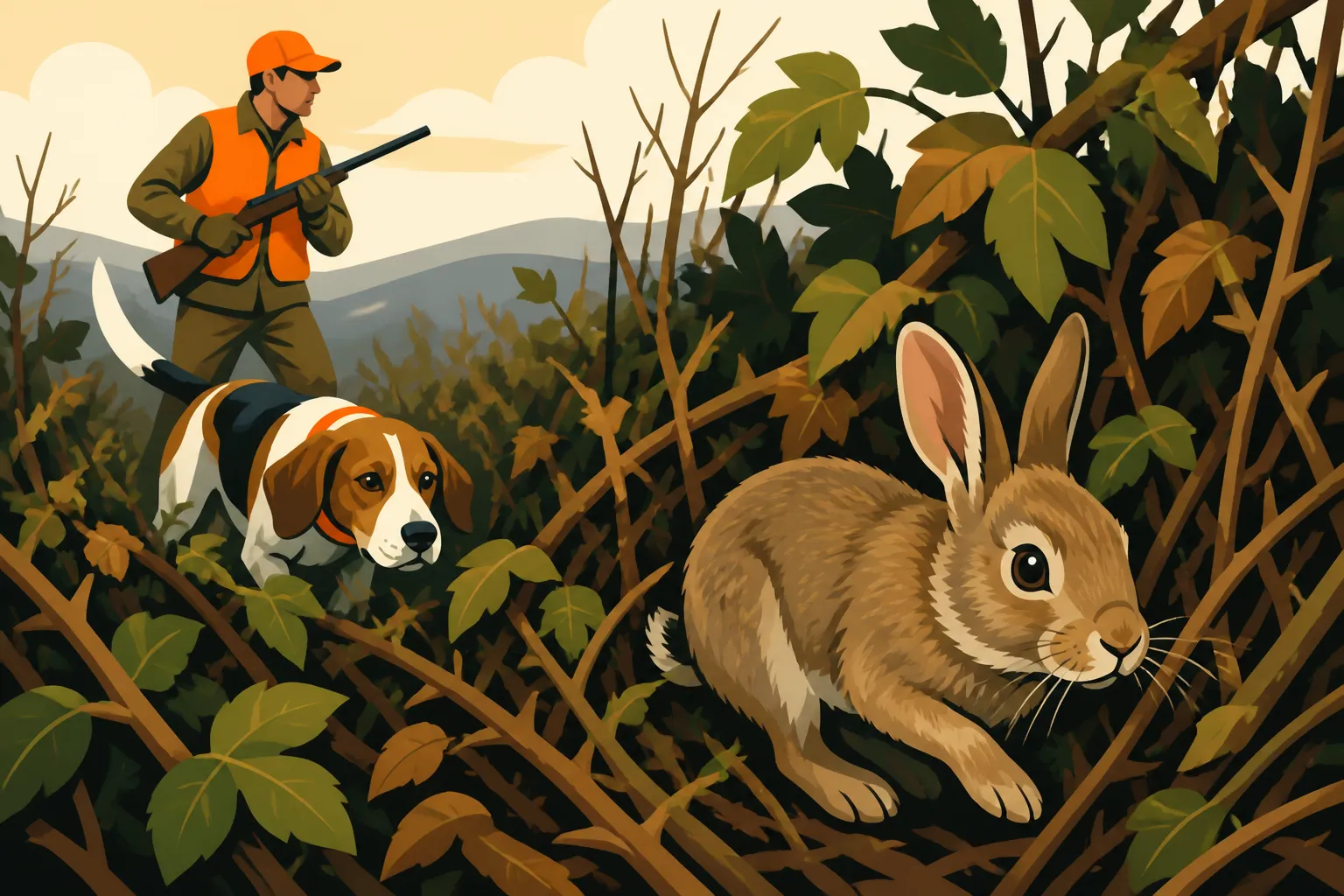
While it's possible to "stomp" rabbits out of thick cover on your own, it's undeniably more efficient, effective, and frankly, more enjoyable with a good rabbit dog. For many, the joyous bawl of a beagle on a hot trail is the essence of rabbit hunting. These dogs are purpose-built for the task, possessing an incredible sense of smell and the tenacity to push rabbits out of cover humans simply can't penetrate.
Beagles are by far the most popular choice for Running Beagles on Virginia Cottontails, and for good reason. Their smaller size allows them to weave through dense briars, and their strong pack instinct means they work well in groups. Other breeds like Basset Hounds or even Dachshunds can also be used, though they typically work at a slower pace. The key is a dog with a good nose, a strong desire to trail, and a willingness to stay on a track, even when the rabbit tries to circle back or escape into extremely heavy cover. A well-trained rabbit dog will push the rabbit out, vocalizing the whole time, giving hunters time to position themselves for a shot. The dog's persistence allows the rabbit to be pushed around, creating opportunities for a clean shot as it tries to escape. Remember, dogs also need protection in the brush; consider protective vests to prevent cuts and scrapes. You can also track your dogs using GPS collars, ensuring they don't get lost in vast public lands or dense private tracts, especially important when hunting in areas with significant Hunting Pressure on Virginia Public Land.
| Breed | Key Trait | Ideal Cover | Speed | Vocalization |
|---|---|---|---|---|
| Beagle | Excellent scent, persistent | All types, especially dense briars/thickets | Medium | High, "choppy" bawl |
| Basset Hound | Powerful nose, slower, sturdy | Very thick, tangled, heavy undergrowth | Slow | Loud, baying |
| Dachshund | Small, agile, determined | Brush piles, fallen timber, extremely dense | Slow | Medium, persistent |
| Cottontail Hound | Versatile, strong drive | Varied, good for open fields and brush | Medium-Fast | Deep, melodic bay |
Effective Hunting Tactics for Virginia's Thick Brush
Once you're geared up and potentially have your canine companions ready, it's time to talk strategy. Hunting rabbits in thick brush isn't about aimlessly wandering; it's about anticipating movement, setting up effectively, and working the cover systematically.
The Art of the Push and Stand
This is arguably the most common and effective tactic for hunting rabbits with dogs in dense cover. It involves a combination of "pushers" (often the dog handler and a few others) actively working through the thick brush, while "standers" position themselves strategically around the edges of the cover, anticipating where the rabbits will try to escape.
The pushers' role is to methodically move through the densest parts of the cover, trying to get the dogs on a fresh trail and flush any rabbits holding tight. This can be hard, physically demanding work, often involving pushing through seemingly impenetrable tangles. The standers, on the other hand, need to find vantage points that offer a clear shot at potential escape routes. Think about natural funnels, narrow openings in the brush, or even areas where the cover thins out slightly. When the dogs jump a rabbit, their vocalizations will guide the standers to where the rabbit is likely to emerge. It's crucial for standers to remain absolutely still and quiet, as any movement or noise can cause a circling rabbit to change its mind and retreat deeper into the cover. Communication between pushers and standers, even if just through dog barks, is vital. This team-based approach significantly increases the chances of intercepting a rabbit that the dogs have pushed out.
Slow-and-Steady Stalking in Dense Cover
Even without dogs, or perhaps as a supplementary tactic when the dogs are working a different section, slow-and-steady stalking can be productive in thick brush. This method relies on your ability to spot a rabbit before it flushes, or to surprise it into running within range.
The key here is extreme patience and keen observation. Move at a snail's pace, pausing frequently to scan the cover ahead and around you. Look for anything that seems out of place – a patch of fur, an eye, a twitch of an ear. Rabbits are masters of camouflage, and often the only thing that gives them away is their subtle movement or a small part of their body. As you walk, shuffle your feet to stir the undergrowth, which can sometimes spook a rabbit into moving. Pay close attention to any small openings or clearings in the brush, as rabbits might use these to sun themselves or browse. When a rabbit flushes, react quickly but calmly. Often, you'll only get a brief glimpse as it zips through the dense vegetation. This method is physically less demanding than a full "push" but requires a different kind of mental discipline and sharp eyesight. It's also excellent for areas that might not be suitable for dogs, like small isolated patches of cover or properties with strict dog rules.
Working Different Types of Brush Fields
Virginia offers various "brush field" types, and adapting your strategy to each will improve your success. For example, a young pine plantation, just a few years old, can be incredibly dense. Here, pushing through lanes or fire breaks, if they exist, can be effective, with standers posted at the ends. The thick rows of pines often channel rabbits in predictable directions.
In old agricultural fields that have reverted to briars, honeysuckle, and sumac, the cover can be almost wall-to-wall. This is where a team of hunters with dogs truly shines, systematically grid-searching the field. One or two hunters with the dogs will work the interior, while others fan out along the edges, ready for a flush. Creek bottoms and swamp edges, with their mix of water, thick reeds, and vines, require careful navigation. Rubber boots are almost mandatory here, and hunters should be aware of slippery conditions. Rabbits in these areas might hold tighter due to the heavy cover and dampness, making dog work even more important. When looking at these areas on a map, perhaps using a tool like GoHunt, pay attention to elevation changes or slight breaks in the vegetation that could serve as natural travel corridors or escape routes for rabbits. These subtle landscape features can be the difference between a successful hunt and a frustrating walk.
Safety and Ethical Considerations in Dense Hunting Environments
Rabbit hunting in thick brush, especially with multiple hunters and dogs, introduces specific safety considerations. It’s imperative that everyone involved understands and adheres to strict safety protocols to ensure a fun and incident-free outing. Beyond safety, responsible hunting also means following all regulations and practicing ethical sportsmanship.
Prioritizing Safety in Thick Cover with Dogs and Fellow Hunters
The biggest challenge in thick cover is visibility. You simply cannot see clearly, which means every movement, every shot, and every step needs extra caution. When hunting with a group, clear communication is paramount. Before the hunt begins, establish who will be pushing, who will be standing, and where everyone will be positioned. Wear plenty of blaze orange or blaze pink, even if it's not legally required for small game in a particular area – it's just plain smart. Virginia requires 100 square inches of solid blaze orange or pink visible above the waist for hunters during general firearms deer season, and while small game often has different rules, it's wise to always maximize visibility in dense cover. For more details, always consult Virginia Small Game Season Rules.
Always know where your hunting partners and dogs are. Never shoot at sound or movement alone; you must positively identify your target. Be extra careful when shooting at rabbits running low to the ground, as your shot pattern can easily travel further than you think and hit an unseen hunting partner or dog. Take extra care when navigating obstacles like fallen trees, ditches, or muddy patches, as falls can lead to injuries, especially with a firearm in hand. Keeping your firearm unloaded until you're in position, and immediately unloading it when moving through extremely dense areas or crossing fences, is a good habit.
Understanding Virginia's Regulations and Season Dates
Before heading out, it's essential to be thoroughly familiar with Virginia's specific hunting regulations for rabbits. These rules cover everything from season dates and bag limits to legal hunting hours and public land access. The statewide rabbit season typically opens in the fall and runs through late winter, but precise dates can vary slightly year to year. You can find the exact dates for Virginia Rabbit Season Opening Day on the Virginia Department of Wildlife Resources (DWR) website.
Pay close attention to bag limits – how many rabbits you can take per day – and possession limits. Also, be aware of any specific regulations that might apply to the area you're hunting, such as special rules for Wildlife Management Areas (WMAs) or federal lands like the George Washington and Jefferson National Forests. Always carry your valid Virginia hunting license and any required permits. If you're hunting on private land, ensure you have explicit permission from the landowner. Ethical hunting practices also mean only taking clean, ethical shots, avoiding unnecessary suffering for the animal. It also includes proper game retrieval and respectful treatment of the land. Familiarize yourself with how to quickly and humanely dispatch a rabbit once it's harvested, and ensure you field dress it promptly to preserve the meat.
Disclaimer
Always check the current Virginia Department of Wildlife Resources (DWR) regulations before any hunting trip, as rules and seasons can change. This guide is for informational purposes only and does not supersede official DWR regulations.