Gray Versus Fox Squirrels in Virginia
It’s easy to think all squirrels are created equal when you’re out in the woods, especially when they’re zipping through the canopy or darting across a log. But here in Virginia, we've got two primary species that often cause a bit of head-scratching for hunters: the Eastern Gray Squirrel and the Fox Squirrel. Many a hunter has seen a particularly large, reddish squirrel and wondered if it was just a big gray, or something entirely different. This guide is going to clear up that confusion, diving deep into the characteristics, habitats, and behaviors of both, so you can confidently identify and pursue them on your next outing.
The Eastern Gray Squirrel: Virginia's Ubiquitous Bushy-Tail
Let’s start with the one most Virginians, whether hunters or just backyard observers, are intimately familiar with: the Eastern Gray Squirrel (Sciurus carolinensis). These guys are practically everywhere, from the deepest woods to our bustling city parks. But don’t let their commonality fool you; they offer fantastic hunting opportunities and are incredibly adept at navigating their world.
Appearance and Size
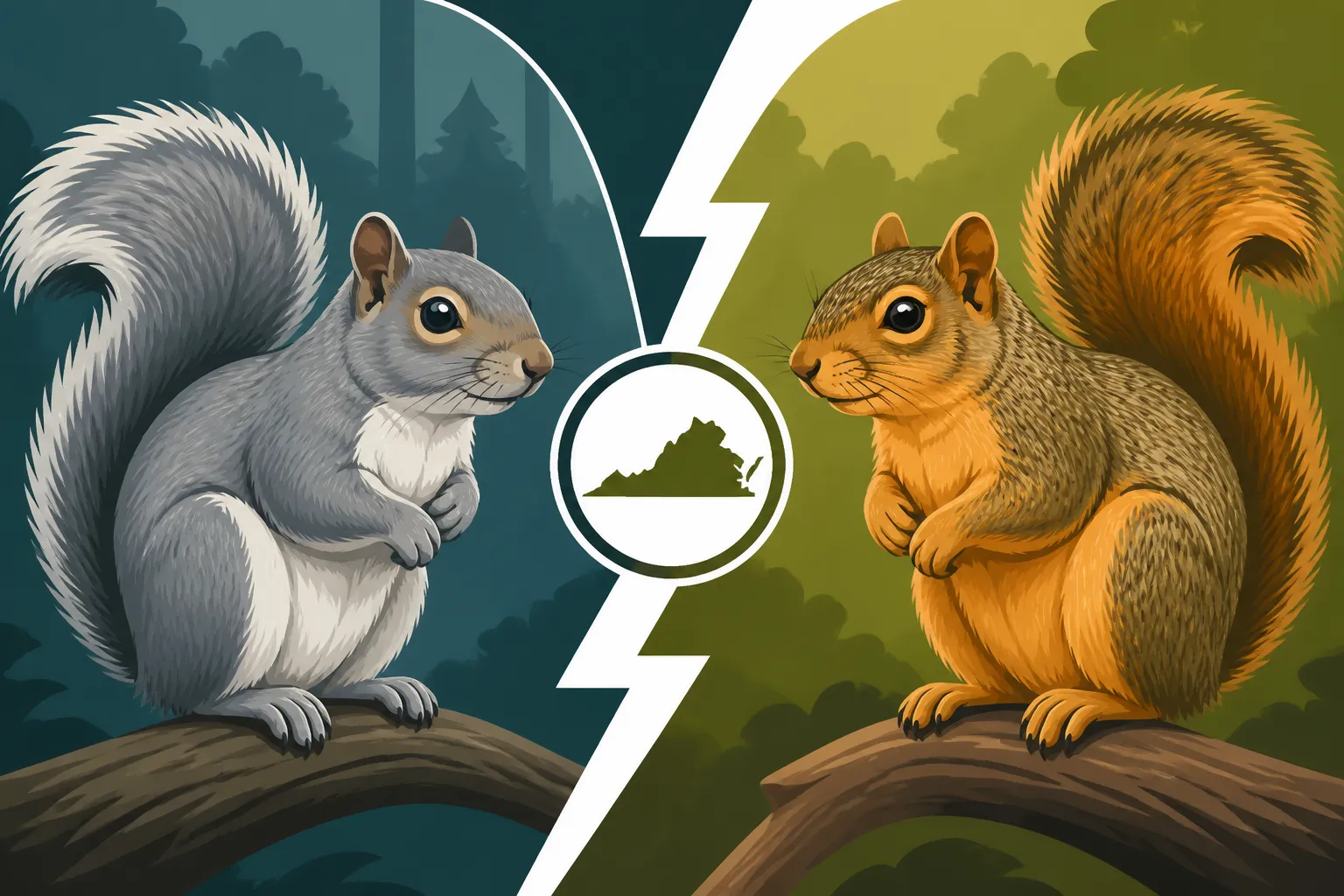
When you think of a "squirrel," you're likely picturing the Eastern Gray. They typically weigh in at about 1 to 1.5 pounds and measure around 16 to 20 inches from nose to tail tip. Their fur is, predictably, a mix of gray on the back and sides, often with a brownish wash, fading to a lighter, sometimes white, belly. Their most distinguishing feature is that magnificent, bushy tail, often edged with white, which they use for balance, communication, and even as a cozy blanket in colder weather. While largely gray, don’t be surprised to see variations, including melanistic (black) grays, especially in certain parts of the state. These darker individuals are still Eastern Grays, just sporting a different fashion sense.
Habitat and Behavior
Eastern Grays are true generalists when it comes to habitat, but they absolutely thrive in mature hardwood forests. Think oak-hickory stands, areas with a good mix of mast-producing trees that provide their primary food source. You’ll find them equally comfortable in river bottoms, suburban woodlots, and sprawling urban parks. They are primarily arboreal, meaning they spend most of their time in trees, whether it's for foraging, escaping predators, or nesting.
Their behavior is what often stands out. These squirrels are incredibly agile and fast. They’re the ones you see scampering up a tree trunk in a blur, chattering incessantly from a high branch, or burying acorns with a frantic, almost obsessive energy. They're often out and about during the early morning and late afternoon, though you can find them foraging throughout the day, especially on cooler days. They build two types of nests: leaf nests (dreys) high in trees, which look like big, messy clumps of leaves and twigs, and dens in tree cavities, which offer more protection from the elements and predators. When you're Squirrel hunting a Virginia oak ridge, you'll often see these guys pouring out of the oaks.
Diet and Hunting Considerations
The Eastern Gray Squirrel's diet is largely dictated by what's available in their hardwood forest homes. Acorns, hickory nuts, walnuts, and beechnuts are staples. They'll also munch on tree buds, seeds, fungi, and occasionally insects or bird eggs. This reliance on mast means that a good mast crop year often translates to a healthy, abundant squirrel population.
For hunters, grays offer a fast-paced, engaging hunt. Their quick movements and tendency to circle trees can be challenging, but also a lot of fun. Stalking through an oak flat, sitting quietly and waiting for them to show themselves, or even still-hunting through a bottomland can be effective. They're often found in higher densities than fox squirrels, which can make for a more target-rich environment. Don't forget to look for fresh Reading cuttings under an oak – those tell-tale chewed nut shells are a dead giveaway that squirrels are actively feeding in an area.
The Fox Squirrel: Virginia's Larger, More Elusive Cousin
Now, let's talk about the Fox Squirrel (Sciurus niger). These are the giants of the squirrel world in Virginia, and while they might not be as universally distributed as their gray cousins, encountering one in the right habitat is always a treat for a hunter. They bring a different dynamic to the small game woods.
Appearance and Size
The most immediate difference you’ll notice with a Fox Squirrel is its size. They are noticeably larger than Eastern Grays, typically weighing between 2 to 3 pounds and measuring 20 to 30 inches long, including their impressive tail. Think of them as almost twice the size of a gray squirrel.
Their coloration is also quite distinct, though it can vary significantly across their range in Virginia. They often exhibit a grizzled gray and black back with a rusty or orange-red belly, face, and feet. Sometimes, they can appear much more reddish or even yellowish-brown. The tail is long and bushy, often with a reddish tint, lacking the prominent white edging seen on a gray squirrel’s tail. This variability in color sometimes leads to misidentification, but their sheer size is usually the dead giveaway. When you spot a squirrel that just seems too big for a gray, you’re likely looking at a fox squirrel.
Habitat and Behavior
Unlike the gray squirrel’s preference for dense, mature hardwoods, fox squirrels tend to favor more open, fragmented woodlands, often interspersed with agricultural fields. They are frequently found in small woodlots, along forest edges, in riparian (riverbank) habitats, and areas with scattered mature trees and less dense undergrowth. Think of them preferring a park-like setting within the woods. They're particularly fond of pine-hardwood mixes, especially where large, open-grown trees provide excellent den sites and a clear view of their surroundings. You might even find them in old pecan groves or along fencerows where mast trees are available.
Fox squirrels are generally less frantic and more deliberate in their movements than gray squirrels. They are often slower to react to perceived threats and might move with a more "loping" gait on the ground. While they still spend time in trees, they also spend a considerable amount of time foraging on the ground, often traveling longer distances between trees. They are less prone to the rapid-fire chattering of grays and can be surprisingly quiet. This can make them a bit more challenging to locate, as they aren't broadcasting their presence as readily. They also build dreys and use tree cavities, much like grays, but often in more isolated, larger trees.
Diet and Hunting Considerations
Fox squirrels have a varied diet, much like grays, but with a slight leaning towards whatever large-seeded mast is available in their more open habitats. This includes acorns, hickory nuts, walnuts, and pecans. They also consume pine cones, seeds, fungi, fruits, and occasionally corn or other agricultural crops when their territory borders fields. Because they often occupy more marginal habitats, their diet can be quite opportunistic.
Hunting fox squirrels requires a slightly different approach. Due to their lower densities in many areas and their less frenetic behavior, patience is often key. Still-hunting slowly through open woods, especially along field edges or in mature timber stands with good visibility, can be productive. They tend to be less numerous, so bagging one feels like a real trophy. Keep an eye out for their distinctive, larger cuttings around the base of trees. If you’re using an app like GoHunt to scout, look for those open timber areas mixed with agriculture – that’s prime fox squirrel country. Remember, Squirrel and Small Game Hunting in Virginia often requires flexibility in tactics depending on the species you encounter.
Key Differences and Identification Tips in the Field
Knowing the subtle differences can really enhance your hunting experience. While size is often the easiest indicator, combining that with coloration, tail markings, and behavior will give you a definitive ID in the field.
Let's lay out a quick comparison to help solidify these distinctions:
| Feature | Eastern Gray Squirrel | Fox Squirrel |
|---|---|---|
| Size | Smaller (1-1.5 lbs, 16-20 inches total length) | Larger (2-3 lbs, 20-30 inches total length) |
| Coloration | Mostly gray with brownish wash, white belly | Grizzled gray/black back, rusty/orange-red belly/face/feet |
| (Can vary to more reddish/yellowish overall) | ||
| Tail | Bushy, often edged with white | Very bushy, often reddish/orange tint, no white edge |
| Habitat | Dense, mature hardwood forests, suburban areas | Open woodlands, forest edges, woodlots, agricultural areas |
| Behavior | Fast, agile, frantic, chattering, mostly arboreal | Slower, more deliberate, quieter, spends more time on ground |
| Distribution | Widespread across most of Virginia | More localized, often in western/central Piedmont and mountain fringes |
Behavioral Cues
Beyond simply looking at them, how they act can tell you a lot. If you see a squirrel that seems to be in an absolute frenzy, bounding up and down trees, barking and chattering at you non-stop, it's almost certainly a gray. Their energy levels are typically higher, and they're quick to vocalize.
A fox squirrel, on the other hand, might offer a more subdued reaction. It might hold still longer on a limb, or slowly make its way to the opposite side of a tree trunk without the same frantic pace. When they move on the ground, it's less of a nervous scamper and more of a steady, deliberate trot. Their sheer size on the ground is quite striking and makes them look almost like a small, bushy-tailed rabbit.
Geographical Distribution Nuances in Virginia
While Eastern Gray Squirrels are truly found statewide, the distribution of Fox Squirrels in Virginia is a bit more scattered. They are generally more prevalent in the western and central Piedmont, the Great Valley, and the mountain regions, particularly in areas with open, mature timber. They can be found in some coastal plain areas, but are generally less common there compared to the grays. If you're hunting in the George Washington National Forest, you're more likely to encounter fox squirrels in the higher, more open timbered ridges, whereas the deep, dense hollows will be teeming with grays. Understanding these preferences, perhaps by checking local wildlife population data available through resources like GoHunt, can help you target your efforts.
Knowing the species you're pursuing isn't just about identification; it's about understanding their world, their habits, and how to best approach them. Whether you're chasing the abundant grays or seeking out the larger, more elusive fox squirrel, Virginia offers fantastic small game hunting opportunities. Make sure to consult the Virginia Small Game Season Rules before you head out, and understand the general opening days like Virginia Squirrel Season Opening Day. Happy hunting!
Hunting Strategies for Both Virginia Species
Hunting squirrels, whether grays or fox squirrels, is a fantastic way to enjoy the outdoors, hone your stalking skills, and put some delicious meat on the table. While their behaviors differ, many core tactics can be adapted.
Still-Hunting and Stalking
This is arguably the most effective method for both species. The key is to move slowly. Take a few steps, then pause and observe for several minutes. Use your binoculars to scan tree trunks, limbs, and the forest floor. Squirrels are experts at blending in, but their movement will often give them away. When you’re still-hunting, you’re trying to catch them unaware while they’re foraging. For fox squirrels, which spend more time on the ground and are often in more open woods, this can be particularly productive. Listen for the tell-tale scratch of claws on bark or the rustle of leaves on the ground.
When you spot one, try to get a clear shot before it bolts. If it runs up a tree and circles to the other side, be patient. Many times, it will eventually peek back around the trunk. This is where a hunting partner can be invaluable: one hunter can circle the tree to keep the squirrel pressured, while the other waits for a shot. For a solitary hunt, quietly positioning yourself on the opposite side of the tree from the squirrel, then gently tapping the trunk, can sometimes coax it back into view.
Sit-and-Wait Tactics
Sometimes, the best strategy is simply to find a good spot and let the squirrels come to you. This works especially well in areas with abundant mast, like a stand of mature oak trees or a hickory grove. Find a comfortable spot with good visibility, preferably with your back against a large tree for concealment, and stay still. The early morning and late afternoon are prime times for this.
This method is excellent for both gray and fox squirrels. Grays will eventually resume their foraging if you remain quiet and still enough, often providing multiple shot opportunities. For the less numerous fox squirrels, patience is critical. You might sit for an hour or two without seeing anything, then suddenly, a large fox squirrel might appear, slowly making its way to a productive feeding area. Hunting a Funnel Between Two Hollows or a similar choke point can be very effective for sitting and waiting.
Calling and Decoys
While not as common as for turkeys or deer, some hunters do use squirrel calls, primarily distress calls, to draw squirrels closer. A barking squirrel call can sometimes pique the curiosity of nearby squirrels, especially grays. Decoys are less frequently used, but a realistic squirrel decoy placed near a feeding area might occasionally draw a curious glance, though they’re more of a novelty than a core tactic for most hunters.
Gear Considerations
For squirrel hunting, a .22 caliber rifle is a classic choice, offering accuracy and minimal meat damage. A shotgun, especially a .410 or 20-gauge with light game loads, is excellent for fast-moving targets in thick cover. Binoculars are essential for spotting squirrels high in trees or those camouflaged against bark. Comfortable boots are a must, as you’ll be doing a lot of walking or standing. And of course, always wear appropriate safety gear, including hunter orange if required by Virginia Blaze Orange Requirements in your specific hunting scenario or during certain seasons. For long walks into public land areas like Virginia Wildlife Management Areas, a good day pack to carry water, snacks, and your harvested game is indispensable.
Ultimately, whether you're after the acrobatic gray or the stately fox squirrel, the most important tools are patience, keen observation, and an understanding of their natural environment. Enjoy the pursuit!
Disclaimer
This article is for general informational purposes only and does not constitute professional advice. Laws, prices and regulations vary by location and change over time. Consult a qualified professional for guidance on your specific situation.