Timber Cuts and Where Deer Move After
One of the biggest challenges we face as hunters, especially those of us who chase whitetails in Virginia, is when our favorite hunting grounds get a haircut. That familiar stand of timber you've scouted for years? Suddenly it's a patchwork of stumps and new growth, and it feels like the deer just vanished into thin air. This guide is all about helping you understand how timber cuts affect deer movement and behavior in Virginia, and more importantly, how you can adapt your hunting strategies to consistently find success in these dynamic environments.
Understanding Deer Behavior in Cut Timber
When the chainsaws start humming and the logging trucks roll in, it creates a massive disturbance in the deer woods. It can feel like your carefully laid plans are ruined, but understanding how deer react—both immediately and over the long term—is key to staying on their trail.
Immediate Reactions to Logging Activity
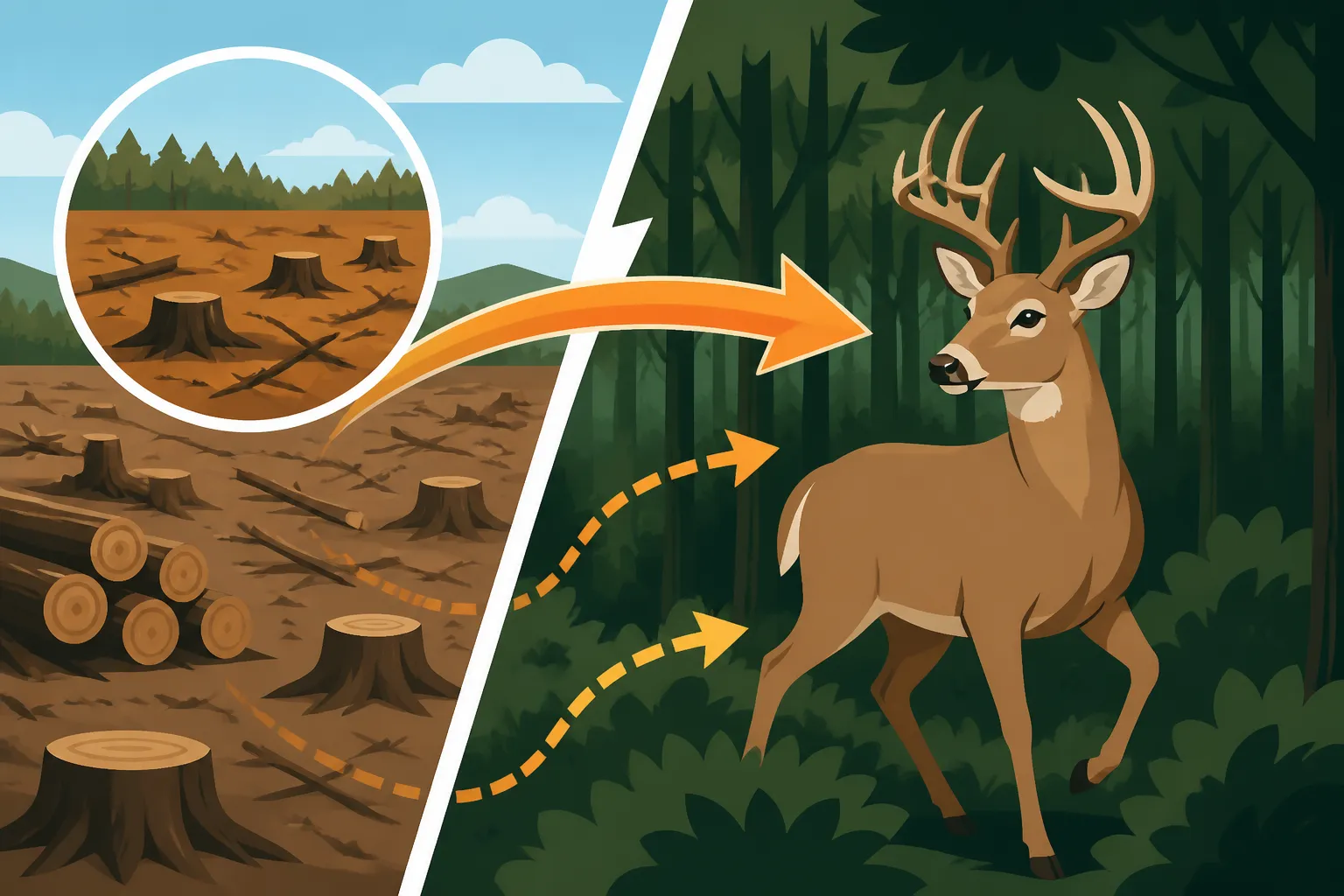
Initially, when active logging is happening, deer will vacate the immediate area. Think about it: the noise, the human activity, the heavy machinery tearing through their home—it's incredibly disruptive. This isn't a long-term abandonment, however. Deer are highly adaptive creatures, but their first instinct is to find quieter, safer cover nearby. They might shift to an adjacent mature timber block, move into a thicker creek bottom, or simply cross a property line into an unlogged parcel. This immediate displacement can last as long as the logging crew is actively working in a given section. It's frustrating when you see fresh tracks heading out of your preferred spot, but remember, it's a temporary migration. Your focus during this phase should be on identifying these temporary sanctuary areas, which are often just a short distance away.
Adaptation to New Cover and Food Sources
Once the saws quiet down and the loggers pull out, the real adaptation begins. What was once a dense, shaded forest floor is now exposed to sunlight, and that's when the magic starts for deer habitat. Within months, sometimes even weeks, new vegetation begins to sprout. Tender shoots, briars, saplings, and weeds explode from the soil, offering an incredible buffet of new browse. Deer, especially does and fawns, are quick to key into these fresh food sources.
Simultaneously, the downed tops and slash left behind by logging operations create incredibly dense bedding cover. Imagine a fortress of tangled branches, almost impenetrable to predators and humans alike. Deer will often return to these cut areas to bed down, enjoying the security and the close proximity to their new food supply. While the mature timber might offer more open travel, these regenerating cuts become prime bedding and feeding grounds, transforming from a noisy construction zone into a deer haven in a surprisingly short amount of time. Late-Season Food Sources for Virginia Whitetails are often found in these areas, even if they're not traditional agricultural plots.
Scouting Timber Cuts for Deer Sign
You can't just walk into a recently cut area blindly and expect to find deer. Successful hunting in these zones starts with meticulous scouting, both on the ground and with the incredible technological tools we have at our disposal today.
Reading the Landscape: What to Look For
When you're boots-on-the-ground in a cut, your eyes need to be trained for specific indicators. Start by looking for established deer trails leading into and out of the cut. Deer often use the edges of the cut as travel corridors, especially where it meets mature timber or a field. Once inside, look for well-worn paths through the thick regeneration, usually leading to specific bedding pockets or feeding zones. You'll often find these trails winding around the densest piles of tops.
Evidence of browsing is a huge clue. Look for nipped-off stems, especially on young briars, saplings, and forbs. The height of the browse can tell you if it's deer or something else. During the rut, don't forget to look for rubs on remaining saplings or even larger trees along the cut's edge, and scrapes along these new travel routes. Scrape Lines Along a Logging Road are common in these transitional areas. Pay attention to how dense the cover is; deer love the thickest stuff for bedding, so focus your efforts on the fringes of these impenetrable zones where they might stage before heading out to feed.
Using Technology for Pre-Season Planning
Before you even step foot in the woods, your digital scouting tools can give you a massive advantage. Satellite imagery, which you can easily access through platforms like onX Hunt or GoHunt, is your best friend here. Look for changes in canopy cover over the past year or two. Fresh clear-cuts will be glaringly obvious—large, bright patches where dense timber once stood. Older cuts will appear as lighter green patches, indicating new, shorter growth.
Once you've identified potential timber cuts, use your mapping app to analyze topography, access points, and proximity to water sources or agricultural fields. You can often see old logging roads or skidder trails that cut through these areas. These are excellent, less-dense travel routes for both deer and hunters. Mark potential bedding areas (the thickest, most secluded parts of the cut), natural funnels where deer might be forced to travel narrow corridors, and likely feeding zones. Reading Aerial Photos for Piedmont Deer can reveal a lot about these types of areas, showing you the mosaic of habitat changes. Plot out potential entry and exit routes that minimize disturbance, considering factors like wind direction. These apps allow you to drop pins, measure distances, and essentially build a comprehensive scouting plan right from your couch.
Hunting Strategies for Post-Timber Cut Areas
Once you've done your homework, it's time to translate that knowledge into effective hunting strategies. These areas demand a slightly different approach than hunting mature, open woods.
Stand Placement and Wind Considerations
With new bedding and feeding patterns established, your stand placement needs to adapt. Instead of focusing solely on oak flats, you'll want to position yourself where deer are transitioning between the dense cover of the cut and nearby food sources, or moving along the edges. Look for pinch points—a narrow strip of timber between a cut and a field, or a saddle that connects two cut areas. Deer will often hug the edge of the thick stuff, so setting up just inside the mature timber overlooking the cut's edge can be incredibly effective.
Wind becomes even more critical in these areas, as the turbulent air over uneven terrain and dense new growth can be unpredictable. Wind and Thermals on a Blue Ridge Slope are particularly tricky. Always play the wind, but understand that swirling thermals can be more common. A good strategy is to set up a stand that allows you to hunt multiple wind directions or have several stand locations for different winds. Consider using a ground blind if the cover is dense enough, as it offers more concealment from swirling winds and provides a flexible setup. Using a Ground Blind on Virginia Public Land can be a game-changer here.
Still-Hunting and Drives in Thick Regrowth
For the more active hunter, still-hunting through a regenerating timber cut can be incredibly rewarding, albeit physically demanding. The key is to move slowly—think one step every few minutes. Stop frequently, use your binoculars to pick apart the dense cover, and listen for the subtle sounds of deer moving through the brush. The noisy nature of this terrain can work in your favor, masking your own movements to some extent. Focus on walking into the wind or with a slight crosswind, paying close attention to any fresh sign you encounter. You might not see deer at long ranges, so be ready for close encounters. This is where a good Hunting a Clear-Cut Regrowth Edge tactic shines, moving deliberately along the perimeter.
For larger cuts, or if you're hunting with a group, organized deer drives can be highly effective. The dense cover makes it hard for deer to slip away unnoticed, and the natural funnels created by the cut edges can be exploited. Safety is paramount here: ensure everyone knows their role, wears plenty of blaze orange, and communicates clearly. Drivers move through the thickest parts, while standers position themselves on known escape routes, such as old logging roads, creek bottoms, or the edges of the cut where it meets open woods. Deer Drives With Three or Four Hunters can be especially productive in these kinds of environments.
Here's a quick look at how different types of timber cuts might impact deer movement:
| Type of Timber Cut | Immediate Impact on Deer | Long-Term Impact on Deer | Best Hunting Strategy |
|---|---|---|---|
| Clear-Cut | High displacement, deer move to adjacent cover. | Excellent new browse & bedding, dense cover, high deer density after 1-2 years. | Still-hunt thick edges, stand on pinch points, group drives. |
| Thinning | Moderate displacement, some deer remain if cover exists. | Increased understory growth, more browse, improved visibility but less dense cover. | Stand hunting along travel corridors, still-hunting selectively. |
| Shelterwood | Low displacement, some mature trees left for cover/seed. | Good browse, continuous cover, varied food sources. | Stand hunting specific food sources, still-hunting through residual trees. |
| Selection Cut | Very low displacement, minimal impact on daily routines. | Minor increase in browse, more light for understory, consistent habitat. | Hunt as normal, focus on new browse patches and enhanced travel. |
Long-Term Habitat Benefits and Future Hunting
It's easy to see a timber cut as a temporary setback, but in reality, it's often a long-term investment in prime deer habitat. Understanding this cyclical process helps you plan for future seasons and appreciate the ecological benefits.
How Cuts Create Future Deer Hotspots
Timber cuts, particularly clear-cuts and heavy thinnings, are incredible habitat creators. When the forest canopy is opened, sunlight finally reaches the forest floor, stimulating the growth of herbaceous plants, grasses, and woody shrubs that were once suppressed. These "early successional" plants provide abundant forage that is highly nutritious for deer. Young saplings, briars, and various forbs become readily available food sources, vastly increasing the carrying capacity of the land for deer.
Beyond food, the dense tangle of downed trees and subsequent regrowth offers unparalleled cover. Does find safe places to fawn, fawns have excellent concealment from predators, and mature bucks can bed down undisturbed in almost impenetrable thickets. This cyclical process is vital for healthy deer populations. Without these disturbances, forests can become too mature and shaded, losing much of their value as deer habitat. So, while it might look barren initially, that cut-over parcel is actually a supercharged nursery for future deer populations. It's often where you'll find Where George Washington Forest Bucks Bed once the regrowth takes hold.
Timing Your Hunts with Habitat Development
The impact of a timber cut isn't a one-and-done deal; it evolves over several years, and so should your hunting strategy.
- Year 1 (Immediate Aftermath): Deer use the edges of the cut and adjacent mature timber as temporary refuges. Food is scarce in the cut itself, but escape cover is abundant if they stay. Focus on entry/exit routes and nearby undisturbed areas.
- Years 2-5 (Early Regeneration): This is often prime time. The vegetation is waist to head-high, providing dense bedding and an explosion of tender browse. Deer will be in the cut, bedding and feeding. This is when still-hunting and setting up inside the cut, or on major trails leading into it, can be highly effective.
- Years 5-10 (Mid-Regeneration): The growth becomes thicker, some trees start to dominate, and the best browse might be higher up. Deer still use these areas, but perhaps less exclusively. They might move through more, utilizing it as dense travel corridors and secondary bedding.
- Years 10+ (Maturing Forest): As the canopy closes again, the understory thins out, and the area slowly transitions back to mature timber, reducing its primary value as a consistent feeding and bedding area, though it can still be a travel corridor.
By understanding this progression, you can predict where the deer will be and adapt your hunting efforts accordingly. A keen eye on the changing landscape, combined with consistent scouting and smart use of mapping apps like onX Hunt, will keep you on deer year after year, no matter what the loggers do. Scouting Virginia Public Land Before Season is crucial to staying ahead of these changes.
Disclaimer
This article is for general informational purposes only and does not constitute professional advice. Laws, prices and regulations vary by location and change over time. Consult a qualified professional for guidance on your specific situation.