Working a Creek Bottom for Late-Season Deer
As the late season grinds on in Virginia, many hunters find themselves facing a real dilemma: deer seem to have vanished into thin air. The easy-to-spot patterns of early archery are long gone, food sources are dwindling, and every deer feels like it's wearing a PhD in evasion. But don't give up hope! This comprehensive guide will delve into how creek bottoms often become overlooked sanctuaries and consistent producers for weary whitetails, offering a lifeline for hunters trying to fill those last tags.
Why Creek Bottoms Are Late-Season Magnets for Deer
When the leaves are off the trees and the wind bites hard, deer aren't just looking for food; they're desperate for thermal cover and a sense of security. Creek bottoms, often overlooked by hunters focused on ridge tops or field edges, naturally provide both in spades. These low-lying areas create microclimates that offer crucial protection from the elements and a surprising array of persistent food sources, making them prime real estate for deer trying to survive the winter.
Consistent Food Sources When Others Disappear
One of the most compelling reasons deer gravitate to creek bottoms in the late season is the sheer availability of food. While acorn crops on the high ridges might be long gone or buried under snow, the moisture retention in creek bottoms often means a prolonged or more varied food supply. Hard mast trees like oaks and hickories growing along these waterways can drop their bounty later, or the nuts might remain visible and accessible on the relatively softer ground near the water.
Beyond mast, creek bottoms are often natural funnels for agricultural runoff, which can sustain lush green browse longer into the cold months. Think about the edges of a cornfield where it dips down to meet a creek; that low-lying section often holds standing corn or spilled kernels long after the rest of the field has been picked clean. Even if the immediate area isn't farmed, the rich soil and ample moisture support a greater variety of understory plants and forbs that provide sustenance when upland areas are barren. This is particularly true in the Piedmont and Tidewater regions of Virginia, where diverse plant life thrives in these fertile strips.
Thermal Cover and Security from the Elements
Beyond food, the structural advantages of a creek bottom provide unbeatable thermal cover. The banks themselves offer a natural barrier against harsh winds, and the lower elevation often means slightly warmer temperatures than the exposed uplands. Picture a bitter January day with a stiff northwest wind; a deer bedded on a sunny creek bank, shielded by topography and dense vegetation, will be far more comfortable and expend less energy than one trying to weather the storm on an open ridge.
Moreover, creek bottoms are frequently choked with dense, almost impenetrable vegetation. This can include thick briar patches, tangled honeysuckle, multiflora rose, and dense stands of young timber that thrive in moist soil. This provides visual obstruction and an incredible sense of security for deer, making them feel safe from predators, including hunters. When pressure mounts from other hunters, deer will naturally seek out these areas of thick cover, becoming masters of disappearing within a few yards of water. They know these places offer both refuge and easy access to water, completing their late-season survival checklist.
Scouting and Reading a Virginia Creek Bottom for Deer
Successfully hunting a creek bottom in the late season isn't about aimlessly wandering; it's about meticulous scouting and understanding how deer use these unique environments. The key is to identify specific travel corridors, bedding areas, and subtle shifts in topography that create natural pinch points and funnels. This requires a different approach than typical early-season scouting, focusing on more nuanced sign and leveraging modern tools.
Identifying Key Funnels and Travel Corridors
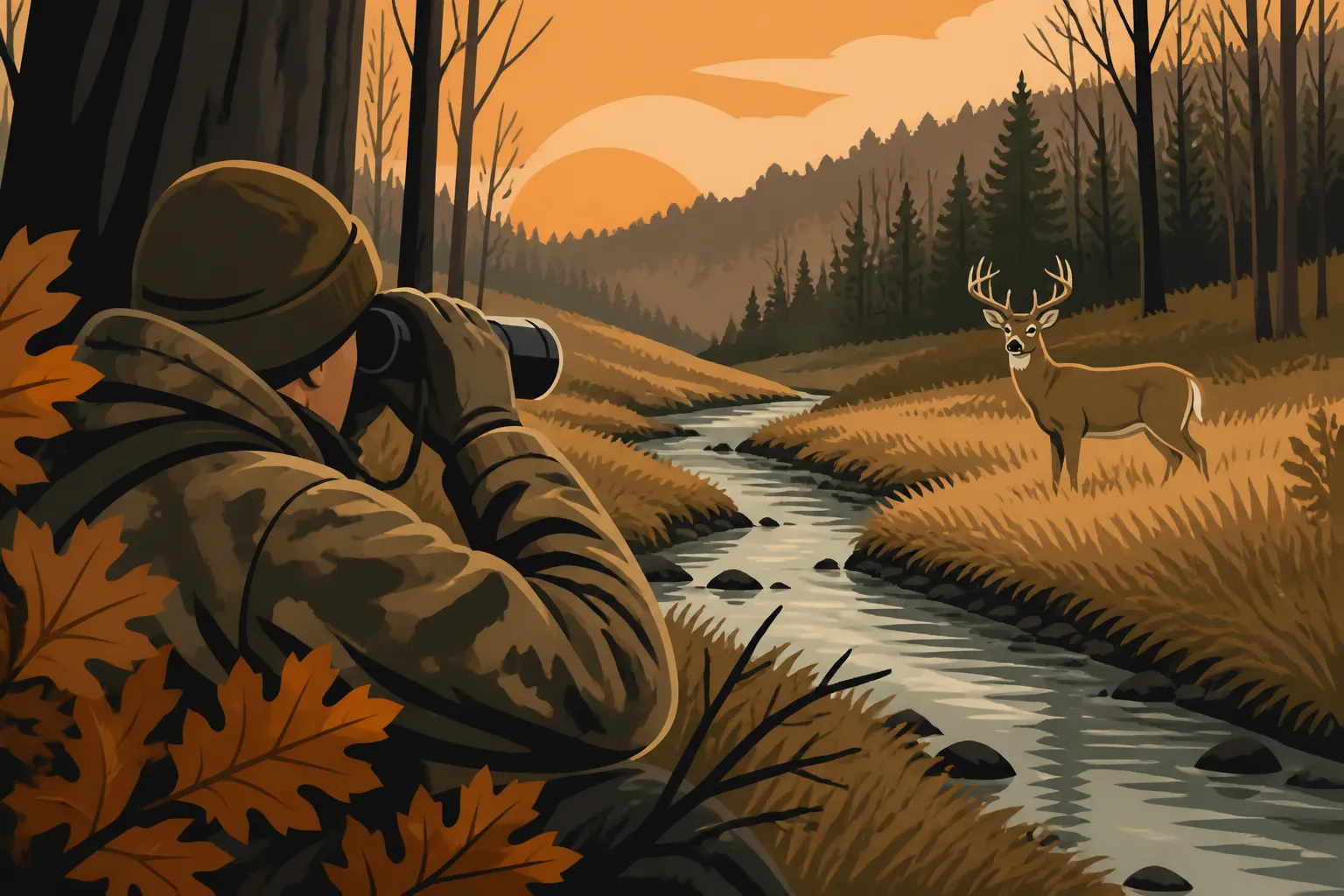
Deer don't just randomly walk through a creek bottom; they have preferred routes. These often occur where the creek makes a hard bend, where a tributary joins the main stem, or where the banks create a natural "pinch point" in the terrain. Look for obvious crossings – places where deer are regularly entering and exiting the water. These might be shallow spots, downed logs, or even well-worn paths leading up a less steep bank. Often, deer will skirt the densest tangles, opting for the path of least resistance along the edge of the creek or through slightly more open timber within the bottomland.
Digital mapping tools, like the GoHunt app or the Virginia DWR app, are incredibly useful here. You can identify potential funnels, benches, and subtle elevation changes before you even set foot in the woods. Look for areas where topography forces deer movement into a narrower strip, or where dense cover transitions into more open timber. These natural movement corridors are goldmines for stand placement. Thinking about how a deer might move from a bedding area in a thick briar patch along the creek to a late-season food source further down can help you predict their travel. You can find more details on how to use such tools by reading our guide on Scouting With the Virginia DWR App.
Fresh Sign and Pressure Indicators
In the late season, fresh deer sign can be subtle but incredibly informative. While rubs might be older and scrapes less active, fresh tracks in the mud or snow along the creek banks are undeniable proof of recent activity. Pay close attention to the size and direction of these tracks. Are they consistently leading from a thicket to a food source? Are there multiple sets, indicating a small group of deer? You're looking for patterns, not just isolated sign. Our post on Reading Virginia Mud for Fresh Deer Movement can provide more in-depth tips.
You might also find late-season beds, particularly on sunny, sheltered banks, often near thick cover. These beds will feel somewhat warm if fresh, and you might notice small droppings or even hair left behind. The presence of fresh droppings, especially those that are still soft and moist, indicates recent feeding activity. Also, consider the impact of hunting pressure. If you're on public land, heavy pressure elsewhere will push deer into these creek bottom hideouts. If you find a creek bottom with lots of fresh sign but no obvious boot tracks from other hunters, you’ve hit a jackpot. This also applies to shed hunting; even after the season closes, knowing where the deer concentrate in the late season will give you a major advantage for Shed Hunting on Virginia Public Land when spring arrives.
| Late-Season Food Source | Typical Location in Creek Bottoms | Availability & Appeal |
|---|---|---|
| Acorns | Under oak/hickory trees on banks | Longer retention due to moisture, can be buried by snow/leaves |
| Standing/Spilled Corn | Adjacent agricultural fields | Highly attractive, especially after harvest; moisture keeps kernels viable |
| Honeysuckle/Green Briar | Dense thickets along water's edge | Browse available all winter, provides cover & food |
| Winter Browse (Misc.) | Edges of thickets, moist openings | Various green plants, twigs, and buds can be found |
| Hard Mast (Misc.) | Other nut trees on well-drained banks | May be present, but less common than acorns; good secondary food |
Effective Hunting Strategies for Creek Bottoms
Once you've scouted and identified promising creek bottom locations, it's time to put a strategy into action. The unique characteristics of these areas demand specific tactics, whether you prefer sitting on stand, still-hunting, or even organizing a small, strategic drive.
Stand Placement and Approach Considerations
Choosing the right stand location in a creek bottom is paramount. You want to be positioned to intercept deer moving between bedding and feeding areas, or those simply using the creek as a travel corridor. Look for a tree that offers good concealment while providing a clear view of a crossing, a pinch point, or the edge of a thicket where deer are likely to emerge. Consider a setup where you can watch a natural funnel, perhaps where the creek makes a hard bend and deer are forced to move around it. Our article on Hunting a Funnel Between Two Hollows has some excellent crossover advice.
Your approach and exit routes are just as critical. The goal is to get into your stand undetected and leave without alarming deer. This often means using the creek itself as a pathway, especially if it’s shallow enough to walk in or along, masking your scent and sound. If you're hunting private land, make sure you have explicit permission to access from landowners. For public land, planning your route meticulously using an app like GoHunt can prevent you from bumping deer on the way in. When setting up, remember that late-season deer are exceptionally wary. Minimize movement, and ensure your scent is well managed, especially with the swirling winds common in bottomlands. Sometimes, a well-brushed-in ground blind can be even more effective than a treestand in these dense, low-visibility areas, allowing you to blend seamlessly into the bankside vegetation. Read up on Using a Ground Blind on Virginia Public Land for more details.
Still-Hunting and Small Deer Drives
If sitting on stand isn't your style or the deer are simply not moving much, still-hunting a creek bottom can be incredibly productive. This involves moving slowly, taking a few steps, and then stopping for several minutes to glass and listen. The dense cover often means close-quarters encounters, so be ready for quick shots. Focus on moving into the wind, carefully picking apart the cover in front of you. Pay attention to every flicker of movement, every unnatural shape. The key is patience; you're essentially glassing and stalking simultaneously. This can be particularly effective during the middle of the day when deer might be bedded down in those thickets.
For groups of 2-3 hunters, a small, organized deer drive can also be very effective in creek bottoms. One or two hunters act as "blockers" positioned ahead at key pinch points or crossings, while the "driver(s)" slowly walk through the dense cover, pushing deer along the creek. Communication is vital, and safety is paramount. Everyone should know where each other is and understand the pre-determined boundaries and exit points. This tactic often works best on larger creek systems with clear boundaries, like a steep bank on one side and an open field on the other, funneling deer toward the blockers. Learn more about effective strategies by checking out our guide on Deer Drives With Three or Four Hunters. Just remember that if you're hunting during Virginia's General Firearms Deer Season, blaze orange requirements are in effect for everyone involved.
Weather and Time of Day Considerations
Late-season weather can dramatically influence deer movement, and creek bottoms become even more attractive during certain conditions. A cold front with plummeting temperatures will send deer seeking the thermal cover offered by these low-lying areas. Similarly, a fresh snowfall can make tracking easier and also highlights the importance of shelter, driving deer into the protective embrace of the creek. During these harsh conditions, deer may move and feed throughout the day, not just at dawn and dusk. This makes midday sits or still-hunts more productive than earlier in the season.
During extremely cold periods, deer need to conserve energy. This means they will move less but when they do, it will be purposeful – typically between their secure bedding areas in the bottom and available food. Focus your efforts during the warmest parts of the day, when deer might be more inclined to browse or move to sun themselves. Conversely, an approaching warm front might signal increased activity just before the temperature rises significantly. Adjusting your Cold-Weather Sitting Strategy in the Mountains to these specific conditions will greatly increase your odds.
Gear and Logistics for Creek Bottom Success
Hunting creek bottoms presents unique challenges, primarily related to the terrain and weather. Having the right gear and a solid logistical plan can make the difference between a successful hunt and a miserable one.
Essential Gear for Cold, Wet Conditions
First and foremost, you need to stay warm and dry. Creek bottoms are inherently damp, often muddy, and can be significantly colder than the uplands due to trapped cold air. Invest in quality waterproof boots with excellent insulation. Rubber boots are often preferred for their waterproof capabilities and ease of cleaning after slogging through mud. Layered clothing is crucial; start with a good moisture-wicking base layer, add insulating layers (wool or synthetics are best for their warmth-to-weight ratio and ability to retain heat when damp), and top it off with a waterproof and windproof outer shell. Hand warmers and foot warmers are not a luxury in these environments – they are a necessity for staying comfortable during long sits.
Don't forget the small but mighty items: a reliable headlamp for walking in and out in the dark, a sharp knife for field dressing, and a small backpack with water, snacks, and any emergency supplies. A good pair of binoculars, even modest ones like an 8×42, will be invaluable for picking apart dense cover for deer sign or for spotting a deer before it spots you. For detailed insights into footwear, check out Boots for Virginia Swamps and Ridges.
Dealing with Difficult Terrain and Recovery
Navigating a creek bottom can be tough. Expect to encounter thick briars, downed timber, muddy banks, and potentially water crossings. Wear durable pants that can withstand thorns and brush. If you expect to cross water, consider waders or waterproof gaiters. Once you've successfully harvested a deer, the challenge shifts to recovery. Dragging a deer out of a thick, muddy creek bottom can be back-breaking work.
Consider bringing a deer cart or a sled, especially if you have a long way to go, though a sled is often more practical in very thick, muddy, or snowy conditions. If you're hunting steep terrain, like the mountainous regions of western Virginia, a sturdy frame pack for boning out the animal on-site might be your best option, saving you from a brutal drag. Discussing your recovery plan with your hunting partners beforehand is always a good idea. Our guide on Sleds and Drags for Mountain Country offers some excellent tips that can apply to the challenging terrain of creek bottoms as well.
Disclaimer
Hunting is an inherently dangerous activity. Always prioritize safety, understand and follow all Virginia Department of Wildlife Resources (DWR) regulations, and ensure you have proper training and licensing. This guide provides general information and recommendations, but individual hunting conditions and regulations may vary. It is your responsibility to know and abide by all current laws and safety practices.