Glassing a Powerline Cut at Last Light
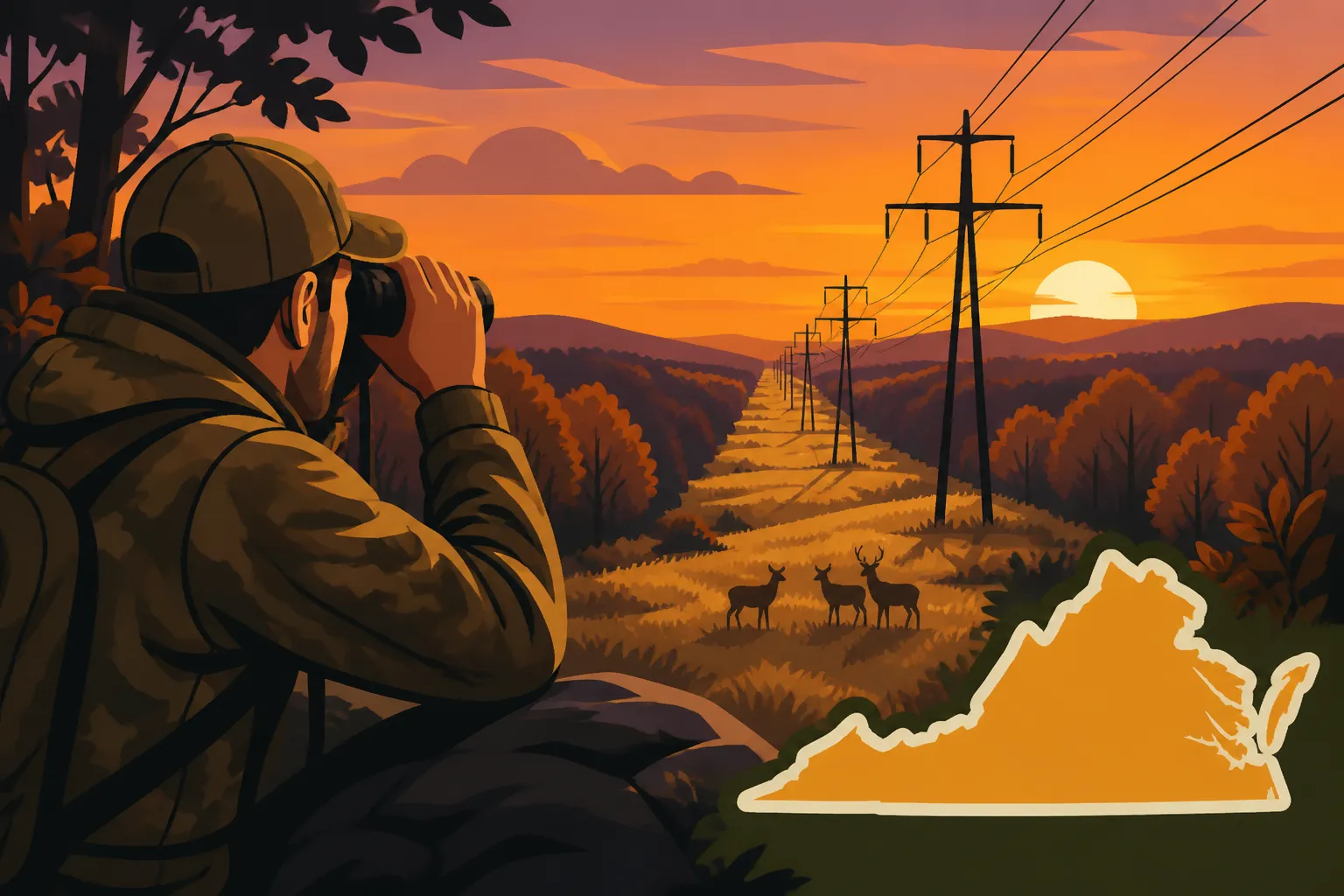
The sun dips low, casting long shadows across the Virginia landscape, and suddenly, the woods seem to come alive. You've been sitting tight all afternoon, maybe shivering a bit as the temperature drops, but nothing. Then, as the light begins to fade, that tell-tale deer silhouette steps out into the powerline cut. It's a common frustration for many hunters: deer often wait until the last possible moment to move, making it incredibly tough to get a clear visual, let alone a shot. This guide is all about mastering the art of glassing those crucial powerline cuts as the day winds down, giving you a powerful edge in understanding deer movement and ultimately, filling your tag.
Why Powerline Cuts Are Deer Magnets at Last Light in Virginia
If you spend any time hunting in Virginia, you’ve probably noticed that powerline cuts aren't just scars on the landscape; they're often highways and dining halls for deer. There’s a good reason for this, especially as evening approaches and deer start to think about their nightly routine. Understanding why they use these areas is the first step to effectively glassing them.
Natural Edge Habitat and Forage
Think about what grows in a cleared powerline cut versus the mature timber on either side. Those cuts are constantly being disturbed, which allows sunlight to hit the forest floor, promoting an explosion of young, succulent plants that deer absolutely crave. You’ll find everything from blackberry brambles, honeysuckle, and sumac to young maples and oaks, all providing tender shoots and leaves. This buffet is a major draw.
Deer are browsers, not grazers like cattle, so they're constantly nibbling on twigs, leaves, and buds. A powerline cut provides a linear pantry of diverse browse that’s often more accessible and nutritious than the sparse understory of a mature, shaded forest. This makes them ideal feeding zones, especially when deer are transitioning from bedding areas to more open feeding fields or vice versa. It’s like a deer-sized grocery aisle stretching for miles, offering a quick meal on the way to their next destination.
Moreover, these cuts often have different soil compositions and moisture levels than the surrounding woods, leading to a unique microclimate that can encourage certain food sources at different times of the year. For instance, you might find more acorns from scattered oaks or soft mast like persimmons or wild grapes along the edges. These varied food sources ensure that powerline cuts remain attractive to deer through different seasons, from the lush growth of summer to the dormant but still vital woody browse of late fall and winter.
Thermal Cover and Travel Corridors
Beyond the food, powerline cuts offer a strategic advantage for deer in terms of movement and security. The dense, thick regeneration within the cut itself, often a mix of briars, small trees, and brush, provides excellent thermal cover, especially on cold Virginia evenings. Deer can bed down in these thickets during the day, feeling secure, knowing that any approach would be noisy and easily detected.
As the sun begins to set, these cuts transform into efficient travel corridors. Instead of navigating the tangled underbrush and fallen timber of a dense forest, deer can use the relatively open lane of the powerline to move quickly and quietly between their bedding areas in the deeper woods and their evening feeding spots. Imagine a buck trying to conserve energy during the rut; a straight shot down a powerline is much easier than busting through thick woods. This is where you often see deer emerge from the shadows, step into the open, and move with purpose. Understanding these movements is key to successful Scouting Virginia Public Land Before Season.
The adjacent mature timber provides the ultimate security blanket. Deer won’t just step out into the middle of a wide-open powerline cut in broad daylight without good reason. Instead, they’ll hug the edges, using the cover of the tree line as a shield, slowly picking their way out as darkness grants them more confidence. This interplay between the openness of the cut and the security of the forest edge creates predictable patterns that keen hunters can exploit, particularly as legal hunting hours dwindle.
Overcoming Visibility Challenges in Dense Woods
Let's be honest, hunting in Virginia's dense forests can be incredibly frustrating when it comes to visibility. Thick hardwoods, cedar thickets, and rolling terrain mean your effective vision might only extend 50-75 yards, if you’re lucky. Trying to spot a subtle flick of an ear or the flash of a white tail in that kind of cover is a monumental challenge, especially as shadows deepen.
This is where powerline cuts become invaluable. They offer those precious, long sightlines that are so rare elsewhere. Suddenly, you can see hundreds of yards, allowing you to observe deer movement, identify animals, and plan your approach long before they are within shooting range. This extended visibility isn't just about seeing deer; it's about seeing their behavior, their travel routes, and even their body language. You can watch an entire scenario unfold, giving you critical intelligence for future hunts.
By positioning yourself correctly, perhaps on a slight rise overlooking a section of the cut, you can use your optics to systematically scan for activity. This wide-open vantage point allows you to cover far more ground with your eyes than you ever could creeping through the woods. It's about working smarter, not harder, and leveraging the landscape to your advantage. This strategy is particularly effective when trying to fill multiple tags, as discussed in Filling a Six-Deer Eastern Limit or Filling a Five-Deer Western Limit.
Essential Gear and Setup for Effective Glassing
To truly capitalize on the opportunity that powerline cuts present at last light, you need the right tools and a smart setup. It’s not just about having binoculars; it’s about having the right binoculars and knowing how to use them to extract every bit of detail from the fading light.
Selecting the Right Optics
Your binoculars are your primary weapon for glassing powerline cuts. For Virginia hunting, especially when light is low, you want something that gathers light efficiently and provides a clear, crisp image. Generally, 10×42 binoculars are an excellent all-around choice. The "10x" means they magnify objects 10 times, bringing distant deer much closer, and the "42" refers to the diameter of the objective lens in millimeters, which dictates how much light they can gather. For even lower light conditions, or if you plan to hunt wide-open spaces a lot, bumping up to 12×50 or even 15×56 binoculars can make a noticeable difference in brightness and detail as dusk settles in.
However, if you're truly trying to pick apart a distant clear-cut or a powerline that stretches for a mile or more, a spotting scope becomes invaluable. A 60-80mm objective spotting scope, often with variable magnification from 15x to 60x, will allow you to count antler points, assess body size, and even determine the exact path a deer is taking from much farther away. Brands like Maven, Vortex, and Leupold offer excellent options across different price points, focusing on superior glass coatings for light transmission. When researching gear, I often use resources like GoHunt to compare different models and read reviews, making sure I'm investing in optics that will perform when it matters most – in those critical low-light moments.
| Optic Type | Magnification/Objective | Best Use Case | Key Benefit for Last Light | Average Price Range |
|---|---|---|---|---|
| Binoculars | 10×42 | All-around, mobile hunting | Good balance of magnification and light gathering | $200 – $1000+ |
| Binoculars (Larger) | 12×50 or 15×56 | Wider fields, lower light | Excellent light gathering, enhanced detail | $500 – $2000+ |
| Spotting Scope | 15-60×65-85mm | Long-range observation, detail analysis | Extreme magnification for antler scoring and distant details | $700 – $2500+ |
Remember, it's not just about the numbers; it's about the quality of the glass and the coatings. Better glass means less chromatic aberration (color fringing) and better light transmission, which translates to a brighter, clearer image when deer are just starting to emerge from the timber. You can learn more about finding the right pair in our guide on Optics for Blue Ridge and Piedmont Hunting.
Stable Tripod and Positioning
You can have the best optics in the world, but if you’re trying to hold them steady freehand for an extended period, you’re going to miss details. A stable tripod is absolutely non-negotiable for serious glassing, especially with higher magnification binoculars or a spotting scope. Even 10x binoculars benefit immensely from being mounted on a tripod; the difference in clarity and the ability to detect subtle movement is astounding.
When choosing a tripod, look for something lightweight but sturdy, with smooth panning and tilting capabilities. Carbon fiber models from brands like Vortex or Slik are excellent, offering portability without sacrificing stability. A good tripod adapter for your binoculars is also essential, ensuring they attach securely and quickly.
Your physical position is equally important. You want to be elevated if possible, to give you a better overview of the entire cut and to minimize foreground obstructions. Look for a natural rise, a small hill, or even a sturdy tree (if you're using a treestand for observation, which is perfectly viable). Concealment is also key. Even though you’re at a distance, deer have incredible eyesight, and you don’t want to skyline yourself. Position yourself with a solid backdrop, perhaps against a cluster of pines or a thick fencerow. The goal is to be a silent, invisible observer, allowing you to watch the natural movements of the deer without alerting them to your presence.
Clothing and Wind Considerations
Even if you’re a quarter-mile away, wind direction and your choice of clothing still matter. Deer often use powerline cuts as travel routes, and if the wind is blowing your scent directly down the cut, there’s a good chance any deer moving through will pick up on it. Always try to position yourself so the wind is blowing crossways to the cut, or better yet, quartering into your face, carrying your scent away from the deer’s likely approach. This is fundamental to all deer hunting, as explained in Wind and Thermals on a Blue Ridge Slope.
For clothing, think about two main factors: comfort and concealment. You’ll be sitting for potentially a couple of hours, so dress in layers appropriate for the cooling evening temperatures in Virginia, particularly in late fall. Wool or synthetic base layers, an insulating mid-layer, and a quiet, weatherproof outer layer are ideal. Brands like Sitka, Kuiu, and First Lite make excellent hunting apparel designed for stealth and warmth.
Camouflage is important, but equally so is the quietness of your fabric. Avoid noisy materials that rustle with every slight movement. And don't forget your blaze orange or blaze pink if it's during general firearms season. While you're observing, you're still a hunter in the woods. Review Virginia Blaze Orange Requirements to ensure you're compliant and safe, especially during popular seasons like Virginia's General Firearms Deer Season. Even if you're not actively hunting from your glassing position, wearing orange makes you visible to other hunters who might be moving through the area.
Strategic Glassing Techniques for Virginia Powerline Cuts
Glassing isn't just staring through binoculars; it's a systematic and patient process. To make the most of those precious last minutes of daylight, you need a strategy for how you scan the landscape and what you focus on.
Grid Searching and Segmentation
One of the biggest mistakes hunters make when glassing is simply sweeping their optics randomly across an area. This is a sure way to miss subtle details, especially when a deer might just be taking a step or flicking an ear. The most effective technique is a systematic grid search. Start at one end of the powerline cut, say the far left edge, and slowly, methodically scan horizontally across a small section. Then, drop your gaze slightly and scan back in the opposite direction. Repeat this process until you've covered the entire powerline cut, from one edge to the other, and from the furthest visible point back to your immediate foreground.
It helps to mentally (or even physically, with your tripod) segment the powerline into smaller, manageable chunks. Instead of thinking of it as one long, overwhelming expanse, break it into 100-yard sections. Focus intently on one section, looking for any anomaly – a horizontal line that shouldn't be there, a flicker of movement, a patch of brown that isn't a stump. Only once you've thoroughly scoured that segment do you move on to the next. This methodical approach might feel slow, but it's the best way to detect deer that are either standing perfectly still, partially obscured, or moving very slowly. It’s about letting your brain process small segments of information rather than trying to take in the whole picture at once.
Remember to take breaks from the glass every 10-15 minutes. Staring through optics for too long can cause eye fatigue and make everything blend together. Give your eyes a rest, look at the full landscape, and then return to your systematic search. Often, during those brief rests, your peripheral vision might catch something you missed while "tunnel visioning" through the glass.
Focusing on Transition Zones and Cover Edges
Deer are masters of edges. They live in them, travel them, and feel secure near them. Powerline cuts are, by definition, one giant edge habitat. However, certain parts of that edge are more likely to produce deer sightings than others. Focus your initial and most intense glassing efforts on the transition zones where the open cut meets the dense timber. This is where deer will stage before moving out into the open, or where they’ll pause before disappearing back into the woods.
Pay close attention to any dips, humps, or subtle changes in elevation within the cut itself. These undulations can provide hidden pockets of cover or small benches where deer might browse or pause. Similarly, look for variations in vegetation density within the cut – areas with thicker brush, clumps of pines, or even large boulders. These small patches of cover offer security and often serve as preferred travel lanes or brief feeding spots. For instance, a small, isolated patch of pines might be a bedding area, or a natural funnel point between two hollows. Learning to read these landscape features is crucial, similar to Reading a Ridge for Blue Ridge Deer.
Also, don't forget about any creek bottoms or drainages that cross the powerline. These are natural travel corridors for deer and often provide a denser, greener understory that stays attractive longer into the fall. Deer will often follow these natural contours, emerging from the creek bottom, crossing the powerline, and then dipping back into the timber on the other side. These are prime locations to watch as the light fades, because they combine both a travel route and a source of water and food.
Timing Your Glassing Session
The "last light" window isn't just the final 15 minutes; it’s a more extended period that begins well before sunset. To maximize your chances, you should be in your glassing position and settled at least 1 to 1.5 hours before actual sunset. Deer activity often ramps up dramatically in the last hour of daylight as they feel more comfortable leaving their bedding areas.
This early arrival allows you to thoroughly scan the area in good light, identifying any deer that might be out early or already moving. It also allows your eyes to adjust to the changing light conditions gradually. As the sun drops below the horizon, the ambient light diminishes rapidly, and your optics become even more critical. You'll want to stay vigilant until legal shooting light is completely gone, which in Virginia, is usually 30 minutes after sunset. Those final moments are often when the biggest bucks make their appearance, having waited until they feel completely safe under the cloak of impending darkness. This timing is especially important during Hunting the Rut East of the Blue Ridge or Hunting the Rut West of the Blue Ridge when bucks are actively seeking does.
Always check your local sunrise/sunset times, and be acutely aware of the legal shooting hours. It's exhilarating to watch deer move at dusk, but you must respect the law. Have your hunting app or a watch handy to know precisely when legal light ends. You don't want to get caught making a last-second, illegal shot because you misjudged the time.
Interpreting Deer Behavior and Planning Your Next Move
Glassing at last light isn't just about spotting deer; it's about learning. Every observation is a piece of the puzzle that helps you understand the deer in that specific area, informing your future hunting strategies.
Reading Deer Movement Patterns
Once you spot deer, don't just admire them; analyze their movements. Are they simply feeding casually, slowly picking their way through the browse in the powerline cut? Or are they moving with a purpose, perhaps traveling quickly from one timber block to another? Understanding this distinction is crucial. A deer feeding casually might indicate a nearby bedding area or a preferred food source. A deer moving swiftly might be heading to a larger feeding field or responding to pressure from another part of the woods.
Pay attention to where they enter and exit the cut. Do they always use the same trail? Are there multiple entry/exit points? Do they favor a certain side of the powerline based on wind direction or available cover? Over several glassing sessions, you might start to see patterns emerge. A specific clump of cedars or a bend in the powerline might consistently be a staging area or a crossing point. This intel is invaluable for setting up a treestand or ground blind, allowing you to choose the most opportune location for Treestand Setups in George Washington National Forest or Using a Ground Blind on Virginia Public Land.
Also, observe how they react to other deer. Are they solitary, or are they part of a larger group? Do they exhibit any dominance displays or breeding behavior during the rut? All these interactions can give you insights into the local deer dynamics. For instance, if you consistently see a particular group of does, you can bet a buck will eventually show up to check them out, especially during late October and November.
Identifying Key Bucks and Doe Groups
This is where the power of good optics truly shines. At a distance, and in fading light, it can be challenging to distinguish between a mature doe and a young buck, let alone judge antler size. However, with quality binoculars or a spotting scope on a stable tripod, you can take your time to assess what you're looking at. Look for body size – older bucks tend to have thicker necks, broader chests, and a more developed sag in their belly compared to younger deer or does.
When it comes to antlers, try to count points and assess width and mass. Is it a basket rack 8-point, or a wider, heavier-antlered buck? Observe how it carries its head; a heavy-racked buck will often carry its head lower or appear more muscular in the neck. If you have a good mapping application like GoHunt on your phone, you can mark the exact location where you saw the deer. This feature is fantastic for future planning, allowing you to return to that precise spot or analyze the surrounding terrain.
Don't just focus on bucks, though. Locating large groups of does is often a prerequisite for finding a mature buck, particularly during the breeding season. Bucks are constantly cruising for estrous does, and where the does gather, the bucks will eventually follow. By identifying consistent doe groups, you can predict where the rutting activity will concentrate.
Post-Glassing Strategy and Follow-Up
The information you gather during a last-light glassing session is gold. It’s not just for that evening; it’s for planning your next move. If you see a mature buck emerge from a specific patch of woods and head down the powerline, your next hunt might involve setting up an ambush point along that exact travel corridor for the following morning or evening. Consider which approach would be best for you: Still-Hunting Jefferson Forest Ridges or perhaps a more stationary approach in a blind.
Perhaps you notice that all the deer are entering the powerline from a particular, inaccessible side. This might prompt you to scout that area more thoroughly on another day, looking for alternative access points or new stand locations. You might also identify specific food sources they are targeting, which could influence your choice of stand for later in the season. For example, if they're hammering acorns, your strategy could shift to Hunting After a Poor Acorn Year or finding alternative food sources.
Always take detailed notes, either mentally or in a hunting journal. Log the date, time, wind direction, temperature, and what you observed (number of deer, sex, approximate size, direction of travel, etc.). This historical data builds a comprehensive picture of deer movement patterns over time, which becomes an invaluable tool for your future hunting success. Glassing at last light isn't the end of your hunt; it's often just the beginning of your next, more informed, and hopefully, successful one.
Disclaimer
Hunting involves inherent risks, including serious injury or death. Always prioritize safety, understand and follow all local, state, and federal hunting regulations. Consult with the Virginia Department of Wildlife Resources (DWR) for the most current rules and season dates. The information provided here is for educational purposes and should not replace professional guidance or legal consultation. Practice ethical hunting and respect wildlife and the outdoors.