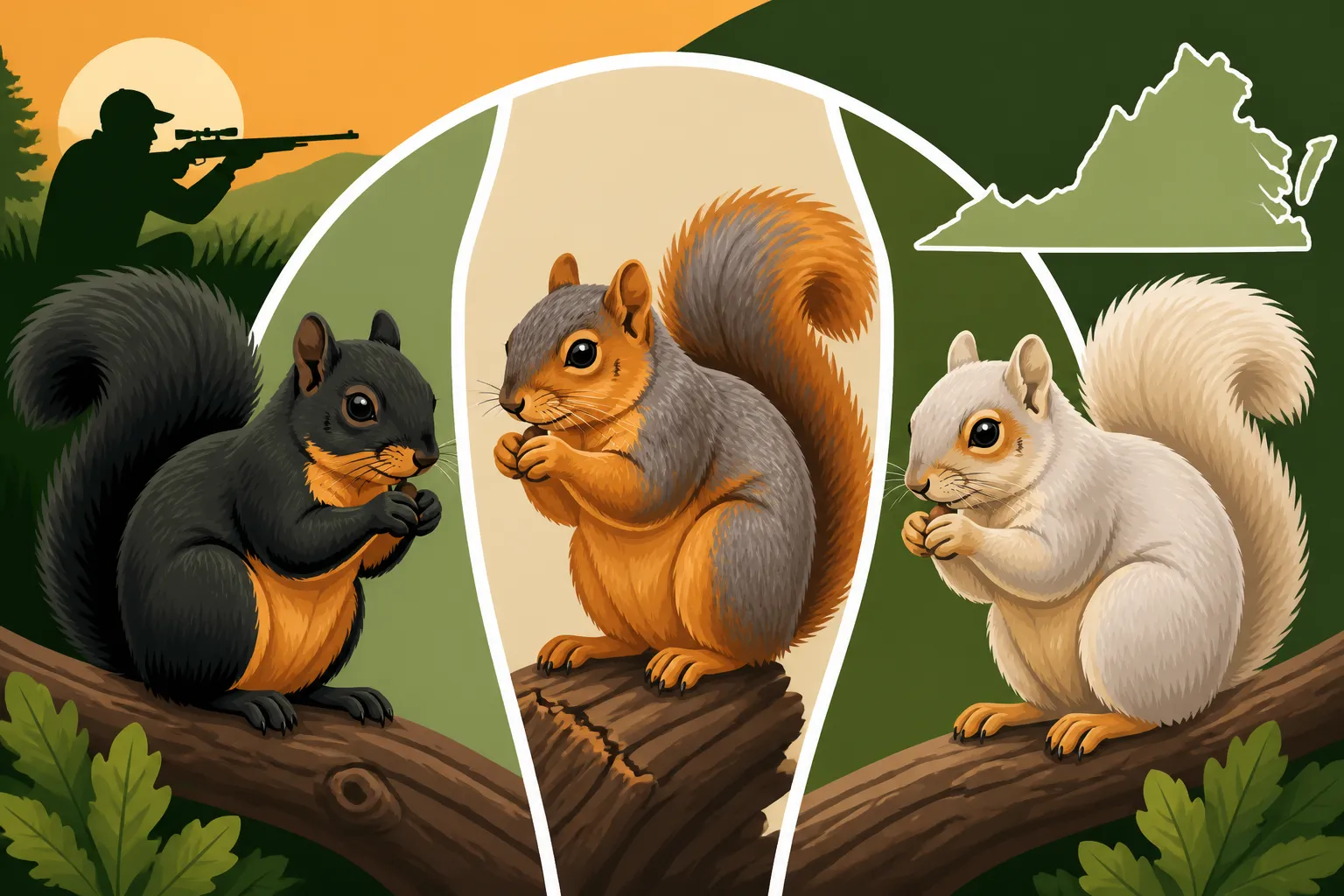
Virginia Fox Squirrel Color Variations
If you've spent any time in the Virginia woods, you know our squirrels aren't always just plain grey. From the dense mountain forests to the sprawling Piedmont farmlands, you might stumble upon a fox squirrel sporting shades that make you wonder if you’re seeing something entirely new. This guide will dive deep into the fascinating world of Virginia's fox squirrel color variations, explaining why these bushy-tailed residents boast such a diverse palette and what it means for hunters and wildlife enthusiasts alike.
Understanding Virginia's Fox Squirrels
Virginia is home to two primary species of tree squirrels: the common Eastern gray squirrel and the larger, less numerous Eastern fox squirrel. While gray squirrels are ubiquitous, the fox squirrel tends to be a bit more elusive and offers a broader range of color variations that often captivate those lucky enough to spot them.
The Basics of Fox Squirrel Biology
Eastern fox squirrels (Sciurus niger) are the largest tree squirrels in North America, and certainly the biggest we have here in the Old Dominion. They're typically about twice the size of a gray squirrel, both in body length and weight. You'll often find them with a body stretching over a foot long, not including their impressive, bushy tail, which can add another foot or more. Their build is robust, designed for navigating open woodlands and savannah-like habitats more so than the dense canopy favored by their gray cousins. They're not nearly as frantic as gray squirrels; instead, they often move with a deliberate, almost chunky gait, frequently spending time on the ground foraging for nuts, seeds, and even fungi. This larger size and slower demeanor make their unique coloration even more striking when you encounter one.
Regional Differences in Habitat and Behavior
Fox squirrels thrive in more open, mature hardwood and pine-oak forests, especially those with an open understory. They appreciate mast-producing trees like oaks and hickories, which provide crucial food sources, as well as den trees with cavities for shelter and raising young. In Virginia, you'll find them scattered throughout the state, though their populations can be less dense and more localized than gray squirrels.
East of the Blue Ridge, particularly in the Piedmont and Coastal Plain, they often inhabit fragmented woodlots, mature timber along agricultural fields, and even suburban areas with large, old trees. Hunting East of the Blue Ridge often means looking for those big, isolated oaks or stands bordering crop fields. West of the Blue Ridge, they favor the more open, mature hardwood ridges and valleys of the Appalachian Mountains. While both areas support fox squirrels, the specific characteristics of the habitat can sometimes lead to differences in local populations, including the prevalence of certain color variations. Their tendency to be less arboreal than gray squirrels means you might spot them foraging on the forest floor or scampering across a field more often than you'd see a gray squirrel.
The Kaleidoscope of Virginia Fox Squirrel Colors
This is where things get truly interesting! Unlike the fairly consistent grey of the Eastern gray squirrel, fox squirrels in Virginia can display a dazzling array of coat colors. It's not uncommon for hunters and outdoor enthusiasts to report seeing squirrels that seem almost entirely different from one another, even within the same general area.
Common Color Phases Across the Commonwealth
While "fox squirrel" implies a reddish or foxy hue, their coloration is incredibly diverse. The most common color variation across Virginia is generally a grizzled grey or brownish-grey back with rust or reddish-orange undersides, ears, and often around the face. You might also notice prominent black markings on their heads or feet, creating a striking contrast. For example, in many parts of the Piedmont, you'll encounter fox squirrels with a reddish-brown body, a dark, sometimes blackish, head and feet, and a tail that blends these colors with some frosted tips.
However, the "common" can quickly diverge. In some regions, you might see individuals with much more subdued red tones, appearing almost entirely dusky grey, while others lean heavily into a vibrant orange or deep rust, with only minimal grey. The tail, often a mix of these colors, can also vary, sometimes being mostly reddish, other times more grizzled with black and white hairs, especially towards the tip. It's like nature decided to give each region its own squirrel fashion show!
Explaining Genetic and Environmental Influences
The primary driver behind these stunning color variations is genetics. Several genetic conditions can affect melanin production, leading to different color morphs:
- Erythrism: This is characterized by an excess of red pigmentation and a reduction or absence of black pigment. Squirrels with erythrism will appear much redder or orange than typical, often lacking the darker markings.
- Melanism: On the other end of the spectrum, melanism results in an excess of dark (black) pigment. Melanistic fox squirrels are often entirely black, or at least predominantly dark, with perhaps only a hint of the usual reddish undertones. These all-black squirrels can be quite startling to see, almost like a small bear cub scurrying up a tree. They're less common in Virginia than the reddish phases but definitely present, especially in certain localized populations.
- Leucism/Albinism: While rarer, you can also find leucistic or albino fox squirrels. Leucistic squirrels have reduced pigmentation across their entire body, resulting in a pale, often yellowish-white coat, but typically retain normal eye color. Albino squirrels, on the other hand, lack all melanin production and will have pure white fur and pink or red eyes due to the blood vessels showing through. Seeing a pure white fox squirrel is truly a once-in-a-lifetime experience for many hunters.
While genetics are the dominant factor, environmental elements might play a minor role in the vibrancy or dullness of a coat, such as diet quality affecting overall health and fur condition, or even sun exposure leading to some fading over time, but these impacts are generally subtle compared to the genetic predispositions.
Spotting Rare and Unusual Variations
Spotting a rare color variation is often the highlight of a day afield. Imagine you're Squirrel Hunting a Virginia Oak Ridge and instead of the usual grey or reddish-brown blur, a completely black squirrel bolts across your path. That's a melanistic fox squirrel, and they are truly distinct. They often seem to absorb light, making them almost invisible in deep shadows. Conversely, a leucistic squirrel might pop out like a beacon, especially against a dark tree trunk or forest floor.
These rarer morphs, like pure black or white, aren't tied to a specific region in Virginia in the same way some common color tendencies might be. They can appear anywhere a fox squirrel population exists, as they are genetic mutations that can arise within any breeding group. However, some areas might have a slightly higher incidence due to localized gene pools where the trait has been passed down more frequently. For example, certain parks or isolated woodlots might develop a higher proportion of melanistic individuals simply by chance and continued breeding. Observing and reporting these unique sightings can contribute valuable data to local wildlife agencies, helping them understand local population genetics.
Here's a quick overview of some common and uncommon fox squirrel color variations you might encounter in Virginia:
| Color Variation | Description | Typical Location in VA (Tendency) | Visibility for Hunter | Rarity in VA |
|---|---|---|---|---|
| Classic Red/Orange | Grizzled brown-grey back, bright reddish-orange belly, ears, and face. | Widespread, common in Piedmont/East | Moderate contrast, blends with fall foliage. | Common |
| Dark-Headed | Reddish-brown body with distinct dark (often black) head, feet, and tail base. | More common in Western Mountains | Good contrast, but dark areas can make it blend in shade. | Common |
| Dusky Grey/Brown | More muted red tones, appearing predominantly dark grey or brownish-grey. | Widespread, can be seen anywhere | Blends well with tree bark, especially in low light. | Common |
| Melanistic (Black) | Entirely or predominantly black fur, sometimes with faint reddish undertones. | Localized populations, often Western | Stands out in open, but disappears in deep shadow. | Uncommon |
| Leucistic (Pale) | Reduced pigment, resulting in pale cream, yellow, or white fur; normal eyes. | Very rare, isolated sightings | Highly visible, stands out dramatically against natural backgrounds. | Very Rare |
| Albino (White) | Complete lack of pigment, pure white fur, pink or red eyes. | Extremely rare, genetic anomaly | Extremely visible, unmistakable. | Extremely Rare |
Hunting Considerations for Varied Fox Squirrel Colors
While the beauty of these color variations is undeniable, for the hunter, they can also present interesting challenges and opportunities. Understanding how these colors interact with the environment can give you an edge, or at least a good story to tell around the campfire.
Visibility and Camouflage Implications
The coloration of a fox squirrel can significantly impact its visibility in different hunting scenarios. A classic reddish-orange squirrel, for instance, might blend remarkably well with the vibrant hues of autumn leaves, making it harder to spot when it's foraging on the ground or clinging to a leaf-covered branch. However, against a dark, wet tree trunk in winter, that same coloration would stand out more prominently.
Conversely, a melanistic (black) fox squirrel, while a striking sight, can be incredibly difficult to pick out in the deep shadows of an oak canopy or within the dense underbrush of a pine stand. They seem to melt into the gloom. Yet, if that same black squirrel crosses a sun-drenched field edge or climbs a light-colored sycamore, it becomes highly conspicuous. Hunters should always be aware of the background and lighting conditions when scanning for squirrels. This is especially true when you're Reading Cuttings Under an Oak and trying to distinguish a static animal from the forest floor debris. No matter the color, the key is often to spot movement first, then resolve the shape.
Regional Hotspots for Specific Color Morphs
While genetic variations can pop up anywhere, some regions of Virginia are more noted for certain color morphs. For example, the more rugged terrain and diverse forest types of western Virginia, including areas within the George Washington National Forest and Jefferson National Forest, are sometimes associated with a higher incidence of darker, more melanistic fox squirrels. Perhaps it's genetic isolation, or perhaps these darker squirrels have a slight survival advantage in the shadow-drenched mountain hollows.
In contrast, the Piedmont and Eastern parts of the state might yield more of the classic reddish-orange varieties. However, this is more of an observation of prevalence rather than a hard-and-fast rule. A good strategy is to familiarize yourself with the general characteristics of fox squirrels in the area you plan to hunt. Websites and apps like GoHunt can sometimes offer user-submitted photos or discussions that might hint at local color trends, though nothing beats firsthand scouting. Remember to check Virginia Squirrel and Rabbit Season Rules before heading out, no matter where you plan to hunt.
Ethical Hunting and Conservation of All Variants
It's important to remember that regardless of their captivating colors, all fox squirrels in Virginia are the same species, and their conservation status is stable. From a hunting perspective, a melanistic squirrel is no different from a red one; it's simply a genetic variant. There's no special tag or restriction based on color.
Ethical hunting practices remain paramount. This includes proper identification of your target, ensuring a clear shot, and always respecting bag limits and season dates as outlined in the Virginia Small Game Season Rules. Responsible hunters contribute to wildlife management efforts that help sustain healthy populations for all species, including those with unique genetic expressions. Harvesting a beautiful, unusually colored fox squirrel is a memorable experience, and many hunters choose to have such trophies mounted, not just for their size but for their striking coloration.
Beyond the Hunt: Appreciating Virginia's Wildlife Diversity
The fascinating array of fox squirrel colors in Virginia speaks volumes about the rich biodiversity present in our state's wild places. It's a reminder that nature is constantly at work, creating endless variations and beauty, sometimes in the most unexpected forms.
Citizen Science and Reporting Unique Sightings
If you encounter a particularly striking or unusual fox squirrel – especially a pure black (melanistic) or pure white (leucistic/albino) individual – consider reporting your sighting to the Virginia Department of Wildlife Resources (DWR). While they don't necessarily track every color variation, consistent reports from specific areas can provide valuable insights into localized genetics or population trends. Taking a clear photo, if possible, along with the location and date, can be very helpful. You can often find avenues for submitting observations through the DWR website or via apps like GoHunt, which often integrate with wildlife agencies for data collection. These contributions fall under the umbrella of "citizen science" and help professionals monitor and understand wildlife populations, including Virginia Wildlife Disease Monitoring and other crucial data.
The Role of Fox Squirrels in Virginia's Ecosystem
Beyond their aesthetic appeal and their role as a challenging small game species, fox squirrels play an integral part in Virginia's ecosystems. Like all squirrels, they are vital seed dispersers. By burying nuts and seeds for later consumption and then forgetting about some of them, they effectively "plant" new trees and shrubs. This contributes significantly to forest regeneration and maintaining healthy habitats.
They are also a food source for various predators, including hawks, owls, bobcats, and coyotes, thus contributing to the food web. Their foraging habits help turn over soil and can influence the distribution of fungi, further integrating them into the complex tapestry of our natural world. Whether you're hunting them, observing them, or just enjoying their presence, the diverse and often colorful fox squirrels of Virginia are a true testament to the beauty and complexity of our wild spaces. For those interested in pursuing them, remember that Squirrel and Small Game Hunting in Virginia offers a great way to experience this diversity firsthand.
Disclaimer
This article is for general informational purposes only and does not constitute professional advice. Laws, prices and regulations vary by location and change over time. Consult a qualified professional for guidance on your specific situation.