Virginia Whitetail Color Phase Rarities
We've all spent countless hours in the woods, our eyes scanning for that familiar flash of a brown coat and white flag. Virginia's whitetail deer are a constant presence, a beautiful, wild part of our landscape, but sometimes, just sometimes, nature throws us a curveball. You might catch a glimpse of something truly extraordinary, something that makes you do a double-take and wonder if your eyes are playing tricks on you. This guide is all about those incredibly rare and fascinating color phase variations in Virginia whitetails, helping you understand what you might be seeing and why it's so special.
Understanding Typical Whitetail Coloration in Virginia
Before we dive into the extraordinary, let's ground ourselves in the ordinary – the everyday beauty of the Virginia whitetail. Most of the deer you encounter, whether you're scouting new ground or sitting in a stand during Virginia's General Firearms Deer Season, will exhibit a consistent range of colors, perfectly adapted to their environment.
The Classic Brown and Tan Coat
The typical whitetail deer coat is a masterclass in natural camouflage. During the warmer months, roughly from spring through late summer, deer sport a reddish-brown or "rufous" coat. This lighter, often thinner hair helps them blend seamlessly with the green foliage of summer woods and fields. Think of those long, lazy afternoons watching fawns in a clover plot – their coats are usually a richer, almost reddish hue. As autumn approaches and the temperatures begin to drop, they undergo a remarkable transformation. Their summer coat is shed, replaced by a much thicker, denser, and often grayer-brown winter coat. This winter attire provides essential insulation against the biting cold and helps them disappear against the barren trees and muted browns of fall and winter landscapes. The hairs are hollow, trapping air for warmth, and their texture changes, making them appear duller, less reflective. It's a pragmatic wardrobe change that’s critical for survival, allowing them to endure everything from a mild Piedmont winter to the deeper snows in the mountains.
Regional Nuances in Standard Colors
While the general brown-to-gray pattern holds true statewide, you might notice subtle regional differences in Virginia's deer. Deer in the eastern part of the state, particularly in the more fertile farmlands of the Virginia Piedmont or the coastal plain, might sometimes appear slightly richer in color, perhaps due to a more protein-rich diet or different sun exposure. Their coats can have a deeper, almost chestnut tone in summer. Contrast that with deer living in the rugged terrain of the George Washington National Forest Hunting or the Jefferson National Forest Hunting out west. These mountain deer might lean towards a more muted, almost steel-gray in their winter phase, blending with the rocky outcrops and deep, dark timber. The density of the undergrowth, the types of trees, and even the soil color can all play a small part in the overall impression of a deer's coat. It's not a dramatic shift, but if you spend enough time hunting different regions, you'll start to pick up on these nuances. These subtle variations are still within the "normal" range for White-Tailed Deer Across Virginia, a testament to their adaptability.
Unpacking the Genetics Behind Color Phase Variations
So, what causes a deer to deviate from this perfectly sculpted palette? It all comes down to the fascinating world of genetics and, specifically, the pigments that give color to an animal's hair, skin, and eyes. Understanding these basic building blocks helps demystify why some deer look so strikingly different.
The Role of Melanin and Pigmentation
At the heart of all animal coloration is a group of pigments called melanin. Think of melanin as the biological dye that dictates how dark or light an animal's fur will be. There are two main types relevant to deer: eumelanin, which is responsible for black and brown tones, and pheomelanin, which produces reddish and yellow hues. The amount, type, and distribution of these melanins within a deer's hair follicles are what create its specific coat color. When everything is working as it typically should, the deer produces a balanced amount of both, resulting in that classic brown or gray-brown we know so well.
However, sometimes a genetic hiccup occurs. A mutation in the genes responsible for melanin production or distribution can cause an overproduction, underproduction, or complete absence of these pigments. This isn't necessarily a bad thing; it's just a variation in the genetic code. Imagine it like a recipe. Most of the time, the recipe for a deer's coat is followed perfectly. But sometimes, a single ingredient is either missing, doubled, or entirely swapped out, leading to a very different final product. These genetic mutations are often rare, which is why seeing a color phase deer feels like encountering a true anomaly in the wild.
Genetic Dominance and Recessiveness
The expression of these unusual color phases is often governed by the principles of genetic dominance and recessiveness. In simple terms, for many traits, an animal inherits two copies of a gene—one from each parent. Some genes are "dominant," meaning if you have even one copy of it, that trait will show up. Others are "recessive," meaning the trait will only appear if the animal inherits two copies of that specific gene, one from each parent.
For most rare color phases in whitetails, the genes causing the unusual coloration are recessive. This means that a deer can carry the gene for albinism or piebaldism without actually showing those traits itself. If two deer that both carry the recessive gene (but look perfectly normal) breed, there's a chance their offspring will inherit two copies of that recessive gene, and voilà, a rare color phase deer is born. This explains why you might hear about an albino deer appearing in an area where none have been seen before—the recessive genes were simply waiting for the right combination. This also means that even if you never see a piebald deer, the gene might be quietly present in the local Virginia Deer Herd Size, passed down through generations.
Rare Whitetail Color Phases Found in Virginia
While the vast majority of Virginia Deer Population Estimate are typically colored, there are a handful of truly unique and rare color variations that occasionally grace our woods. Each is a product of specific genetic quirks, and encountering any one of them is a memorable experience.
Albino Whitetails: The True Ghost of the Forest
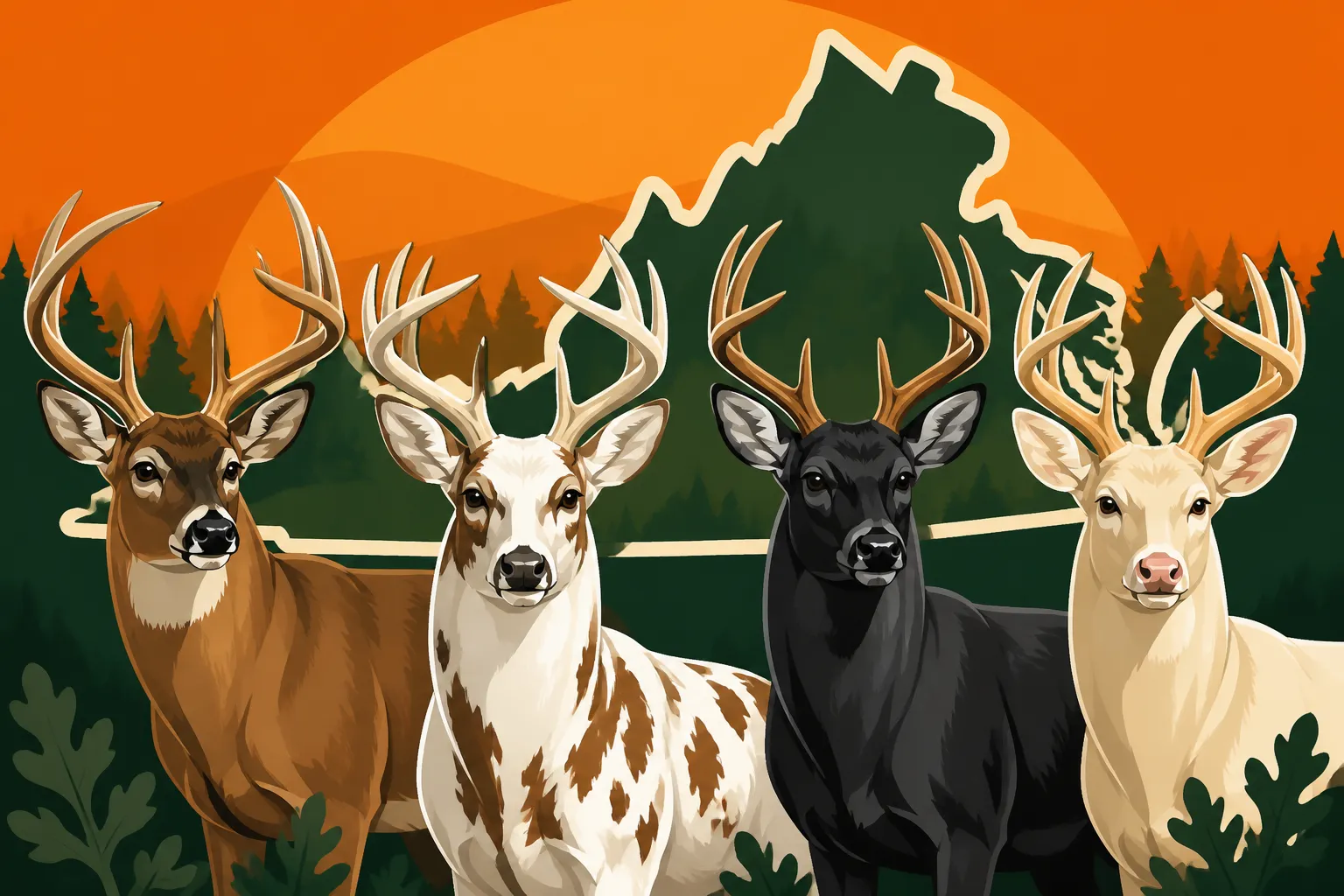
When people think of a "white deer," an albino is usually what first comes to mind, and for good reason. True albinism is perhaps the most striking and rarest of all whitetail color phases. An albino deer is completely devoid of melanin. This means their fur is pure, stark white, often described as ghostly or ethereal. But the defining characteristic that truly separates an albino from other white deer is the color of its eyes: they are pink or reddish. This pink hue is due to the blood vessels showing through the unpigmented iris. You’ll also notice their nose and hooves will be pink, lacking any black pigment.
These deer face significant challenges in the wild. Their pure white coat, while beautiful to us, makes them incredibly conspicuous in most environments, especially when they need to blend in with foliage or bare timber. This increased visibility makes them more vulnerable to predators, a tough break for a deer just trying to survive. Beyond predation, albinos can also suffer from poor eyesight and increased sensitivity to sunlight, making them less efficient at foraging and navigating. While extremely rare, albinos have been sighted across Virginia, from the farmlands of the Shenandoah Valley to the remote corners of Southwest Virginia. It’s truly a special thing to witness, a living testament to genetic variation.
Leucistic Whitetails: A More Common "White" Deer
Often confused with albinos, leucistic (pronounced loo-SIS-tic) deer are another form of white deer, but with a crucial difference: they have partial pigment loss. Unlike albinos, leucistic deer still produce some melanin, just not in all of their hair follicles or to the full extent. This means their fur can range from mostly white with some patches of normal color, to entirely white but still possessing pigmented eyes, noses, and hooves. Most commonly, a leucistic deer will have a white coat but blue eyes, or sometimes even normal brown eyes, along with a black nose and dark hooves. This partial pigmentation is what sets them apart genetically from true albinos.
Because they retain some pigment, leucistic deer generally don't suffer from the extreme eyesight problems or sun sensitivity that often plague albinos. Their camouflage, however, is still compromised by their predominantly white coat, making them stand out in most natural settings. Still, having some natural eye and nose color likely gives them a slight survival edge over their fully albino cousins. It's not uncommon for a hunter or nature enthusiast to spot a white deer and immediately label it an albino, but more often than not, it's a leucistic individual. They are rare, but statistically, you're more likely to see a leucistic deer than a true albino in Virginia.
Melanistic Whitetails: The Shadow Deer
If white deer capture our attention with their stark contrast, melanistic deer do so with their profound darkness. Melanism is the opposite of albinism: it's an overproduction of melanin, resulting in an unusually dark or even jet-black coat. Imagine a whitetail that looks like a sleek, dark shadow moving through the underbrush – that's a melanistic deer. Their eyes, nose, and hooves are typically normal, sometimes even darker than average, but it's the intense, deep hue of their fur that truly sets them apart.
These deer are incredibly rare, arguably even rarer than true albinos, and often reported in very specific geographical pockets around the world. While sightings are few and far between, an occasional report of a dark, almost black whitetail does surface in Virginia, often leaving observers stunned. For a deer, being entirely black in the eastern hardwood forests can be a unique challenge; while it might provide excellent camouflage in deep shadows, it could make them stand out in bright sunlight or against snow. Their rarity makes them a true treasure to behold, an unexpected twist in the familiar tapestry of Virginia's deer. You might even mistake one for a black bear from a distance, if not for its gait and antler characteristics (for bucks), but the rarity of them makes such a sighting truly once-in-a-lifetime.
Piebald Whitetails: Nature's Spotted Canvas
Piebaldism is another genetic anomaly that affects pigmentation, but instead of uniform white or black, it results in a patchy, spotted appearance. A piebald deer will have irregular patches of white fur mixed with areas of normal brown coloration. Think of a domestic pinto horse, but on a deer. The size and distribution of these white patches can vary wildly from deer to deer; some might have just a few small white spots, while others can be almost entirely white with only a few brown areas.
What makes piebald deer particularly interesting, and often concerning, is that the genetic mutation causing piebaldism is often linked to other physical deformities. It's not uncommon for piebald deer to have a roman nose (a downward-curving profile), short legs, an arched spine, or internal organ issues. These deformities can significantly impact their ability to thrive in the wild, making them less agile, slower, and more susceptible to injury or predation. Their irregular coloration also hinders their natural camouflage, whether in the green woods or against snow. Virginia Deer Antler Growth Timeline might be impacted if their overall health is compromised by these other conditions. Despite these challenges, piebald deer are perhaps the most frequently observed color anomaly in whitetails across Virginia, certainly more common than pure albinos or melanistics, though still quite rare in the grand scheme of the Virginia Deer Herd Size. Each one is a unique, living piece of art.
Here's a quick comparison of these fascinating color phases:
| Color Phase | Key Characteristics | Eye Color | Relative Rarity (in VA) | Associated Health/Survival Impact |
|---|---|---|---|---|
| Typical | Reddish-brown (summer), Gray-brown (winter) | Brown | Common | Well-camouflaged, generally robust. |
| Albino | Pure white fur, no pigment in skin/hooves | Pink/Red | Extremely Rare | Poor camouflage, sun sensitivity, vision problems, vulnerable to predators. |
| Leucistic | White fur, but may have normal colored eyes/nose/hooves | Blue, Brown | Rare | Poor camouflage, potentially better vision/sun tolerance than albinos, still vulnerable. |
| Melanistic | Unusually dark to jet-black fur, overproduction of melanin | Brown/Dark Brown | Extremely Rare | Variable camouflage depending on environment, rare sightings. |
| Piebald | Irregular patches of white and normal brown fur | Brown | Rare (most common anomaly) | Poor camouflage, often associated with physical deformities (bowed legs, curved spine), reduced agility. |
Encountering and Reporting a Rare Color Phase Deer
Spotting one of these unique deer in the wild is truly a special moment, one that most hunters and wildlife enthusiasts will never experience. It's a reminder of nature's incredible diversity and the subtle genetic dance happening all around us.
What to Do If You See One in the Wild
If you're lucky enough to encounter an albino, leucistic, melanistic, or piebald whitetail in Virginia, take a moment to appreciate it. These are wild animals, and like all wildlife, they deserve respect and space. Your first instinct might be to get closer for a better look or a photograph, and that's perfectly understandable! If you can capture a picture or video without disturbing the animal or altering its behavior, that's fantastic. These visual records are invaluable.
However, remember to always prioritize the animal's well-being and your own safety. Maintain a respectful distance, use binoculars or a spotting scope like those you might use for Optics for Blue Ridge and Piedmont Hunting to get a better view, and observe its natural behavior. Avoid chasing, calling, or otherwise stressing the deer. If you're hunting and one of these deer presents itself, consult the latest Virginia DWR regulations carefully. While generally legal to harvest, some landowners or hunters choose to pass on these unique animals, preferring to let their rare genetics continue in the population. Ethical hunting means making informed decisions.
Reporting Sightings to Virginia DWR
Your sighting of a rare color phase deer isn't just a personal anecdote; it can also be valuable information for the Virginia Department of Wildlife Resources (DWR). While DWR isn't actively tracking every single individual rare deer, reports of these anomalies can contribute to their broader understanding of genetics within Virginia's White-Tailed Deer Across Virginia population and overall herd health. It's especially useful if you can provide the location, date, and any photos you might have taken.
The DWR doesn't have a specific "rare deer hotline," but you can often submit observations through their general contact channels, or even through their online reporting tools. Tools like Scouting With the Virginia DWR App might offer a way to log wildlife sightings, or at the very least, you can use the app to pinpoint your exact location to include in an email or phone call to a DWR biologist. This kind of community involvement helps wildlife management agencies keep a finger on the pulse of what's happening in the field, even with these incredibly uncommon occurrences. Knowing that these genetic traits exist and where they pop up helps researchers understand deer movements and gene flow. For example, if a cluster of piebald deer reports came from a specific county, it might indicate a localized genetic predisposition worth noting. Always refer to the official DWR website or contact them directly for the most current methods of reporting wildlife sightings or any questions regarding Virginia Wildlife Disease Monitoring and population health.
Disclaimer
This article is for general informational purposes only and does not constitute professional advice. Laws, prices and regulations vary by location and change over time. Consult a qualified professional for guidance on your specific situation.