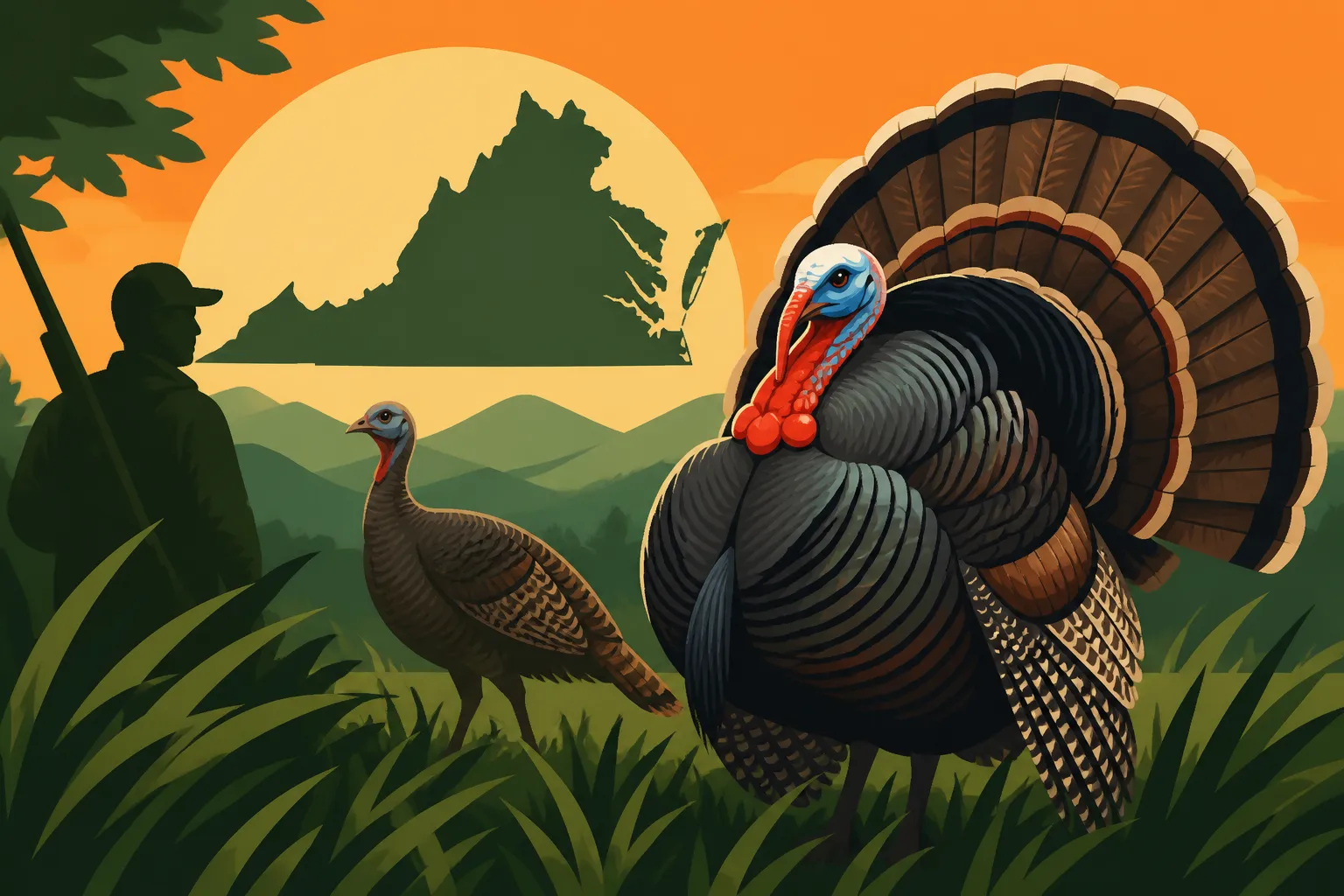
Wild Turkeys in Virginia
For many hunters, the sound of a gobbler ringing through a pre-dawn Virginia forest is the purest sign of spring. But finding and consistently fooling these wary birds can be an incredible challenge, often leading to frustrating hunts and empty vests. This comprehensive guide is designed to peel back the layers of hunting wild turkeys in Virginia, offering insights into their behavior, the regulations that govern their pursuit, and proven tactics to help you fill your tag.
Virginia's Turkey Population and History
The journey of the wild turkey in Virginia is nothing short of a conservation triumph. Not too long ago, these magnificent birds were practically nonexistent in much of the Commonwealth, a stark contrast to the robust populations we enjoy today. Understanding this history helps us appreciate the efforts that have gone into ensuring their presence for future generations of hunters and wildlife enthusiasts.
The Remarkable Restoration Story
Back in the early 20th century, wild turkeys faced a grim future across much of their historic range, including Virginia. Unregulated market hunting, coupled with widespread habitat destruction from logging and agricultural expansion, decimated their numbers. By the 1930s, Virginia's wild turkey population was estimated at a mere 2,000 to 3,000 birds, clinging to existence in only the most remote mountain and swamp regions. It was a truly disheartening situation, one that many thought might be irreversible.
However, thanks to dedicated conservation efforts, primarily spearheaded by the Virginia Department of Wildlife Resources (DWR) and its partners, a monumental restoration project began. This involved a combination of habitat improvement, strict hunting regulations, and, most critically, trapping and relocating wild-caught turkeys to areas where they had been extirpated. Unlike pen-raised birds, which often failed to thrive, these wild-trapped turkeys were resilient and quickly re-established thriving populations. It's a testament to what focused conservation can achieve, turning a near-empty forest into a vibrant soundscape once more. If you're curious about the specifics of this incredible comeback, you might find it fascinating to learn How Turkeys Were Restored to Virginia.
Current Population Estimates and Trends
Today, Virginia boasts a healthy and widespread wild turkey population, estimated to be well over 180,000 birds. This remarkable recovery means that hunters almost anywhere in the state have a realistic chance of encountering these elusive game birds. While overall numbers remain strong, it’s worth noting that populations aren't static; they fluctuate based on various factors like weather patterns during nesting season, predator impacts, and mast crop availability.
Recent years have seen some localized dips in poult-to-hen ratios in certain areas, which can concern hunters who remember the lean times. However, the DWR actively monitors these trends, adjusting seasons and bag limits as needed to ensure sustainable hunting opportunities. Staying informed about Virginia Turkey Population Trends is a smart move for any dedicated turkey hunter, as it can influence your expectations and scouting strategies for the upcoming season.
Regional Distribution Across the Commonwealth
Virginia's diverse landscape means wild turkeys aren't uniformly distributed. While you can find turkeys in nearly every county, certain regions tend to hold denser populations and offer different hunting experiences. The mountainous western regions, with their vast tracts of timber, historically served as critical strongholds during the lean years and continue to support excellent turkey numbers. The Piedmont, with its mix of hardwoods, agriculture, and sprawling timber blocks, also offers fantastic opportunities, especially in the central and southern counties.
Even the more developed northern Virginia and eastern Tidewater regions have thriving turkey populations, often adapting surprisingly well to suburban fringes and smaller woodlots. You might be surprised to find turkeys even near metropolitan areas, proving just how adaptable these birds can be. For those willing to put in the legwork and secure access, nearly any part of the Commonwealth can yield a successful turkey hunt.
Understanding Virginia's Turkey Biology and Behavior
To become a consistently successful turkey hunter, you need to think like a turkey. Understanding their natural history, daily routines, and seasonal changes is paramount. Virginia's terrain and climate certainly influence their behavior, making local knowledge incredibly valuable. It’s not just about calling; it’s about knowing when and where to call, and crucially, why.
Virginia's Eastern Wild Turkey Subspecies
The wild turkeys inhabiting Virginia are almost exclusively the Eastern subspecies (Meleagris gallopavo silvestris). These are the classic, majestic birds known for their iridescent bronze and copper plumage, dark barring on their wings, and the characteristic gobble that sets many a hunter's heart racing. Easterns are incredibly wary and intelligent, making them a formidable challenge in the woods. Their keen eyesight, sharp hearing, and uncanny ability to vanish into seemingly thin cover are legendary.
While other subspecies like the Osceola, Merriam's, or Rio Grande exist in different parts of the country, the Eastern is our native gobbler, perfectly adapted to the hardwood forests, pine plantations, and agricultural fringes of Virginia. Their survival instincts are honed by generations of navigating dense woods and avoiding predators, which means you need to bring your A-game every time you step into their domain.
Seasonal Movement and Food Sources
A turkey's life revolves around food and reproduction, dictating their movements throughout the year. In spring, as breeding season kicks into high gear, gobblers are primarily focused on attracting hens, and their movements will often follow these groups of females. They'll frequent open fields, food plots, and hardwood ridges where hens might be foraging. During this time, insects, fresh green vegetation, and leftover mast from the previous fall are important.
As spring transitions to summer, and then into fall, their diet shifts dramatically. Acorns, beechnuts, and other hard mast become incredibly important, especially in the mountains and Piedmont. They’ll also feast on a variety of berries, seeds, and insects. Fall turkeys will form larger flocks—hens and poults in one group, gobblers often in bachelor groups—and these flocks will move extensively in search of abundant food sources. Understanding these seasonal dietary shifts is key to scouting success, helping you pinpoint where turkeys are likely to be throughout the year.
Roosting and Breeding Dynamics
Turkeys are arboreal creatures when it comes to sleeping, preferring to roost in tall trees at night to escape ground predators. This behavior is a crucial aspect of hunting, as knowing where birds are roosting can give you a significant advantage, especially for early morning setups. They typically fly up to their roosts around dusk and fly down at first light. Finding these "roost trees" is often a product of persistent scouting, listening for evening gobbles or putting birds to bed. If you're looking to master this aspect of turkey hunting, understanding Roost Hunting Virginia Gobblers can be a game-changer.
The breeding season, usually from late March through May in Virginia, is when gobblers are most vocal and vulnerable. Dominant gobblers will establish territories and perform elaborate courtship displays, fanning their tails, strutting, and gobbling incessantly to attract hens. Hens, after mating, will seek secluded nesting sites, often in dense cover, to lay and incubate their clutches. Once hens are bred and on nests, gobblers can become less vocal and harder to locate, making the early part of the spring season often the most active for hunters.
Key Virginia Spring Turkey Season Rules and Regulations
Navigating the regulations for Virginia's spring turkey season can sometimes feel like trying to untangle a knot of fishing line. It's not overly complicated, but paying close attention to the details is crucial to ensure a legal and ethical hunt. The Virginia Department of Wildlife Resources (DWR) sets these rules to manage the turkey population sustainably, and every hunter has a responsibility to understand and follow them precisely.
License Requirements and Permits
Before you even think about setting foot in the woods, you'll need the proper licensing. For Virginia residents, a basic hunting license is required, along with a Virginia Big Game License. Non-residents will need a non-resident hunting license and a non-resident big game license. If you plan to hunt on certain Wildlife Management Areas (WMAs), an access permit might also be necessary, so always double-check the specific WMA rules before you go.
It's easy enough to purchase your licenses online through the DWR website or at authorized vendors like sporting goods stores. Always carry proof of your licenses with you while hunting; a digital copy on your phone through the Go Outdoors Virginia app is usually sufficient, but having a physical copy as backup is always a good idea, especially in remote areas where cell service is spotty. Don't let a simple license oversight ruin your hunt and potentially lead to a hefty fine. For a full breakdown of what you need, check out Virginia Hunting Licenses and What They Cost.
Understanding Early and Late Season Periods
Virginia's spring turkey season is typically split into two distinct periods: an "early" period and a "late" period. The early period often has more restrictive hunting hours, frequently ending around noon, to give birds a break in the afternoon and allow for more natural breeding activity. This midday closure can be a source of frustration for hunters who want to spend all day in the woods, but it's designed with conservation in mind. The late period usually allows for all-day hunting, often running until sunset, offering more flexibility for those who can't get out at dawn.
The exact dates for these periods can shift slightly from year to year, so always consult the most current DWR hunting regulations pamphlet or their website. Pay close attention to these distinctions, as hunting outside of legal hours can lead to serious penalties. Additionally, there’s a special Virginia Youth and Apprentice Turkey Weekend that typically occurs a week or two before the general opener, providing a fantastic opportunity for mentored young hunters to get out when pressure is lower.
Bag Limits and Reporting Your Harvest
The statewide bag limit for spring gobblers in Virginia is usually two bearded birds per hunter per license year, with a daily limit of one. This means you can't harvest two birds on the same day, no matter how good the hunting is. "Bearded bird" means any turkey with a visible beard, which typically includes adult gobblers and occasionally a jake. Remember, hens are protected during the spring season to allow them to nest successfully and contribute to the next generation.
Once you harvest a turkey, it's mandatory to report it to the DWR. This can be done online through the DWR website or using the Go Outdoors Virginia app on your smartphone. Reporting your harvest is crucial for wildlife management, as it provides the DWR with vital data on population health and harvest trends. This information helps them make informed decisions about future regulations. You'll need to report your bird before transporting it more than eight hours from the kill site, or before processing it for consumption or taxidermy. These reporting requirements are simple but essential steps in responsible hunting.
Hunting Tactics for Virginia Spring Turkeys
Spring turkey hunting in Virginia is a game of strategy, patience, and a little bit of luck. It's a truly immersive experience, demanding your full attention from the moment you step into the pre-dawn woods. While there's no single "right" way to hunt turkeys, a few tried-and-true tactics can significantly increase your odds of success against these cunning birds.
Scouting for Gobblers Before Opening Day
Successful turkey hunting often begins long before the season opener. Pre-season scouting is absolutely critical in Virginia, especially on public lands where competition can be stiff. It's about more than just locating birds; it's about understanding their routines, travel corridors, and preferred strutting zones. Listen for gobbles at dawn and dusk, look for tracks in soft soil, droppings, and shed feathers, and identify potential roosting areas. Don't forget to look for scratch marks in leaf litter, indicating where turkeys have been foraging.
Using mapping apps, like those provided by GoHunt or the DWR, can be invaluable for identifying potential turkey habitat, such as hardwood ridges, field edges, and creek bottoms. Consider hanging trail cameras in areas with good sign to monitor activity without disturbing the birds. The more you know about the specific birds you're targeting, the better your chances when opening day arrives. Understanding Scouting Virginia Public Land Before Season is a great resource if you're looking for more in-depth pre-season strategies.
Mastering Turkey Calling Techniques
Calling is arguably the most iconic aspect of spring turkey hunting, and it's a skill that takes practice and finesse. There are myriad calls available: box calls, slate calls, diaphragm calls, and push-button calls, each with its own advantages and learning curve. The key isn't necessarily making the perfect sound, but making realistic and varied sounds at appropriate times. Yelp, cluck, purr, cut – learn a few basic vocalizations and understand when to deploy them.
Start with soft, subtle calls, especially in the early morning or when you first set up on a bird. As the day progresses, or if a gobbler is hesitant, you can increase the volume and intensity. The biggest mistake many new hunters make is over-calling. Turkeys, especially on pressured public land, can become "call-shy." Sometimes, silence, or just a few soft tree yelps, is the most effective call of all. Practice year-round, not just weeks before the season, to build confidence and muscle memory with your preferred calls.
Effective Setup Strategies and Decoy Use
Once you’ve located a gobbler and he’s responding to your calls, your setup is paramount. Turkeys have incredible eyesight, so concealment is non-negotiable. Choose a spot with good back cover—a wide tree trunk, a brush pile, or a ground blind—that breaks up your outline and offers a clear shooting lane. Make sure you can comfortably shoulder your shotgun and swing it without being detected. Patience is key; often, a gobbler will hang up just out of range, trying to pinpoint the hen he hears.
Decoys can be a powerful tool, especially for drawing in a hung-up tom. A simple hen decoy, or a jake/hen combo, can provide the visual confirmation a gobbler needs to commit. Place decoys where a bird can see them from a distance, ideally 20-30 yards from your position, so that when the gobbler comes in to challenge or breed the decoy, he’s well within shotgun range. Remember to consider your shooting lanes when setting decoys. On heavily pressured land, however, some hunters forgo decoys entirely, opting for a minimalist approach, as birds can become wary of them.
Run-and-Gun Tactics on Public Land
Sometimes, waiting patiently for a gobbler to come to you simply isn't cutting it, especially when birds are silent or moving constantly. This is where the "run-and-gun" tactic shines, particularly on large tracts of public land. The idea is to cover a lot of ground, calling frequently as you move, trying to strike a hot gobbler. Once you hear a response, you quickly move to set up, get concealed, and try to bring the bird into range.
This mobile approach requires lightweight gear, good physical conditioning, and an intimate knowledge of the terrain. You're essentially bringing the hunt to the bird, rather than waiting for the bird to come to you. This can be incredibly effective when birds are "henned up" or when hunting quiet periods later in the season. It’s physically demanding but often pays off with those hard-earned public land gobblers. If this sounds like your style, diving deeper into Run-and-Gun Turkey Tactics on Public Land could significantly refine your approach.
Hunting Virginia Fall Turkeys
While spring turkey hunting often grabs all the headlines, Virginia also offers a fantastic fall turkey season, providing a completely different, yet equally rewarding, hunting experience. Fall birds behave differently than their spring counterparts, meaning your tactics need to adjust accordingly. It's less about seductive calling and more about breaking up flocks and calling in curious, lost birds.
Fall Season Rules and Regulations
Just like spring, fall turkey hunting has its own specific set of rules and seasons, which can vary by county or region. Historically, fall seasons have typically allowed for the harvest of either sex, bearded or not, but regulations can change. It's crucial to check the current DWR regulations pamphlet each year for specific dates, county-by-county variations, and bag limits. The bag limit in fall is typically lower than the spring, often one bird per season or sometimes even less in certain areas, to ensure sustainability.
Firearms restrictions also apply in some areas, with shotguns being the most common legal method, though specific calibers or gauges might be stipulated. Unlike spring, where hunting hours are often restricted, fall turkey hunting generally allows for all-day hunting. Always confirm the most up-to-date regulations to avoid any confusion or legal issues, especially when traveling to different parts of the state.
Locating Fall Flocks and Breaking Them Up
Fall turkeys congregate in larger flocks, often composed of hens and their poults from the spring hatch, along with a few adult hens. Bachelor groups of gobblers will also form. These flocks can be substantial, sometimes numbering dozens of birds. Locating these flocks is the first step in fall turkey hunting. This often involves extensive scouting, looking for feeding sign, dusting bowls, and fresh tracks. Glassing open fields in the early morning or late afternoon can also reveal feeding flocks.
Once a flock is located, the primary fall tactic is to "scatter" or "bust" the flock. This means intentionally running into the birds, yelling, waving your arms, and making as much commotion as possible to send them flying and running in every direction. The goal is to break them up completely, isolating individual birds. This might seem counterintuitive to spring hunting where you try to be stealthy, but in fall, it’s a proven strategy.
Still-Hunting and Calling Lost Birds
After you've successfully broken up a flock, the real fall hunting begins. Turkeys are social creatures, and when separated, their instinct is to regroup. Your job is to set up quickly where the birds scattered, usually near the center of the bust, and wait patiently. After a period of silence (often 15-30 minutes), the birds will start calling to each other, primarily with "assembly calls" or "lost calls," which sound like loud, pleading yelps.
Your role is to mimic these calls, using soft, reassuring hen yelps or kee-kees (the lost call of a young turkey) to draw the separated birds back in. You’re not trying to entice a gobbler to breed; you’re playing on their social instincts to regroup. Often, young poults will come running in to these calls, providing excellent opportunities. Still-hunting, moving slowly and quietly through the woods, can also be effective for encountering birds that are subtly trying to regroup or new flocks. It's a game of patience and knowing when to make just enough noise to sound like a lonely bird.
Prime Virginia Turkey Hunting Areas
Virginia is blessed with abundant wild turkey habitat, offering opportunities across its diverse geographical regions. However, some areas consistently stand out as prime locations, whether you're looking for public land access or aiming to secure a spot on private ground. Knowing where to focus your efforts can save you a lot of time and increase your chances of success.
Exploring Virginia's Public Lands for Turkeys
Virginia offers a significant amount of public land accessible to hunters, primarily through its National Forests (George Washington and Jefferson National Forests) and numerous Wildlife Management Areas (WMAs). These vast tracts of timber, varying from rugged mountain terrain to rolling Piedmont hills and even some coastal plain swamps, all hold huntable turkey populations. The key to success on public land is often getting away from the crowds. Don't be afraid to walk that extra mile or two where others won't.
National Forests, particularly the George Washington National Forest and Jefferson National Forest, are sprawling and offer immense opportunities for the adventurous hunter. While turkeys are present, they are often widely dispersed, requiring extensive scouting and legwork. WMAs, managed specifically for wildlife, can also be fantastic. Many WMAs, such as the Amelia Wildlife Management Area in the Piedmont or the James River Wildlife Management Area, offer excellent turkey hunting. However, WMAs can sometimes experience higher hunting pressure due to easier access. Utilizing mapping tools like the Go Outdoors Virginia map tool can help you identify and explore these areas, helping you find potential honey holes. Be aware of Virginia Public Land Hunting Hours and other specific WMA regulations.
Securing Private Land Access
While public lands offer great opportunities, some of the most consistent turkey hunting in Virginia often occurs on private land. This is particularly true in the Piedmont and Tidewater regions, where large agricultural tracts interspersed with mature timber provide ideal turkey habitat. Securing private land permission can be a challenge, but it's often worth the effort. Start by politely knocking on doors, introducing yourself, and explaining your intentions. Many landowners appreciate responsible hunters who are respectful of their property.
Building relationships with farmers and other landowners over time is key. Offer to help with chores, clear brush, or even assist with deer management. Sometimes, joining a hunting lease or a local hunting club can provide consistent access to prime private ground. These options often come with membership fees but can open doors to highly managed properties with excellent turkey populations and less hunting pressure. Remember, always have clear, express permission, and respect all landowner rules. The rewards of private land access for turkey hunting can be truly exceptional.
Regional Turkey Hotspots Piedmont, Mountains, Tidewater
Virginia’s diverse geography means each region presents unique turkey hunting challenges and rewards.
-
The Piedmont: This region, characterized by rolling hills, mixed hardwood forests, and agricultural fields, is often considered a turkey hotspot. Counties like Amelia, Prince Edward, and Appomattox frequently report high turkey harvests. The mix of cover and food sources makes for excellent turkey habitat, and birds here can be quite vocal. Many hunters find success by working field edges or hunting creek bottoms. For more specific advice on this terrain, consider reading about Turkey Tactics for Piedmont Field Edges.
-
The Mountains: The vast, rugged terrain of western Virginia, encompassing the Blue Ridge and Appalachian Mountains, is classic turkey country. While the steep slopes and dense timber can be physically demanding, the rewards can be significant. Counties such as Botetourt, Rockingham, and Augusta boast robust turkey populations. Turkeys here are often found on lower slopes in early spring, moving to higher elevations as the season progresses. Understanding wind and thermals is crucial in this environment, as birds can hear and see you from great distances.
-
Tidewater: Though often thought of for waterfowl, the Tidewater region, particularly counties with substantial timber and less development, also holds turkeys. These birds are often found along swamp edges, pine plantations, and agricultural land near river systems. Hunting here can involve navigating wet terrain and adapting to different habitat types than those found further west. While populations may not be as dense as in the Piedmont or mountains, dedicated hunters can still find success.
Here's a quick comparison of regional turkey hunting characteristics:
| Feature | Mountain Region | Piedmont Region | Tidewater Region |
|---|---|---|---|
| Terrain | Steep, rugged, vast timber | Rolling hills, mixed woods, agriculture | Flat, pine plantations, swamp edges, agriculture |
| Hunting Style | Extensive scouting, often run-and-gun, physical | Mix of calling and ambush, field edges | Adapting to varied cover, sometimes wet ground |
| Gobbler Density | Good, often widely dispersed | Excellent, consistent | Moderate, localized high density |
| Pressure | Can be high near access points, less in remote | Varies, moderate to high in accessible areas | Varies, can be lower in remote swamps |
| Primary Food | Acorns, other mast, insects | Crops, acorns, insects, soft mast | Pine seeds, soft mast, insects, crops |
Essential Gear for Virginia Turkey Hunters
Heading into the woods for spring gobblers without the right gear can turn a promising hunt into a frustrating ordeal. From your shotgun to your calls and the clothes on your back, every piece of equipment plays a role in your success and comfort. You don't need to break the bank, but investing in reliable, purpose-built gear is a smart move for any Virginia turkey hunter.
Choosing the Right Shotgun and Choke
When it comes to harvesting a turkey, your shotgun is your most critical tool. Most serious turkey hunters opt for a 12-gauge, though 20-gauge shotguns have become increasingly popular, especially with modern tungsten super shot (TSS) loads. The key is to have a shotgun that patterns well with your chosen turkey load. Semi-autos, pumps, and even single-shots are all viable options. The important factor is consistency and accuracy.
A full or extra-full choke is almost universally recommended for turkey hunting to achieve a tight, dense pattern at typical turkey hunting distances (20-40 yards). Some hunters prefer specialized "turkey chokes" designed to maximize pattern density. Patterning your shotgun with your chosen ammunition before the season is absolutely essential. Don't just assume it shoots straight; take it to the range and see how many pellets are in a 10-inch circle at your intended maximum range. This gives you confidence in your setup. If you're looking for more details on this, a comprehensive guide on Turkey Shotguns and Chokes can really help you dial in your setup.
Must-Have Turkey Calls and Decoys
We've touched on calling, but what calls should you actually carry? A versatile selection is best. A good starting point is a diaphragm call (mouth call) for hands-free calling, a slate or pot call for realistic yelps and purrs, and a box call for loud, far-reaching cuts and yelps. Each has its strengths, and having multiple options allows you to adapt to different scenarios and weather conditions. For example, slate calls can be tricky in the rain.
Decoys, as mentioned, can be incredibly effective. A single hen decoy is often all you need, but a jake decoy can sometimes bring in a dominant gobbler looking for a fight. Modern decoys are lightweight and realistic, making them easy to carry. Brands like Avian-X and Primos offer excellent, lifelike options that can fool wary birds. Remember to place them strategically within your shooting lane, and always be mindful of safety, especially on public land where other hunters might mistake a decoy for a real bird. For an in-depth look at what to carry, check out Turkey Calls Worth Carrying in Virginia.
Camo, Vests, and Other Vital Accessories
Turkeys have vision far superior to humans, so head-to-toe camouflage is non-negotiable. Choose patterns that blend with the spring woods, incorporating greens, browns, and natural textures. A face mask or face paint and gloves are also essential to hide exposed skin. Beyond camo, a good turkey vest is indispensable. It should have plenty of pockets for calls, shells, water, snacks, and a comfortable, built-in seat cushion to keep you comfortable during long waits.
Other crucial items include a good pair of binoculars for spotting distant birds or identifying incoming gobblers, a rangefinder to confirm distances, a small first-aid kit, a headlamp for walking in and out in the dark, and a knife for field dressing. Don't forget bug spray, especially as the season progresses and ticks and mosquitoes become more prevalent in Virginia's woods. Finally, always carry your hunting license and harvest tags. Being prepared with the right gear can make all the difference between a successful, enjoyable hunt and a miserable one.
Conservation and Challenges for Virginia Turkeys
While Virginia's wild turkey restoration is a success story, the work of conservation is never truly finished. The DWR and other organizations continually monitor turkey populations and face new challenges, from habitat changes to disease. As hunters, understanding these factors helps us appreciate the fragility of wildlife populations and encourages responsible practices to ensure turkeys thrive for generations to come.
Population Fluctuations and Habitat Factors
Wild turkey populations naturally fluctuate year to year, largely influenced by nesting success and poult survival. Factors like prolonged cold, wet springs can significantly reduce the number of young birds that survive, leading to a dip in overall population numbers a year or two later. Conversely, mild, dry springs can result in booming hatches. Habitat quality also plays a massive role. Mature forests with a healthy understory for nesting, interspersed with open areas for strutting and foraging, are ideal.
The encroachment of development, changes in agricultural practices, and widespread timber harvesting can all impact turkey habitat, either positively or negatively. Managed timber operations, for instance, can create new early successional habitat that benefits turkeys. However, large-scale clear-cutting without proper planning can degrade habitat. It's a complex equation, and the DWR works to balance these factors through science-based management. Hunters often lament the "ups and downs" of turkey numbers, but these fluctuations are a natural part of wildlife ecology.
Disease Management and Predator Impacts
Wild turkeys, like all wildlife, are susceptible to various diseases, which can sometimes impact local populations. Lymphoproliferative disease (LPDV) and Avian Pox are examples of diseases that have been identified in Virginia's turkeys. While these typically don't cause widespread population crashes, they can weaken individual birds and contribute to localized mortality. The DWR monitors these health indicators, but widespread intervention is often impractical for wild, free-ranging birds.
Predation is another significant factor, especially for vulnerable poults. Coyotes, bobcats, raccoons, opossums, and even domestic cats and dogs can take a toll on turkey nests and young birds. While predators are a natural part of the ecosystem, an imbalance can sometimes lead to lower recruitment rates. This is why a healthy population of predators is as important as the prey they hunt. The DWR manages hunting seasons for some predators, like coyotes, to help balance the ecosystem, though their impact on overall turkey numbers is a complex, ongoing study. For hunters concerned about disease, it's worth checking the DWR's information on Virginia Wildlife Disease Monitoring.
The Future of Virginia's Wild Turkeys
The outlook for Virginia's wild turkeys remains generally positive, thanks to the continued dedication of wildlife agencies, conservation organizations, and hunters. The "user-pay, public-benefit" model of conservation, where hunting license fees fund wildlife management, has been instrumental in securing the future of turkeys and many other game species. As hunters, our continued participation in license sales and ethical hunting practices directly contributes to these ongoing efforts.
However, vigilance is always necessary. Monitoring habitat changes, understanding population dynamics, and adapting management strategies will be crucial. Research into turkey behavior, disease, and habitat needs is ongoing. By staying informed, supporting conservation initiatives, and practicing responsible hunting, we can all play a part in ensuring that the thrilling gobble of a wild turkey continues to echo through Virginia's forests for many springs to come. It’s a legacy we should all be proud to uphold.
Disclaimer
Please note that hunting regulations, season dates, and bag limits are subject to change. Always consult the official Virginia Department of Wildlife Resources (DWR) regulations pamphlet or their website for the most current and accurate information before planning any hunting trip. This guide is for informational purposes only and should not be considered a substitute for official DWR resources.