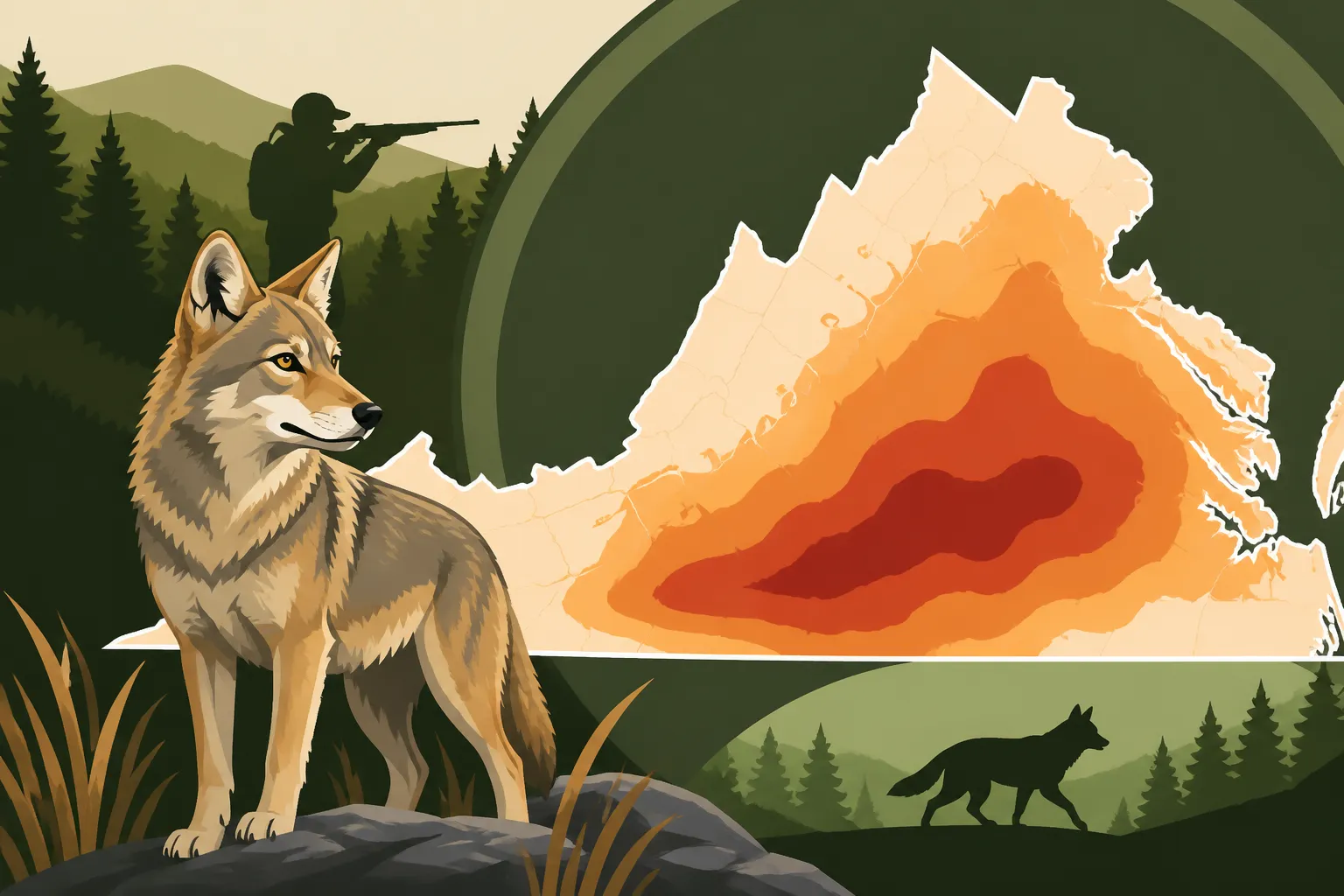
Virginia Coyote Range and Density
For many years, Virginia residents rarely encountered coyotes, but that's a distant memory now. The expansion of coyote populations across the Commonwealth has brought new challenges and concerns for landowners, farmers, and even suburban homeowners. This comprehensive guide will delve into the current range and density of coyotes in Virginia, helping you understand their presence and how they've integrated into our diverse landscapes.
The Rise of the Virginia Coyote
It's hard to imagine Virginia without coyotes today, but their widespread presence is a relatively recent phenomenon. These adaptable canids weren't always a fixture in our woods and fields, and their arrival has profoundly reshaped local ecosystems. Understanding their journey here is key to understanding their current distribution.
A Relatively New Predator in the Commonwealth
Unlike white-tailed deer or black bears, which have long histories in Virginia, coyotes are relative newcomers. Historically, their range was confined primarily to the western and central parts of North America. As human populations expanded and original apex predators like wolves were pushed out, coyotes found open territory and began a remarkable eastward expansion. They're incredibly opportunistic, capable of thriving in a vast array of habitats, from dense forests to agricultural lands and even urban fringes. Their move into Virginia was a slow, steady infiltration, largely unnoticed by most until their numbers became significant enough to create noticeable impacts. This wasn't a sudden invasion, but rather a gradual shift in their territorial boundaries, driven by their incredible adaptability and the availability of new food sources and less competition.
How They Spread Across the Landscape
Coyotes spread into Virginia primarily through two main corridors. Many came down from the north, through Pennsylvania and Maryland, utilizing the Appalachian Mountains as a natural pathway. Others pushed eastward from the Midwest, moving through states like West Virginia and Tennessee. It wasn't always a direct migration; often, individual coyotes, particularly younger ones dispersing from their birth packs, would venture into new territories. They are phenomenal travelers, capable of covering significant distances in search of new hunting grounds and mates. Their ability to cross rivers, navigate varying terrain, and adapt to human-modified landscapes meant that fences, roads, or even cities posed no insurmountable barrier. The increasing fragmentation of forests and the expansion of agriculture ironically created more edge habitats, which are perfect for coyotes, offering both cover and access to prey. This gradual but persistent colonization eventually led to their establishment in all 95 counties of Virginia.
Understanding Coyote Range Across Virginia
One of the most remarkable things about coyotes is their ability to call almost any environment home. From the rugged mountains to the sprawling urban centers, they’ve carved out a niche, adapting their behaviors and diets to whatever resources are available.
East of the Blue Ridge: Adapting to Diverse Habitats
East of the Blue Ridge, the landscape diversifies dramatically, moving from rolling Piedmont hills to the flat, agricultural plains and dense swamps of the Tidewater region. Coyotes here have demonstrated incredible versatility. In the Piedmont, where agriculture intertwines with woodlots and suburban development, coyotes thrive on a diet that includes deer fawns, rabbits, rodents, and even fruit or discarded human food. This mix of cover and abundant food sources makes these areas prime coyote habitat. They are often seen crossing fields at dawn or dusk, or heard howling from distant tree lines. Further east, in the Tidewater and coastal plain, the terrain changes to dense wetlands, pine plantations, and scattered farmlands. Here, coyotes adapt to wetter environments, sometimes even preying on waterfowl or marsh-dwelling rodents. They navigate the labyrinthine creek bottoms and cypress swamps with ease, a testament to their adaptability. Many hunters, especially those focused on Hunting East of the Blue Ridge, have noted a clear increase in coyote sightings and impacts on deer populations in these areas over the last decade.
West of the Blue Ridge: Mountainous Strongholds
The mountainous regions west of the Blue Ridge offer a different set of challenges and opportunities for coyotes. The steep terrain, dense forests, and colder winters require a more rugged existence. Yet, coyotes have established strong populations here, integrating themselves into the complex predator-prey dynamics of these wilder landscapes. Their primary food sources often include deer, especially fawns, as well as wild turkeys, small game like squirrels and rabbits, and whatever carrion they can scavenge. The vast expanses of the George Washington and Jefferson National Forests provide ample cover and diverse hunting grounds. Hunters focused on Hunting West of the Blue Ridge can attest to their pervasive presence. In these areas, coyotes are often harder to spot due to the thick cover, but their tracks, scat, and vocalizations are common. They utilize the same ridge lines and hollows that deer and bears frequent, making them an integral part of the mountain ecosystem. Their adaptability even extends to surviving harsh winters by scavenging on winter-killed deer and other animals.
Suburban and Urban Incursions
Perhaps the most surprising aspect of coyote expansion is their increasing presence in suburban and even urban areas. Richmond, Virginia Beach, Charlottesville, and other cities across the Commonwealth have reported growing numbers of coyote sightings. This isn't just a fleeting visit; coyotes are establishing territories within green spaces, parks, and even residential neighborhoods. They are drawn to these areas by readily available food sources: pet food left outdoors, fallen fruit, garbage, and an abundance of rodents, rabbits, and even small, unattended pets. These urban coyotes learn to navigate human environments, becoming largely nocturnal and incredibly stealthy to avoid detection. For residents, this can be a startling and sometimes concerning development, requiring adjustments in how they manage pets and dispose of waste. Virginia Beach, with its numerous parks and fragmented natural areas, has become a notable example of successful urban coyote adaptation.
Virginia Coyote Density and Population Dynamics
Pinpointing exact numbers for a species as elusive and widespread as the coyote is incredibly difficult. Unlike deer or bears, which have more structured reporting systems through hunting tags, coyotes are managed differently. However, through various studies and observations, we can still glean a strong understanding of their population dynamics.
Estimating Population Numbers: A Challenging Endeavor
Estimating the exact number of coyotes in Virginia is like trying to count individual raindrops in a storm – it's practically impossible to get a precise figure. The Virginia Department of Wildlife Resources (DWR) doesn't conduct statewide population surveys for coyotes in the same way they do for game species like deer or turkey. This is largely because coyotes are not managed with harvest quotas or specific seasons in the same way; they are generally open to hunting and trapping year-round on private land, often with liberal regulations to encourage control. Instead, researchers and wildlife managers rely on a combination of indices:
- Harvest data: While not comprehensive, the number of coyotes reported harvested by hunters and trappers provides some insight into their presence and general trends.
- Scent station surveys: These involve setting up baited stations and recording coyote visits, giving a relative index of activity and abundance in specific areas.
- Trail camera data: Hunters and landowners using trail cameras for deer often capture coyote images, contributing to a broader understanding of their distribution.
- Nuisance complaints: An increase in calls to DWR or local animal control about coyote conflicts can indicate rising local densities, particularly in suburban areas.
- Roadkill data: While tragic, road-killed coyotes can also provide an indication of their presence and movement patterns.
These methods give us a mosaic rather than a clear picture. However, the general consensus is that coyotes are well-established and abundant across the Commonwealth, with localized fluctuations in density. While you can use tools like GoHunt to scout for deer or turkey sign, accurately mapping specific coyote densities across vast regions remains a challenge even with advanced technology.
Factors Influencing Local Densities
Coyote density isn't uniform across Virginia; it varies significantly based on several key factors:
- Food Availability: This is perhaps the most critical factor. Areas rich in prey such as rabbits, rodents, and deer fawns will support higher coyote numbers. Agricultural areas with consistent food waste, or even suburban areas with unsecured garbage and pet food, can also boost local populations. For example, a year with a healthy Virginia Deer Population Estimate often means ample fawns for coyote predation, which can sustain higher densities.
- Habitat Quality and Cover: Coyotes need sufficient cover for denning, resting, and ambushing prey. A mosaic of dense woods, brushy fencerows, and open fields is ideal. Large, unbroken tracts of mature forest might have slightly lower densities than fragmented landscapes with abundant "edge" habitat.
- Human Activity and Development: In highly developed urban cores, coyote densities tend to be lower due to direct human interference and lack of suitable habitat. However, in suburban-rural interfaces, where green spaces meet residential areas, densities can be surprisingly high as coyotes exploit human-provided resources while maintaining enough cover.
- Competition and Predation: While coyotes are often the top small-to-medium predator, competition with other carnivores like bobcats or even larger predators like Virginia's Black Bear Population can play a minor role in certain areas. However, these interactions are generally limited.
- Disease: Outbreaks of diseases like mange (which also affects bears and foxes) or canine distemper can temporarily reduce local coyote populations, but they often rebound quickly due to the species' high reproductive rate.
Coyote Population Control Efforts and Their Effectiveness
Given the concerns surrounding coyote populations, especially regarding livestock depredation and impacts on game animals, various control efforts are employed. However, the effectiveness of these efforts, particularly in significantly reducing overall populations, is often debated.
- Hunting and Trapping: Virginia has very liberal hunting and trapping regulations for coyotes. They can be hunted year-round on private land, often without a bag limit, and night hunting is allowed with certain restrictions, as detailed in Night Hunting Rules for Virginia Coyotes. Trapping is also a common method for professional wildlife control operators and recreational trappers. While these activities can remove individual problem animals and reduce localized densities, especially on specific farms or properties, they rarely result in a substantial, long-term reduction in the statewide population. Coyotes respond to reduced pressure with increased reproduction and immigration from surrounding areas, a phenomenon known as "compensatory reproduction."
- Lethal Control by Landowners: Farmers and ranchers experiencing Virginia Coyote Attacks on Livestock are often granted permits to lethally remove coyotes threatening their animals. This targeted removal can offer immediate relief to specific operations.
- Education and Non-Lethal Deterrents: For homeowners in suburban areas, education on securing trash, removing pet food, and hazing coyotes (making loud noises, throwing objects) is often promoted as a first line of defense. Fencing and LGDs (livestock guardian dogs) are effective non-lethal methods for protecting livestock.
Ultimately, while localized control can mitigate specific problems, widespread population reduction of coyotes across an entire state is an incredibly difficult, if not impossible, task due to their biological resilience and adaptability. Virginia’s approach tends to focus on managing impacts rather than attempting complete eradication.
Impact of Coyotes on Virginia's Ecosystems and Wildlife
The arrival and proliferation of coyotes have not occurred in a vacuum. Their presence has ripple effects throughout Virginia's ecosystems, influencing prey species, other predators, and even domestic animals.
Predator-Prey Dynamics with Deer and Other Game
Coyotes are opportunistic predators, and their diet reflects what's most available. In Virginia, white-tailed deer fawns are a significant food source, particularly during the spring fawning season. It's a reality that can be frustrating for deer hunters and wildlife managers. While coyotes generally don't impact mature, healthy adult deer populations significantly, they can certainly take a toll on fawns, especially in areas with high coyote densities. This can affect local fawn recruitment rates, which is the number of fawns that survive to adulthood and join the breeding population. Some studies suggest that in certain regions, fawn mortality due to coyote predation can be substantial. However, it's a complex issue, as other factors like habitat quality, nutrition, and other predators (like black bears) also influence fawn survival.
Beyond deer, coyotes also prey on wild turkeys, especially poults and nesting hens, and various small game species such as rabbits and squirrels. This means that hunters targeting Virginia Small Game and Furbearers might also notice the indirect effects of coyote predation on their favored species. The overall impact on game populations is a subject of ongoing research and management consideration for the Virginia DWR. Their impact is rarely the sole cause of decline but is a contributing factor within a larger ecological picture.
Interactions with Livestock and Domestic Animals
One of the most immediate and tangible impacts of coyotes, especially for rural Virginians, is their interaction with livestock and domestic animals. While their primary diet consists of wild prey, coyotes will readily take advantage of easy meals, and small calves, lambs, goats, and poultry can become targets. This leads to direct economic losses for farmers and can be a significant emotional strain for pet owners.
- Livestock Depredation: Farms, particularly those with sheep, goats, or free-range poultry, can suffer losses. Young calves are also vulnerable. Livestock producers often employ various strategies, from guardian dogs and improved fencing to targeted lethal removal, to protect their herds. Information for farmers on managing these conflicts is crucial, and DWR provides guidance on Virginia Coyote Attacks on Livestock.
- Pet Safety: In suburban and rural residential areas, coyotes pose a threat to unattended pets, especially small dogs and cats. They see these animals as either prey or, in the case of larger dogs, as competitors. This has led to a growing awareness among pet owners to keep pets leashed, fenced, and never left unattended, particularly at dawn and dusk when coyotes are most active. Many heartbreaking stories circulate about beloved pets falling victim to coyotes, underscoring the need for vigilance.
Disease Transmission Concerns
Like any wild canid, coyotes can carry and transmit diseases that affect other wildlife, domestic animals, and, in rare cases, humans. This is another important aspect of their presence that wildlife managers monitor.
- Rabies: Rabies is a viral disease that can be fatal if untreated. While foxes and raccoons are more common carriers, coyotes can contract and transmit rabies. An encounter with a coyote showing unusual behavior (such as fearlessness towards humans, aggression, or disorientation) should always be reported to animal control or the DWR.
- Canine Distemper and Parvovirus: These highly contagious viral diseases can impact coyote populations, sometimes causing localized die-offs. They can also spread to unvaccinated domestic dogs, which is why keeping pet vaccinations current is critical.
- Mange: Sarcoptic mange, caused by mites, can severely impact coyotes, leading to hair loss, skin infections, and sometimes death. This is also seen in Virginia's fox and bear populations. While distressing to witness, mange can sometimes serve as a natural population regulator.
- Parasites: Coyotes, like all wild carnivores, host various internal and external parasites, including worms, fleas, and ticks. These are generally not a direct threat to humans but can be to domestic animals. Regular deworming and flea/tick prevention for pets are important preventative measures.
Monitoring wildlife health is part of the broader mission of the DWR, as highlighted in their efforts regarding Virginia Wildlife Disease Monitoring. Understanding these disease dynamics helps in managing both wild and domestic animal health.
Living Alongside Virginia's Coyotes
While coyotes are a permanent fixture in Virginia, their presence doesn't have to be a constant source of conflict. With education, responsible practices, and sometimes active management, humans and coyotes can largely coexist.
Minimizing Conflicts with Coyotes
Living in an area with coyotes means being proactive to avoid negative interactions. Most conflicts arise when coyotes become habituated to human presence and associate people or their property with food.
- Secure Food Sources: Never leave pet food or water bowls outside, especially overnight. Store garbage in secure, heavy-duty containers with tight-fitting lids. Compost piles should be enclosed to prevent access. Pick up fallen fruit from trees in your yard. Even bird feeders can attract rodents and small birds, which in turn attract coyotes, so consider placing them strategically or removing them if coyote activity is high.
- Protect Pets: Small dogs and cats are particularly vulnerable. Keep them indoors, especially at night. If they must be outside, always supervise them, and ensure fences are secure, preferably extending underground to prevent digging. Consider bringing small pets inside after dark or creating a "coyote-proof" enclosure for outdoor time.
- Haze Coyotes: If a coyote approaches you or your property, don't run. Make yourself appear large, wave your arms, and make loud noises (yell, blow a whistle, throw small objects near, but not at, the coyote). This teaches them to fear humans and helps prevent habituation.
- Educate Yourself and Neighbors: Share information with your community. A collective effort to eliminate food attractants and practice hazing is far more effective than individual attempts. Tools like the GoHunt app can help identify public land adjacent to residential areas where coyotes might be traveling from, informing local efforts.
By consistently applying these preventative measures, residents can significantly reduce the likelihood of negative coyote encounters and promote a healthier coexistence.
Hunting and Trapping as Management Tools
For landowners, particularly those with livestock or concerns about game populations, hunting and trapping can be effective tools for localized coyote management. Virginia's regulations generally facilitate this, but it’s crucial to understand the rules.
- Year-Round Opportunity: On private land, coyotes can generally be hunted year-round in Virginia, often without a bag limit. This offers flexibility for landowners to manage populations as needed.
- Night Hunting: Many hunters find success targeting coyotes at night when they are most active. Be sure to be familiar with Night Hunting Rules for Virginia Coyotes, which involve specific equipment and safety considerations. Using legal lights and proper identification is paramount.
- Calling and Trapping: Predator calling, using electronic or mouth calls to mimic distress sounds or coyote vocalizations, can be very effective, especially in open areas like those in Predator Calling Virginia Farm Country. Trapping, especially by experienced individuals, can also remove specific nuisance animals or reduce localized populations. Always check current regulations for trapping methods, season dates, and license requirements.
- Targeted Removal vs. Population Control: It's important to differentiate between removing problem animals on a specific property and attempting broad population control. While hunting and trapping can effectively address the former, they typically have limited long-term impact on the overall statewide coyote population due to their high reproductive rate and dispersal abilities.
Coexistence Strategies for Residents
Ultimately, coyotes are here to stay, and adapting to their presence is essential. Coexistence involves a shift in perspective and consistent application of best practices.
- Understanding Their Role: Coyotes play a natural role in the ecosystem, helping to control rodent and rabbit populations, and scavenging carrion. While their impact on fawns can be concerning for hunters, they are part of a natural cycle.
- Community Engagement: In areas experiencing increased coyote activity, community meetings and educational campaigns can be very beneficial. Sharing information from organizations like the Virginia DWR can help demystify coyotes and provide practical advice for residents.
- Responsible Recreation: When hiking or enjoying outdoor activities, especially with dogs, keep pets on a leash. This protects them from potential encounters with coyotes and other wildlife. Being aware of your surroundings, perhaps even checking scouting tools like GoHunt for recent wildlife activity, can help you be prepared.
- Reporting Concerns: If you observe a coyote exhibiting unusually bold or aggressive behavior, or if you find a sick or injured animal, contact your local animal control or the Virginia DWR. This helps wildlife managers track incidents and respond appropriately.
By focusing on prevention, responsible management, and fostering a clear understanding of coyote behavior, Virginia residents can learn to share the landscape with these intelligent and adaptable predators.
| Regional Coyote Density (Estimated) | Primary Habitat Type | Common Food Sources | Potential for Human Conflict (Urban/Suburban) | Management Challenges |
|---|---|---|---|---|
| Piedmont (Central VA) | Mixed forests, agricultural fields, suburban edges | Deer fawns, rabbits, rodents, domestic pets, fruit | High | Fragmented land, diverse food, human habituation |
| Mountains (Western VA) | Dense forests, rugged terrain, scattered clearings | Deer fawns, wild turkeys, rodents, carrion | Low (but increasing in rural communities) | Vast terrain, difficult access, public land regulations |
| Tidewater (Eastern VA) | Pine forests, wetlands, agricultural fields, coastal | Marsh birds, rodents, rabbits, domestic pets | Moderate | Dense cover, unique prey, coastal development |
| Urban/Suburban Zones | Parks, green spaces, residential areas, commercial lots | Garbage, pet food, rodents, rabbits, small pets | Very High | Public perception, restricted lethal control, pet safety |
Disclaimer
The information provided in this article is for general guidance and informational purposes only. Hunting regulations, wildlife populations, and disease prevalence can change. Always consult the official Virginia Department of Wildlife Resources (DWR) regulations and local ordinances before engaging in any hunting or wildlife management activities. Stay safe and hunt ethically.