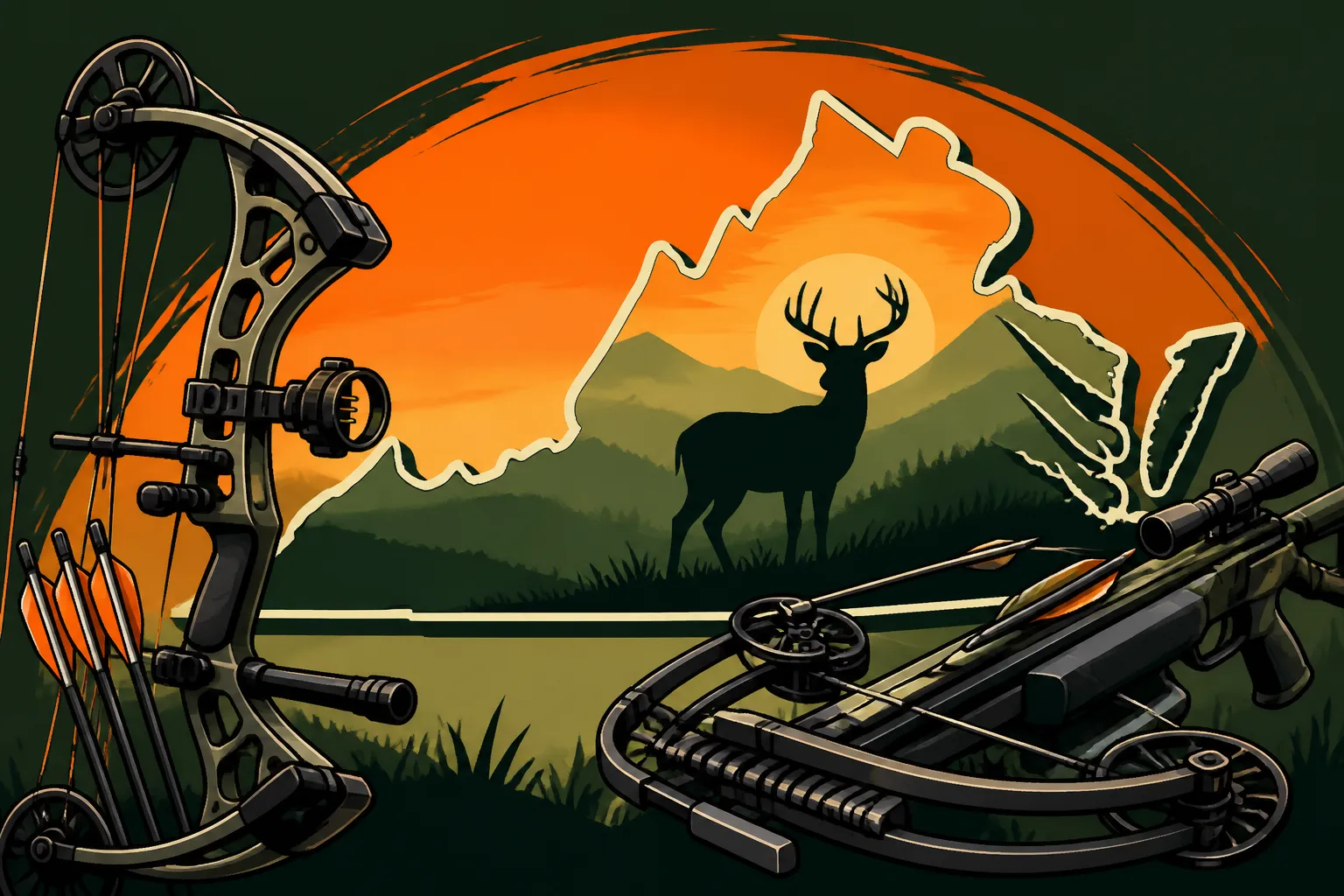
Bow and Crossbow Setups for Virginia
Alright, let's talk about bow and crossbow hunting in Virginia. It's a fantastic way to pursue deer and other game, offering an intimate connection with the woods that rifle hunting sometimes can't. However, navigating the specific rules and ensuring your gear is dialed in for our diverse Virginia landscape – from the steep mountains to the dense Piedmont and swampy Tidewater – can feel like a labyrinth. This guide is all about cutting through that confusion, helping you set up your bow or crossbow for success and enjoy the challenge this unique season offers.
Understanding Virginia's Archery Regulations for Bows and Crossbows
Virginia offers a generous archery season, giving hunters ample opportunity to get out into the woods before the general firearms season opens up. But with that opportunity comes a set of rules that you absolutely need to know, especially when it comes to the nuances of traditional bows versus crossbows. It's not just about flinging an arrow; it's about doing it legally and ethically within the Commonwealth's guidelines.
General Archery Season Rules
The statewide archery season in Virginia is a fantastic time to be in the woods. It typically kicks off in early October and runs for an extended period, providing weeks of hunting before any firearms are allowed for deer. During this time, the woods are quieter, deer are often less pressured, and you get to experience the natural rhythm of the fall before things get really busy. You can pursue deer, bear, and even turkey during the fall archery season, depending on the specific county and concurrent season dates. Legal hunting hours typically follow the standard half-hour before sunrise to half-hour after sunset, giving you those precious low-light opportunities when deer are most active. Always double-check the Virginia DWR regulations booklet or their website for the exact opening and closing dates for the current year, as they can shift slightly. This is also the period where the general antlered and antlerless deer bag limits apply, often allowing for multiple deer to be harvested with archery tackle. Virginia Statewide Archery Season Dates will give you the specific window to plan your hunts.
Crossbow Specific Regulations
For many years, crossbows were restricted in Virginia, often requiring a doctor's note or being limited to specific seasons. Thankfully, those days are largely behind us, and crossbows are now fully legal during the statewide archery season for all hunters. This change has opened up archery hunting to a lot of folks who might not be able to pull a traditional bow due to physical limitations, or simply prefer the mechanical accuracy and ease of use that a crossbow provides. There are no special permits required to use a crossbow during the regular archery season; if you have a valid hunting license, you're good to go. However, just like with vertical bows, you must adhere to minimum draw weight requirements for your bolts to be considered legal for big game. While they operate differently, the fundamental principles of ethical shot placement and game recovery remain the same. Understanding Crossbow Rules During Virginia Archery Season is crucial to ensure you're compliant.
Blaze Orange/Pink Requirements During Archery Season
This is an area that can sometimes cause confusion, especially when archery season overlaps with other hunting seasons like muzzleloader or certain small game seasons. Generally, during the pure statewide archery season, when no firearms are permitted for deer, there is no blaze orange or pink requirement for bowhunters. This allows you to wear full camouflage, which is often preferred for close-range archery encounters. However, pay very close attention to your calendar. If the archery season overlaps with the muzzleloader season or the general firearms season (which it does in some counties, particularly towards the latter part of the archery period), then the blaze orange/pink requirements do kick in. The rule is typically a minimum of 100 square inches above the waist, visible from 360 degrees. This is for safety, making sure you're visible to other hunters who might be using different weapons. Always check the DWR regulations for the specific dates and counties you plan to hunt to ensure you're in compliance. Safety should always be your top priority, even when it means sacrificing a bit of camouflage for visibility.
Essential Bow Setup for Virginia's Diverse Terrain
Virginia's hunting landscape is incredibly varied, from the thick cover of the Blue Ridge Mountains to the open agricultural fields of the Piedmont and the dense swamps of the Tidewater region. Your bow setup needs to be versatile enough to handle these different environments, offering a balance of power, accuracy, and maneuverability. Getting your gear right for these conditions is critical for ethical hunting.
Choosing the Right Bow
When it comes to selecting a vertical bow, you generally have a choice between compound bows and traditional bows (recurve or longbows). For most modern bowhunters in Virginia, a compound bow is the go-to. They offer incredible speed, accuracy, and a significant "let-off" at full draw, which allows you to hold the string back much longer without fatigue, crucial for waiting on that perfect shot opportunity. When choosing a compound, consider your draw length and draw weight. Virginia's legal minimum draw weight for big game is 35 pounds, but for deer, most hunters comfortably shoot 50-70 pounds for good kinetic energy and penetration. Axle-to-axle length is another factor: shorter bows are generally more maneuverable in dense timber or treestands, while longer bows can be more forgiving and stable for target shooting.
Traditional bows, while requiring a much higher skill ceiling and greater physical strength, offer a classic, minimalist hunting experience that many find deeply rewarding. They demand closer shots and flawless form, but connecting with an animal using a recurve or longbow is an unparalleled feeling. Whichever style you choose, ensure it fits you physically. A bow that's too heavy for your comfortable draw weight will lead to poor accuracy and potentially dangerous shooting habits. Take the time to get fitted at a pro shop – it makes all the difference.
Arrow Selection and FOC
Your arrows are just as crucial as your bow itself. For hunting Virginia deer, you want a durable, straight-flying arrow that carries enough kinetic energy and momentum to achieve a clean pass-through. Arrow material typically ranges from aluminum to carbon, or a combination of both. Carbon arrows are popular due to their durability, light weight, and consistent spine. "Spine" refers to the stiffness of the arrow, and it must be matched precisely to your bow's draw weight and draw length. An arrow that's too stiff or too flexible will fly inconsistently.
Weight is another major factor. Heavier arrows (typically 400-500 grains for deer) will carry more momentum, leading to better penetration, especially when encountering bone. Lighter arrows are faster but lose momentum quicker. Front-of-Center (FOC) refers to how much of the arrow's weight is in the front half. A higher FOC (generally 10-15% for hunting) improves accuracy and penetration, helping the arrow steer itself through the air and resist wind drift. Fletchings (the "feathers" at the back) help stabilize the arrow in flight. For hunting, durable plastic vanes are common, often in a helical or offset configuration to induce spin for better stabilization.
Broadheads for Virginia Whitetails
The broadhead is where the magic happens – it's the part that does the work on impact. In Virginia, both fixed-blade and mechanical (expandable) broadheads are legal for deer hunting. Each has its pros and cons, and the best choice often comes down to personal preference, shot distance, and the type of cover you're hunting in.
Fixed-blade broadheads are known for their rugged durability and reliability. They have blades that are rigidly attached to the ferrule, meaning they're always open. This design ensures maximum penetration, especially through bone, and can be more forgiving if you hit an obstacle like a small twig on the way to the target. However, fixed blades can be trickier to tune for perfect flight at higher arrow speeds, sometimes "planing" or acting like a rudder if not perfectly aligned. Many experienced bowhunters swear by fixed blades for their predictable performance in tough situations, especially in thick woods where close-range shots might present themselves.
Mechanical broadheads, on the other hand, have blades that deploy upon impact, creating a larger cutting diameter. This larger cutting surface often leads to wider wound channels and more copious blood trails, which can be a huge advantage when Blood Trailing After Dark in Virginia or through dense cover. They typically fly more like field points, making them easier to tune with your arrows for flat trajectory and high accuracy at various distances. The main concern with mechanicals is the potential for mechanical failure (blades not deploying correctly) or a reduction in penetration compared to fixed blades if they encounter heavy bone or lose energy on deployment. Regardless of your choice, ensure your broadheads are razor-sharp. A dull broadhead is an unethical tool. It's a good idea to practice with "practice" versions of your mechanicals or field-point-tipped arrows to ensure your setup is truly dialed in.
Optimizing Your Crossbow Setup for Virginia Hunting
Crossbows have become a popular choice for many Virginia hunters, offering a blend of rifle-like accuracy with the challenge of archery hunting. While they share some similarities with vertical bows, optimizing a crossbow setup involves a slightly different approach, focusing on balance, speed, and precision sighting systems.
Selecting a Crossbow
Choosing a crossbow involves considering several factors, including speed, weight, design, and your budget. Crossbows are rated by feet per second (FPS), with many modern models launching bolts well over 350-400 FPS. While speed is exciting, it's not the only metric. A crossbow that's too fast might be harder to tune with certain broadheads, and the trajectory can be quite flat, meaning range estimation is still critical. Weight is also important; you'll be carrying this through the woods, so a lighter model can be a huge advantage, especially if you're hiking into remote public land. Designs vary from traditional recurve crossbows to more compact compound models. Compound crossbows are generally narrower and faster, making them easier to maneuver in a treestand or ground blind.
Always aim for a crossbow that feels comfortable to hold and shoot. The trigger pull is also a significant factor; a clean, crisp trigger can drastically improve accuracy. Don't forget about safety features like anti-dry fire mechanisms, which are crucial. Remember that a crossbow is still a powerful hunting tool, and proper handling and maintenance are key. Think about where you'll be hunting most often – in tight cover, a compact crossbow will be your friend. If you're often overlooking large fields, a slightly heavier, longer model might offer more stability.
Bolts and Broadheads for Crossbow Performance
Just like with vertical bows, the bolts (arrows designed for crossbows) and broadheads are critical components of your crossbow setup. Crossbow bolts are typically shorter and heavier than vertical bow arrows, designed to handle the immense force and speed generated by the crossbow. They require specific nocks (the end that engages the string) that are often flat or half-moon shaped to ensure proper contact and consistent launch. Matching the bolt's spine to your crossbow's power is paramount for accuracy. Many crossbow manufacturers will recommend specific bolt weights and lengths for optimal performance.
When it comes to broadheads, the same fixed-blade versus mechanical debate applies, but with some additional considerations for crossbows. Due to the higher velocity of crossbows, mechanical broadheads often perform exceptionally well, delivering devastating wound channels. Many mechanical broadheads are specifically designed and tested for crossbow speeds to ensure reliable deployment. Fixed-blade broadheads, while still effective, might require more careful tuning to prevent "planing" at higher crossbow speeds. Some hunters prefer compact fixed-blade designs or ones with very little blade surface area to minimize air resistance and ensure true flight. Regardless, ensure your broadheads are rated for crossbow speeds and are sharp. Broadheads for Timber Shots are especially important for crossbow hunters due to the velocity.
Scopes and Sighting Systems for Crossbows
One of the major advantages of a crossbow is the ability to mount a scope, which significantly enhances aiming precision, especially at longer distances. Most crossbows come with a basic scope, but upgrading can greatly improve your hunting experience. Crossbow scopes are often designed with multiple reticle lines or illuminated dots to account for different yardages, allowing you to quickly acquire a target and select the correct aiming point without making physical adjustments.
When choosing a scope, look for good light-gathering capabilities, especially important for those dawn and dusk hunting periods in Virginia. Durability and waterproofing are also crucial, as your gear will inevitably face the elements. Variable power scopes (e.g., 1.5-5x or 2-7x) offer versatility, allowing you to zoom in for precise shots or zoom out for a wider field of view in thick cover. Ensuring your scope is properly sighted in is a non-negotiable step. Practice at various distances – 20, 30, 40, and even 50 yards – to understand your crossbow's trajectory. Many hunters use the GoHunt app to mark shot locations and track game, and a precisely sighted scope will help put that pin where you need it.
Accessories for a Successful Virginia Archery Hunt
Beyond the bow or crossbow itself, a range of accessories can significantly improve your chances of success and safety in the Virginia woods. These aren't just "nice-to-haves"; many are essential tools that contribute to ethical hunting practices and a more enjoyable experience.
Scent Control and Concealment
Deer have an incredible sense of smell, and in Virginia's diverse habitats, minimizing your scent is paramount, whether you're hunting in a thick bottomland or a ridge top. Scent control starts well before you ever step foot in the woods. Laundering your hunting clothes in scent-free detergent and storing them in airtight containers or bags is a good first step. Many hunters also use scent-eliminating sprays on their clothing and gear before heading out. While no product can completely eliminate all human odor, these measures can significantly reduce your scent footprint, buying you precious seconds when a wary whitetail is downwind.
Concealment is equally important. Full camouflage is standard for bowhunters, designed to break up your outline in the natural environment. Pay attention to the pattern – a leafy pattern works well in early season green foliage, while a brown or gray pattern blends better as the leaves fall and the woods turn bare. A face mask or face paint can prevent your skin from reflecting light and alerting deer. Remember, deer see in shades of blue and yellow, so avoiding anything that might appear as a bright blue or unnatural color is important. The goal is to blend seamlessly into your surroundings, disappearing from the keen eyes of your quarry.
Treestand, Saddle, and Ground Blind Considerations
Choosing your elevated or ground ambush setup is a personal decision heavily influenced by the type of terrain you're hunting and your mobility preferences. Virginia offers varied terrain, making adaptability key.
Treestands: Fixed-position (hang-on) treestands paired with climbing sticks or climbing ladders offer stability and can be left in place (where legal, especially on private land) for repeated use. Climbing stands are portable and allow you to ascend a tree quickly without external aids, perfect for public land. When using a treestand on Virginia public land, remember that some regulations might exist regarding stand removal or placement. Regardless of the type, Treestand Safety Gear for Steep Ground is non-negotiable. Always use a full-body safety harness and a lifeline that keeps you tethered from the moment your feet leave the ground until you're back down. The last thing you want is a fall in a remote area.
Saddle Hunting: Saddle Hunting in Virginia Hardwoods has gained immense popularity for its ultra-lightweight and mobile approach. A saddle allows you to hunt from any tree that can support your weight, providing 360-degree shooting angles and incredible concealment as you're essentially "part of the tree." This method is fantastic for run-and-gun tactics or hunting pressured public land where you need to get deep and adapt quickly.
Ground Blinds: Ground blinds offer excellent concealment and protection from the elements, making them ideal for field edges, open woods, or when hunting with youth. They're also a great option if you have limited suitable trees for a treestand. When setting up a ground blind, brush it in naturally with local vegetation to help it disappear into the landscape. Pay attention to wind direction, as your scent will be much closer to the ground. Using a ground blind on Virginia public land is generally permissible, but always check specific WMA rules. For both treestands and ground blinds, considering your approach and exit routes to minimize disturbance is crucial.
Rangefinders and Optics for Bowhunters
Accurate range estimation is vital for bow and crossbow hunting. Unlike rifle hunting, where a few yards off might not significantly impact your shot, a mere five-yard miscalculation with a bow can mean a complete miss or, worse, a wounding shot.
Rangefinders: A good rangefinder is an indispensable tool for bowhunters. Look for models with angle compensation, which adjusts the distance reading for shots from elevated positions (like a treestand) or up/down steep inclines. This provides the "true" horizontal distance that gravity affects your arrow's trajectory, not the line-of-sight distance. Practice using your rangefinder regularly, even if you think you're good at estimating distances. Ranging multiple trees or landmarks around your stand before legal shooting light can save you precious moments when a deer finally steps into view. Rangefinders Under 100 Yards are perfectly suited for the typical archery shot distances.
Binoculars: While you might not need the high magnification of rifle hunters, a good pair of compact binoculars (e.g., 8×32 or 10×42) can greatly enhance your situational awareness. They help you spot deer in thick cover, identify antler size, and assess potential shot opportunities without making unnecessary movements. Look for optics with clear glass and good low-light performance, which is essential during those critical first and last minutes of legal hunting light. A binocular harness can keep your optics secure and readily accessible, preventing them from bouncing around or getting lost during your hike to the stand. Binocular Power for Mountain Hunting might dictate a slightly higher magnification if you're regularly glassing distant slopes.
Practice Regimen for Bow and Crossbow Hunters in Virginia
Having the best gear money can buy is only half the battle. The other, arguably more important half, is the mastery of that gear through consistent and realistic practice. For Virginia's diverse hunting conditions, your practice regimen needs to go beyond static target shooting to prepare you for real-world scenarios.
Practicing Realistic Hunting Shots
Deer rarely stand perfectly broadside at a known distance on flat ground, especially in the thick Virginia woods. Your practice should reflect this reality. Instead of always shooting at 20 yards, incorporate shots at various distances, including odd ranges like 17, 26, or 33 yards. Practice shooting from different positions: kneeling, sitting, and from an elevated platform if you hunt from a treestand. If you hunt from a saddle, practice shooting from various angles around your tree.
Incorporate obstacles into your practice range safely. Simulate shooting through small gaps in brush, around tree limbs, or from behind a screen that forces you into awkward body positions. Practice shooting quickly and quietly, as a deer might only give you a narrow window. Use a timer to simulate the pressure of a real encounter. The goal is to build muscle memory and confidence, so when that moment of truth arrives, your movements are fluid and automatic, not hesitant.
Tuning Your Equipment for Peak Performance
A well-tuned bow or crossbow is critical for accuracy and ethical hunting. Tuning involves making adjustments to your equipment to ensure arrows or bolts fly perfectly true and hit where you aim.
For vertical bows, this includes paper tuning (shooting through paper to analyze how the arrow leaves the rest), walk-back tuning (shooting at different distances to ensure broadheads and field points group together), and broadhead tuning (making micro-adjustments to ensure broadheads fly identically to field points). This process takes patience but is absolutely essential. Any inconsistencies in arrow flight can lead to significant misses in the field.
For crossbows, tuning primarily involves ensuring your scope is precisely zeroed at multiple yardages and that your bolts are consistent in weight and spine. If you're using mechanical broadheads, ensure they deploy reliably and that your chosen broadhead weight matches your field point weight for consistent trajectory. Many archery shops offer tuning services, which can be invaluable, especially if you're new to the sport. Don't skip this step; a perfectly tuned setup increases your effective range and confidence.
Mental Preparation and Shot Execution
Hunting, especially with archery equipment, is as much a mental game as it is a physical one. Buck fever is real, and it can ruin an otherwise perfect setup. Mental preparation involves visualizing successful hunts, practicing breathing techniques to calm nerves, and having a clear shot sequence ingrained in your mind.
Before each shot, mentally go through your steps: range the target, check for obstacles, confirm shot angle, find a clear shooting lane, settle your pin/reticle, execute a smooth release (or trigger pull), and follow through. Focusing on these steps, rather than the size of the antlers, can help mitigate buck fever. Ethical shot execution means waiting for the best possible shot at a vital area, typically the lung-heart region. Resist the urge to rush. If the shot isn't right, let the animal walk. There will always be another opportunity. This discipline, combined with your physical practice, makes you a more effective and responsible hunter.
Specialized Tactics and Gear for Virginia's Unique Environments
Virginia's diverse geography presents unique challenges and opportunities for bow and crossbow hunters. Adapting your tactics and gear to the specific environment you're hunting in can make a huge difference in your success. What works in the mountains might not be ideal for a suburban archery zone or a coastal swamp.
Urban Archery Zone Specifics
Virginia's Urban Archery Season is a fantastic opportunity, often providing hunters access to healthy deer populations in proximity to populated areas. However, these zones come with their own strict rules and unique considerations. The season typically runs longer than the statewide archery season, often starting earlier and extending into late winter, offering extended opportunities. Virginia Urban Archery Zone Boundaries are clearly defined by DWR, so you must know if you're hunting within one.
Quiet Gear and Access: Stealth is paramount. Deer in these areas are often accustomed to human presence but are incredibly wary of anything out of place or sudden noises. This means silent clothing, quiet bow or crossbow operation, and extremely careful movement. Access to private land is almost exclusively required, and Getting Landowner Access in an Urban Archery Zone involves building trust and being a good ambassador for hunting. Landowners in these areas are often looking for deer population control rather than trophy hunting.
Recovery and Neighbor Relations: Tracking a deer through suburban yards or dense residential areas requires pre-planning and exceptional discretion. Always have a recovery plan in place, and communicate with landowners about potential recovery scenarios. A wounded deer running into a neighbor's yard can quickly sour public opinion on hunting. Compact ground blinds are often favored for their concealment in smaller woodlots, and being highly scent-conscious is even more critical than usual.
Mountain vs. Piedmont vs. Tidewater Adaptations
Each of Virginia's major geographical regions demands a different approach for bow and crossbow hunters.
Mountain Hunting (Blue Ridge, Appalachian): The mountains are rugged, steep, and covered in thick timber. Here, lightweight, mobile setups are king. Saddle hunting or compact climbing stands are excellent for covering ground and accessing remote benches and saddles. Shots are often steep, so an angle-compensating rangefinder is crucial. Deer densities can be lower than in the Piedmont, but the bucks are often older and wiser. Focus on finding natural funnels, mast crops (acorns, beech nuts), and bedding areas on leeward slopes. Mobility is key to Hunting West of the Blue Ridge effectively.
Piedmont Hunting: The rolling hills of the Piedmont are characterized by a mix of agricultural fields, hardwood forests, and pine plantations. Deer densities are generally high, and good food sources are abundant. Treestands on field edges, pinch points between woodlots, or over natural travel corridors are productive. Longer-range shots across fields might be possible, but most archery shots will still be under 40 yards. Scent control is vital around these productive food sources. Setting Up on a Piedmont Field Edge requires careful consideration of wind and approach.
Tidewater Hunting: This region features flat terrain, extensive swamps, rivers, and dense coastal forests. Humidity and mosquitoes can be intense. Here, waterproof gear, rubber boots or waders, and ample insect repellent are necessities. Hunting from ground blinds or treestands overlooking natural travel corridors through swamp edges or along dry ridges within the wetlands can be effective. Deer often use these slight elevations as travel routes. Shots are likely to be up close and personal in the thick cover.
Dealing with Variable Weather Conditions
Virginia weather can be notoriously unpredictable, especially during the fall archery season. You might start a morning hunt in crisp, cool air only to have temperatures soar by midday, or face sudden rain showers. Your gear needs to be ready for anything.
Layering: The key to comfort in variable weather is layering your clothing. Start with a moisture-wicking base layer, add insulating layers (fleece, wool), and finish with a waterproof and windproof outer shell. As the day warms up or you hike in, you can shed layers to prevent overheating and sweating. Wool is an excellent choice for hunting clothing because it retains insulating properties even when wet and is naturally odor-resistant.
Rain Gear: Always carry lightweight, packable rain gear, even if the forecast looks clear. A sudden downpour can quickly end a hunt or leave you miserable. Waterproof boots are also essential for dealing with dew, wet leaves, or unexpected puddles. Keeping your bow or crossbow dry is also important to prevent rusting or affecting performance. A good quality, waterproof backpack can protect your optics, calls, and other essentials. Remember that cold and wet is a miserable combination that can affect your focus and endurance.
Post-Shot Procedures and Game Recovery Gear
The moment after the shot is often filled with adrenaline and anticipation. What happens next is just as crucial as the shot itself. Ethical hunters prioritize a quick and efficient recovery of their game, and having the right tools and knowledge for post-shot procedures is paramount, especially when bowhunting in Virginia's diverse and often dense terrain.
Tracking a Deer Through Virginia Leaf Litter
After taking a shot, the absolute best thing you can do is be patient. Give the deer time – often 30 minutes to an hour for a good lung shot, and longer (4-6 hours, sometimes more) for a less-than-ideal hit. Rushing in can push a wounded deer, making recovery much harder. Once you begin tracking, move slowly and deliberately. Look for a blood trail, but don't just look for bright red drops. Pay attention to scuff marks, broken twigs, hair (note the color and length, as it can indicate shot placement), and disturbed leaves. A good blood trail might start strong and then diminish, so follow every drop.
Virginia's woods, especially after leaf fall, can make tracking incredibly challenging. Overcast days or rain can further complicate things. Mark your last confirmed blood sign with flagging tape or reflective tacks (and remove them once the trail is found or the animal is recovered). If the blood trail disappears, expand your search in concentric circles or grid patterns around the last known sign. Having a reliable headlamp is essential if you find yourself Blood Trailing After Dark in Virginia. Remember, your responsibility to that animal doesn't end until you've done everything in your power to recover it. Using the GoHunt app to mark the shot location and last blood can be a lifesaver.
Essential Field Dressing Tools
Once you've recovered your deer, prompt field dressing is vital to cool the carcass and preserve the quality of the meat, especially during warmer early archery seasons. Having the right tools makes this often-messy job much more efficient and hygienic.
Knives: A sharp, sturdy hunting knife with a fixed blade is indispensable. Many hunters carry two: a larger one for general work and a smaller, caping-style knife for more precise cuts. Keeping your knife razor-sharp is not just about efficiency; a sharp knife is safer than a dull one. Consider a knife with a gut hook for easier opening of the abdominal cavity. Some hunters prefer replaceable-blade knives for consistent sharpness.
Gloves: Latex or nitrile gloves are a must for hygiene and to protect yourself from potential diseases. Carry several pairs, as they can tear or get excessively dirty.
Other Essentials: A small, compact bone saw can be incredibly helpful if you need to split the pelvis or sternum, especially for larger deer. A sturdy rope or drag strap can make moving the animal easier, particularly if you're working alone. Wet wipes or a small bottle of hand sanitizer are invaluable for cleaning up afterward. Having a game bag to protect the meat from flies and dirt, especially if you have a long hike out, is also a smart addition.
Hauling Your Harvest Out of the Woods
Getting a deer out of the Virginia woods, especially from a remote public land spot or up a steep mountain hollow, can be one of the most physically demanding parts of the hunt. Planning for this beforehand can save you a lot of grief.
Sleds and Drags: For flatter terrain or even slightly rolling hills, a deer sled or a sturdy plastic tarp can make dragging much easier, especially over leaf litter or light snow. They reduce friction and protect the carcass from debris. Simple rope drags are effective for shorter distances, but a dedicated harness that attaches to your waist or shoulders can save your back on longer hauls.
Deer Carts: On forest roads, old logging trails, or relatively flat ground, a deer cart with wheels is a game-changer. These carts allow you to move a significant amount of weight with less effort. Look for models with sturdy tires and a robust frame. Just remember their limitations in truly rugged, steep, or very dense terrain where they might be more of a hindrance than a help.
Frame Packs for Boning Out: If you're hunting deep in remote wilderness areas like the George Washington National Forest, especially in steep terrain, boning out the deer in the field might be your most practical option. A sturdy internal or external frame pack allows you to carry the meat out in manageable portions. This requires a different set of skills and tools, including game bags to keep the meat clean and cool. Dragging a Deer Out of a Mountain Hollow is a brutal task, and often, breaking down the animal is the smarter, albeit more time-consuming, choice. Always check Virginia Deer Reporting Requirements and ensure you follow them even if you bone out your animal in the field.
Disclaimer
This article is for general informational purposes only and does not constitute professional advice. Laws, prices and regulations vary by location and change over time. Consult a qualified professional for guidance on your specific situation.